Kevin Weil, who previously led science at OpenAI, announced Warp Sciences on October 22, 2026, a startup that uses robots to automate wet-lab work for drug discovery. Weil announced on X that the company has raised $215 million at an $865 million valuation, TechCrunch reported. The round was led by Lightspeed, with participation from IVP, Premji Invest and Lux Capital.
The company is aimed at a specific constraint. AI systems can now propose large numbers of candidate molecules and protein designs, but each candidate still has to be physically made and tested, and that step moves at the speed of chemists and contract labs.
What Warp says it will build
According to TechCrunch, the product is robots that make and test promising compounds identified by researchers. The stated goals are to reshore molecule synthesis that biotech firms have outsourced to contractors in China, such as WuXi AppTec, and to reduce exposure to geopolitical supply-chain risk. The training method is notable: human chemists will wear cameras and sensor gloves to teach the robots lab tasks. The company promises robots that can run around the clock to speed up discovery.
| Element | What was reported |
|---|---|
| Product | Robots that synthesise and test compounds that researchers have identified |
| Training approach | Chemists wearing cameras and sensor gloves demonstrate tasks |
| Strategic angle | Reshore synthesis now outsourced to contractors in China, reduce geopolitical exposure |
| Operating claim | Robots can work around the clock |
| Not disclosed in coverage | Customers, lab locations, throughput or timelines |
The bottleneck the company is targeting
Drug discovery runs as a loop: design candidates, make them, test them, learn, repeat. AI has compressed the design step. Our coverage of Claude-designed scorpion toxin binders is one example of design work that depends on physical validation afterwards. When design becomes cheap, the cost of the loop shifts to the other steps.
The table below is our analysis of how that shift could look in general terms, not figures from Warp:
| Step | Effect of AI design tools | Remaining constraint |
|---|---|---|
| Design | Faster, more candidates | Quality of predictions |
| Make (synthesise) | Little direct change | Chemist time, equipment, outsourcing queues |
| Test (assay) | Little direct change | Plate handling, instrument access, repeatability |
| Learn | Faster once data arrives | Data quality and speed of return |
If the make and test steps remain slow, faster design yields a longer queue rather than faster discovery. A robotic loop that closes it is the logic behind the funding, though whether robots can match skilled chemists across diverse reactions is the unproven part.
Cheaper design does not shorten drug discovery by itself. The loop is only as fast as its slowest physical step.
The reshoring angle
TechCrunch reports that the company wants to bring synthesis work back from contractors in China, naming WuXi AppTec. The coverage ties this to geopolitical supply-chain risk and does not state any policy trigger. Automation changes the economics of that choice: manual synthesis at home can compete poorly with outsourced labour, while a robotic line shifts cost toward capital equipment and software. Whether that is enough to make reshored synthesis competitive is an open question, and the coverage gives no cost comparison.
What the numbers say
Our arithmetic from the stated figures, with the caveat that the coverage does not say whether $865 million is pre-money or post-money: if it is post-money, the $215 million raised represents roughly 25% of the company (215 divided by 865). If it is pre-money, the figure would be about 20% of the post-money value of $1,080 million. Either way, investors are paying a meaningful valuation for a company whose public record consists of a stated approach and a team.
 OpenAI
Funding at this stage reflects a thesis about where AI creates value next. A wave of recent rounds has gone to companies that connect AI to physical processes, from humanoids to lab automation, a pattern also seen in Xpeng's $900 million robotics push and Zenithon's physics AI funding. The shared bet is that the next bottleneck is physical rather than computational.
What to watch next
- First customers or pharma partners. Contract research is the likely initial market, but none were named.
- Throughput data. Compounds synthesised per week compared with a conventional lab would be the first hard evidence.
- Reaction coverage. Robots handle repeatable reactions well; the breadth of chemistry they can run determines usefulness.
- Cost versus outsourcing. The reshoring case depends on matching contractor prices once capital costs are included.
For teams working on research workflows, the practical lesson is to keep the software layer flexible while the hardware matures. Research assistants such as Metir can route literature review and analysis across several models, so a team's process does not depend on whichever model currently leads a benchmark.
Sources:
Image credits
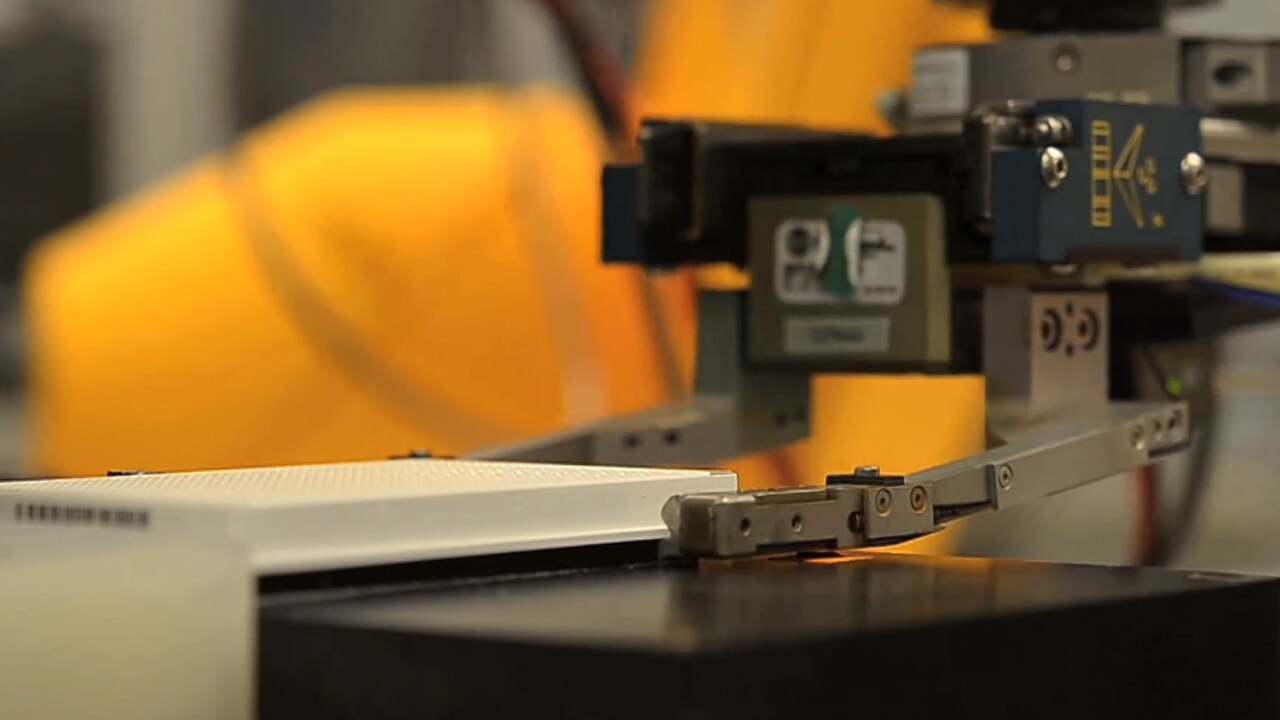
- Hero and in-body photo: "Robot arm handles an assay plate.jpg" by the National Institute of Allergy and Infectious Diseases, public domain, via Wikimedia Commons. Pulled 2026-10-23 and reviewed visually before use.