On October 20, 2026, Anthropic's Science team published a write-up of a protein design campaign in which Claude, working largely on its own, designed small proteins intended to bind scorpion neurotoxins. Of 211 designs tested in two laboratories, 17 met Anthropic's binder criteria, and two of them bound a Mexican scorpion toxin with single-digit nanomolar affinity. Anthropic is explicit that it has not produced an antivenom. The interesting question is what the result does establish, and how far it sits from a usable medicine.
 Anthropic
Why scorpion toxins
According to the write-up, scorpions sting at least 1.2 million people a year and cause more than 3,250 deaths, most of them children in regions with limited medical care. Current antivenoms are made from horse antibodies, a process that takes months and relies on venom milked from thousands of scorpions. Existing products typically cover only a few neurotoxins and can be costly or scarce.
The project began when Citrini Research asked whether an AI system could help motivated non-experts work on a real human health problem. Anthropic's life-science team brainstormed with Claude and settled on scorpion neurotoxins. The designs target five toxins from four regions: Cn2 (Mexico), Ts1 (Brazil), AaH I and AaH II (North Africa), and LqhIII (Middle East). The toxins share one overall fold, but any two are only 26% to 62% identical in sequence, which makes a single universal binder a hard target.
What Claude actually did
Claude received the same prompt Anthropic used in an earlier protein-binder study, adapted with Citrini, plus four follow-up prompts. After the first prompt it worked for roughly 24 hours without human input, and the full campaign took 64 hours. It chose structures from the Protein Data Bank and the AlphaFold database, set quality thresholds, decided how to use 12 design tools, devised multitoxin strategies, analysed the data and drafted the report. Humans supervised. The campaign consumed about 10,000 GPU hours.
Binding is no longer the main bottleneck. The challenge lies in turning binders into practical, affordable drugs.
Timothy P. Jenkins, Technical University of Denmark, as paraphrased in Anthropic's write-up
The funnel, in numbers
The campaign is best read as a filtering exercise. Tool outputs became 318,484 candidate designs. After excluding anything resembling a known protein or toxin, 553,052 design-toxin pairs were co-folded and screened computationally. Claude picked 180 designs and the team added 31, for 211 sent to synthesis. Seventeen passed. Expressed as a rate, about 0.07% of generated designs (211 of 318,484) were ever tested, and about 8% of tested designs (17 of 211) were confirmed binders.
To count as a binder, a design had to hit at both laboratories in every replicate, with a dissociation constant (KD) of 1 micromolar or tighter and no signal against an off-target human protein, CLEC12A. Adaptyv Bio used cell-free expression and Twist Bioscience used mammalian cells, so the two labs test complementary things.
Where the 17 confirmed binders landed
Designs that met Anthropic's binder criteria at both labs, by target toxin, out of 211 tested.
Source: Anthropic Science team, October 20, 2026. Ts1 count inferred from the reported per-toxin totals (7 + 4 + 4 + 2 = 17).
Reading the hit rates
Three comparisons help calibrate the result.
- Single-toxin designs worked at a normal rate. Eleven of 60 single-toxin designs (about 18%) were binders. Anthropic says this matches typical protein design campaigns, including its own earlier work, so the result is consistent with the field rather than a step change in hit rate.
- Multitoxin designs did not deliver their goal. The other 151 designs were aimed at pairs, trios, or all five toxins. None bound more than one toxin. Since 17 binders were found and 11 came from the single-toxin group, the remaining six binders came from multitoxin-category designs but each bound only one target. The authors list several possible reasons, including prompting, tool limits, current model capability, and the possibility that such binders are biologically infeasible.
- Affinity is promising but not yet at the benchmark. The two best designs, Cn2-B1 and Cn2-B2, reached single-digit nanomolar KD against Cn2. Anthropic notes that three existing antibodies or nanobodies against Cn2 or AaH II have reported KD below 1 nanomolar and have protected mice, so the new binders are tighter than the 1 micromolar threshold by roughly two to three orders of magnitude but still weaker than the best known biologics.
From binder to antivenom: the missing steps
Binding a recombinant toxin in a lab assay is the first of several gates. Anthropic lists what has not been done:
- Binding was tested only against recombinant toxins, not toxins purified from venom.
- No design has been tested for neutralisation in vitro, for example with patch-clamp electrophysiology, or for efficacy in animals.
- A therapy must also be safe, stable, affordable and available where stings happen, and that involves clinicians, funders and policymakers.
The write-up points to earlier work in which de novo proteins neutralised snake neurotoxins in mice, and says the authors know of no prior de novo binders against scorpion neurotoxins. That makes this a first step in a new target class, with the hardest validation still ahead. Anthropic released all 211 designs, predicted structures, scores and experimental data on Hugging Face, which allows outside groups to test the neutralisation question themselves.
What the process tells us about agentic science
Setting aside the biology, the campaign is a data point on long-running autonomous work. A 24-hour unattended run that makes tool-selection and thresholding decisions is a different workload from a single chat answer, and it depends on keeping state, checking its own outputs and recovering from failures. Anthropic also reports that a simplified single-agent, single-GPU, 24-hour prompt reached comparable in silico scores, which suggests the computational stage may be becoming commoditised while wet-lab validation remains the scarce resource. Teams that want to compare how different frontier models handle this kind of long-horizon task can run the same brief across several of them, which is one reason tools such as Metir keep model choice open rather than tied to a single provider.
What to watch next
- Whether independent groups report neutralisation data for Cn2-B1 and Cn2-B2.
- Whether multitoxin binders appear with different prompting or tools, which would clarify whether the barrier is the method or the biology.
- How regulators and funders treat AI-designed biologics for neglected tropical diseases.
Sources:
- Anthropic Science: Claude designs scorpion toxin binders (October 20, 2026)
- AI Weekly: AI News Today, October 21, 2026
Image credits
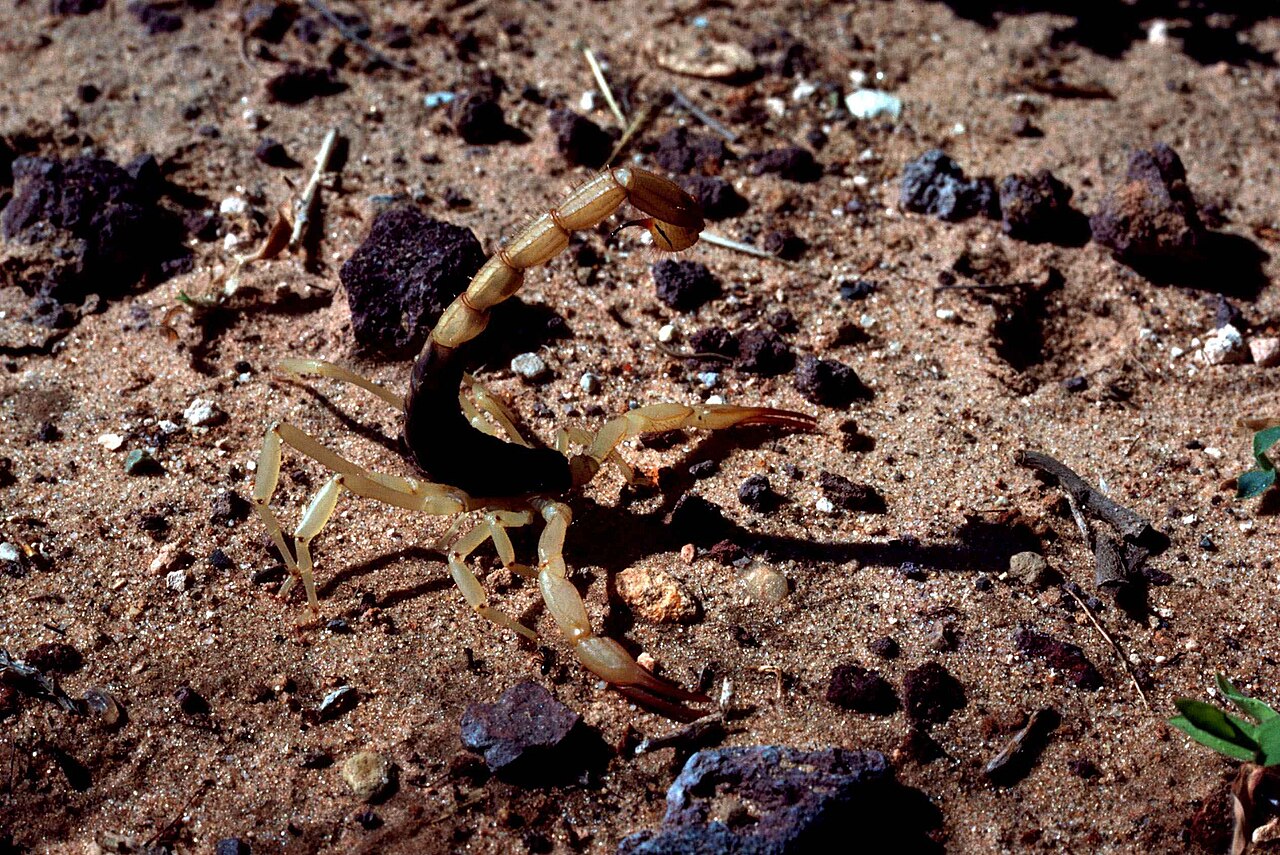
Header and in-body image: Arizona bark scorpion (Centruroides sculpturatus), via Wikimedia Commons, public domain. It depicts a related species, not the specific scorpion that produced the targeted toxin.