Samsung Electronics said on October 8, 2026 that its preliminary third-quarter operating profit was about 107.4 trillion won (roughly $80.1 billion), the first time the company has crossed 100 trillion won in a single quarter. Revenue was about 195 trillion won. The Samsung Q3 2026 earnings guidance is the clearest sign yet of how far AI-driven memory demand has reshaped the economics of the world's largest memory maker (Seoul Economic Daily).
 NVIDIA
The Samsung Q3 2026 earnings numbers
According to Seoul Economic Daily, the 107.4 trillion won operating profit is up 783% from a year earlier and 20.1% from the second quarter's record 89.4 trillion won. Revenue of 195 trillion won is up 127% year on year and 14.0% quarter on quarter. The paper describes it as the fourth consecutive quarter of record operating profit (Seoul Economic Daily).
For scale, Samsung earned 43.6 trillion won in operating profit across all of 2025, so this one quarter is roughly two and a half times that (Korea Herald). The Q3 2025 result was 12.17 trillion won on 86.06 trillion won of revenue (Korea JoongAng Daily).
A simple calculation on the reported figures (ours, not Samsung's) puts the consolidated operating margin near 55%, up from about 14% a year earlier. That is an unusually high number for a company that still sells phones, televisions and appliances, and it hints at how concentrated the profit is in one division.
Samsung operating profit rose about ninefold in a year
Consolidated quarterly operating profit in trillions of won. Only quarters with a cited figure are shown; Q1 2026 onward are preliminary guidance, not audited results.
Samsung Electronics consolidated operating profit, trillion won. Sources: Korea JoongAng Daily, Samsung earnings guidance coverage, Seoul Economic Daily.
Why memory prices drove the quarter
Seoul Economic Daily attributes the result to a continued memory shortage and surging prices, plus a steep rise in HBM4 sales ahead of new chip launches from large technology companies, including Nvidia's Vera Rubin accelerator. It cites DRAMeXchange data showing the average DDR4 8Gb price at $26 at the end of the third quarter, up 23.8% from $21 three months earlier and more than four times the $6.30 of a year ago. The NAND benchmark it cites, $30.61, is about eight times a year earlier.
The mechanism is straightforward. HBM stacks consume far more wafer area per bit than standard DRAM, so every wafer moved to AI memory tightens supply of ordinary DRAM and NAND. Prices rise across the whole product range, and because fabs are largely fixed-cost, a price increase falls almost entirely to operating profit. We covered the supply side in our memory supercycle analysis, and the consumer-facing effect in our look at sub-100 smartphone shipments.
Versus consensus: close to expectations, not a blowout
The headline beat is smaller than the headline number suggests, because expectations had already climbed. TrendForce's preview cited Yonhap consensus of 105.41 trillion won for operating profit, with other Korean outlets at roughly 106 trillion won (TrendForce). A FnGuide compilation published by the Korea Herald put it higher, at 108.1 trillion won (Korea Herald).
Against that range, 107.4 trillion won is about 2% above the lower estimates and about 0.6% below the higher one. Revenue is the more notable gap: the Yonhap consensus for revenue was 200.26 trillion won and FnGuide's was 201.7 trillion won, so reported revenue of about 195 trillion won came in a few percent lower.
Expectations had also been higher earlier. TrendForce notes that brokerages forecast more than 113 trillion won as recently as August, and attributes the trimming to sharp won appreciation against the dollar, which added cost pressure to the consumer electronics (DX) businesses.
A 107 trillion won quarter can still land inside the range of analyst estimates. In a supercycle, the forecast is the story as much as the result.
How it compares with SK hynix, Micron and Nvidia
Direct comparisons need care because the companies report in different currencies and on different calendars. With that caveat:
| Company | Latest sourced figure | Period |
|---|---|---|
| Samsung Electronics | 107.4T won operating profit (about $80.1B), preliminary | Q3 2026 (Jul to Sep) |
| SK hynix | 60.54T won operating profit, 76.3% margin | Q2 2026 (Apr to Jun) |
| Nvidia | $63.7B operating profit, prior record | Q2 FY2027 (May to Jul) |
| Micron | $37.70B GAAP net income on $54.23B revenue | Fiscal Q4 2026 (Jun to Aug) |
SK hynix's figures come from its July 29 disclosure (Korea JoongAng Daily). The Nvidia operating profit record is as cited by Seoul Economic Daily, which says Samsung's quarter now exceeds it. Micron's numbers are in our Micron fiscal Q4 2026 write-up. Note that Micron is quoted here as net income, not operating profit, so it is not a like-for-like row. SK hynix has not yet reported its third quarter, so the memory rivals are one quarter apart.
What preliminary results do and do not include
Samsung's early announcement is guidance, not a full earnings report. In earlier quarters it has stated that the figures have not been reviewed by an external auditor and may differ from final results (Samsung Newsroom). Korean disclosure rules also mean it publishes a single median figure rather than a range, as the company noted for its second-quarter guidance.
What it contains: consolidated revenue and operating profit. What it does not contain: a breakdown by division, net income, capital spending, or an HBM revenue split. The full report, with segment results for the Device Solutions (chips) and DX divisions, is expected later in October.
Until then, segment figures are analyst inference. TrendForce cites Yonhap estimating a Device Solutions operating margin of around 75% and a memory margin that could exceed 80%, and Chosun putting chip-division profit near 110 trillion won. That would exceed the company total and imply losses elsewhere, but TrendForce does not reconcile the two. The Korea Herald's preview expected the foundry and system LSI units to remain loss-making and DX to widen its loss, after DX posted an 800 billion won operating loss in Q2.
Supercycle risks to watch
- Cyclicality. Memory has historically swung from shortage to glut. A quarter at this level raises the bar for what counts as normal, and new capacity from rivals takes time but does arrive.
- Price momentum. TrendForce projects fourth-quarter DRAM contract prices up 10% to 15% and NAND up 15% to 20%, so the trend is still upward, but the pace of increase is a figure to track.
- Customer concentration. HBM4 volumes depend on a small number of AI accelerator programs, such as Vera Rubin. KB Securities, via Chosun, sees HBM4 reaching 80% of Samsung's HBM revenue in 2027, up from 40% this year.
- Currency and mix. A strong won and a widening DX loss are already trimming the consolidated figure relative to earlier forecasts.
- Demand-side pushback. Higher memory costs flow into phones, PCs and servers, as seen in smartphone shipments, which can slow unit demand.
What this means for AI builders
For teams building on AI models, memory pricing is part of the cost of inference capacity, one reason frontier model prices and availability can shift between providers. Using a multi-model workspace such as Metir, where you can switch models as pricing changes, is one practical hedge.
The next datapoints are Samsung's full report with segment detail later this month, SK hynix's third-quarter results, and whether contract prices keep rising into the fourth quarter.
Sources:
- Samsung quarterly operating profit tops 107 trillion won, Seoul Economic Daily
- Samsung 3Q preliminary results preview, TrendForce
- Samsung Q3 expectations preview, Korea Herald
- Samsung Q3 2025 operating profit, Korea JoongAng Daily
- Samsung earnings guidance for Q1 2026, Samsung Newsroom
- Samsung earnings guidance for Q2 2026, Samsung Newsroom
- SK hynix Q2 2026 results, Korea JoongAng Daily
Image credits
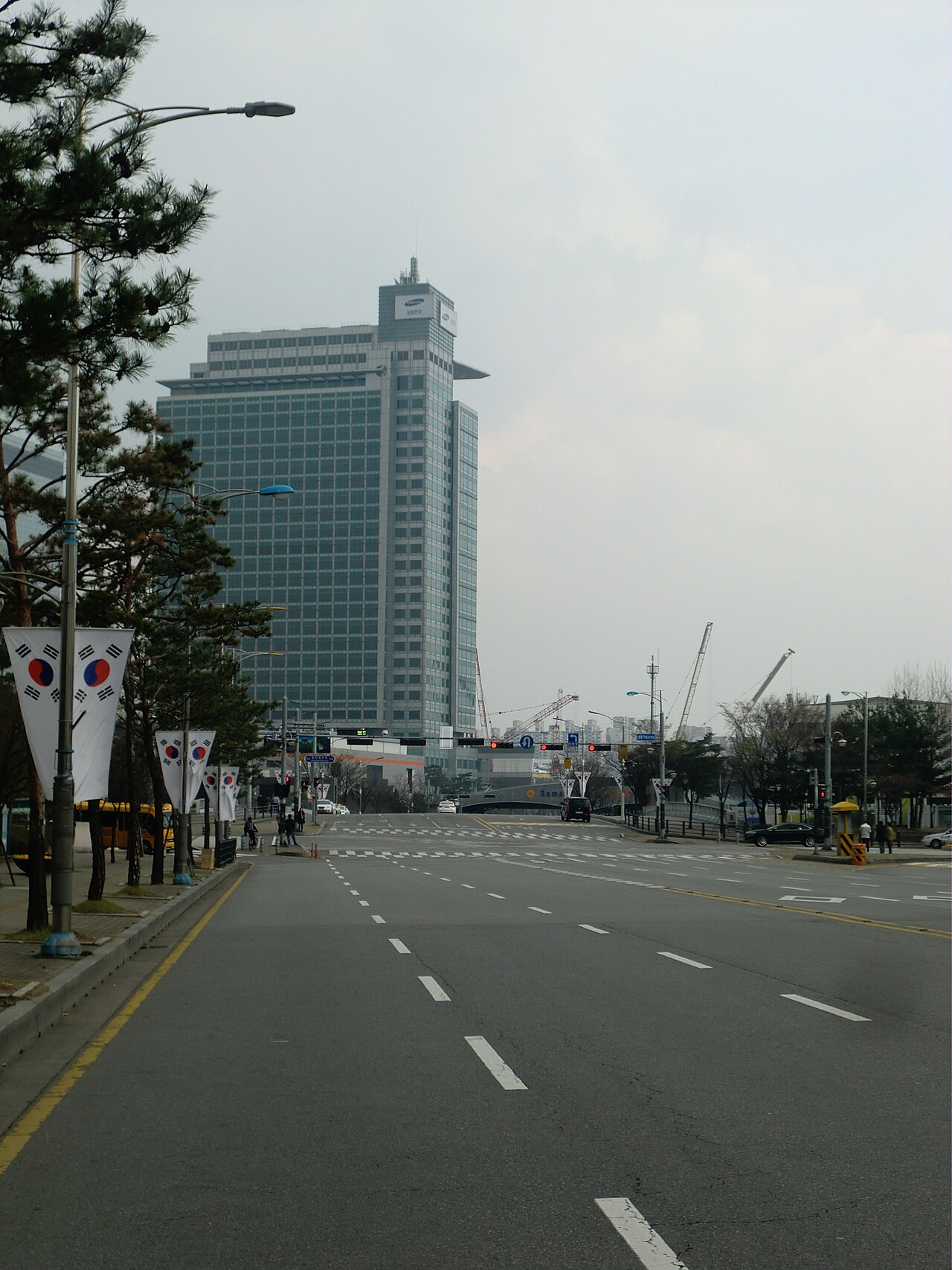
- Samsung Electronics office tower, Suwon (photo dated 2015-04-07): hyolee2, Wikimedia Commons, licensed CC BY-SA 4.0.