
Global shipments of sub-$100 smartphones fell by roughly 60% year over year in the second quarter of 2026, according to a Rest of World report by Kinling Lo published on October 5, 2026. The report ties the drop to a memory chip shortage driven by AI data center demand, which has raised the cost of building the cheapest phones faster than manufacturers can pass it on. The sub-$100 smartphone segment, which shipped 173 million units in 2025 according to IDC, is the part of the market where a few dollars of component cost decides whether a product exists at all.
This piece looks at what the data shows, why the memory used in AI servers pulls supply away from the memory used in budget phones, which markets and companies are most exposed, and what the second-order effects could be for access to the internet.
What the sub-$100 smartphone data shows
Rest of World reports that smartphone prices rose roughly 15% globally in 2026, with new models around 25% more expensive than a year earlier. The increases are uneven: 21% in India, 19% in Asia-Pacific, 18% in the Middle East and Africa, and 5% in the United States.
Smartphone price increases in 2026, by region
Reported percentage increase in smartphone prices. Emerging-market regions carry the largest increases.
Source: Rest of World, October 5, 2026. Hover a bar for details.
Several data points from the same report and its sources show how this reaches individual products and brands:
- Xiaomi raised the price of the Redmi 15C in India from 12,499 rupees (about $140) to 16,999 rupees (about $190), an increase of roughly 36%.
- Oppo's sub-$100 shipments in Southeast Asia fell 96%.
- Chinese manufacturers, which account for around 60% of all smartphones shipped worldwide, have scaled back entry-level programs in favor of higher-margin devices.
IDC's September forecast places this in a wider frame. It projects a 16.7% fall in global smartphone shipments in 2026 to just over 1 billion units, a 27.2% year-over-year decline in the second half, and a 27.6% rise in average selling price to $581. Total market value is still expected to grow 6.3% to $613 billion. IDC puts the year-over-year increase in NAND and DRAM costs at more than 300% and expects pricing pressure to continue until at least 2028. In an IDC statement, Francisco Jeronimo said: "The era of the cheap smartphone has ended."
What used to be below $150 may become below $250, or even $300.
Ivan Lam, senior analyst, Counterpoint Research, quoted by Rest of World
Why AI data centers take memory from phones
Phones and AI servers do not use the same memory product, but they compete for the same factories. Smartphones typically use low-power DRAM (LPDDR) and flash storage (NAND). AI accelerators use high-bandwidth memory (HBM), which stacks several DRAM dies and links them with a very wide interface to feed a GPU. Both are made by the same three DRAM producers, Samsung, SK hynix and Micron, in fabs with finite wafer capacity.
The key figure is the wafer trade ratio. TrendForce reported on September 29, 2026 that HBM consumes roughly three times as much wafer area as conventional DRAM, with one HBM die occupying the wafer space needed for about 3GB of DDR5. HBM currently takes about 20% of industry DRAM capacity, and Samsung expects nearly 30% in 2027. Because of the 3:1 ratio, TrendForce notes that conventional DRAM supply could be displaced at two to three times the pace of HBM's share gain. A shift of 10 points of capacity to HBM can therefore remove 20 to 30 points of the ordinary bits that phones, laptops and standard servers rely on.
 NVIDIA
The economics reinforce the physics. AI buyers have shown they will pay more and commit earlier, so suppliers allocate to them first. IDC analyst Ramon Llamas told Rest of World that memory makers "pivoted the vast majority of their supply towards AI centers instead of consumer electronics." We covered the mechanism in more depth in our analysis of the AI memory supercycle and the supplier side in our Micron earnings breakdown.
Price data for the coming quarter suggest no near-term relief. TrendForce's fourth-quarter forecast expects conventional DRAM contract prices to rise 10% to 15% quarter over quarter and NAND flash prices 15% to 20%. It describes mobile DRAM growth as moderating because large increases were already priced in, while noting that rising costs and the depletion of low-cost inventories continue to weigh on smartphone production.
Why the cheapest phones are hit hardest
A budget phone has a small bill of materials, so a fixed memory cost is a larger share of it. A $75 handset cannot absorb the increase a $900 flagship can. Omdia analyst Manish Pravinkumar put it this way in the firm's Africa report: vendors can no longer profitably manufacture $75 smartphones, while consumers who need connectivity increasingly stretch towards devices of $200 or more.
Africa shows the effect most clearly. Omdia reports that:
- Africa smartphone shipments fell 7% in Q2 2026, and the 2026 forecast is a 26% decline, ending three years of growth.
- Sub-$100 shipments fell 34%, a loss of nearly 3 million units.
- Transsion, which Omdia says is heavily exposed to entry-level demand, saw shipments fall 14%, with its regional share slipping.
- Average selling price rose $41 to $202.
- Country results diverged: South Africa grew 17%, while Nigeria fell 11%, Kenya 15% and Egypt 26%.
IDC adds that emerging markets are expected to decline by more than 20% in 2026, while developed markets are more resilient partly because of interest-free financing, which spreads a higher sticker price over time. That option is far less available to the buyers of a $90 phone.
Second-order effects on digital inclusion
For many people in emerging markets, a low-cost smartphone is the first and only internet device. The report quotes Claire Sibthorpe of the GSMA Foundation: "Stakeholders are increasingly using AI to provide access to important services, but people won't be able to benefit without access to an internet-enabled phone." The tension is direct: the same AI buildout that is absorbing memory supply is also being used to deliver services, such as health information and financial tools, that depend on a handset.
Several outcomes are plausible, and the data does not yet show which will dominate:
- Longer device lifetimes and a larger refurbished market. If new entry-level phones disappear, buyers may keep older devices longer or move to used ones, which can mean slower software updates and weaker security.
- Feature-phone substitution. Some users priced out of smartphones may return to basic handsets, which cannot run most app-based services.
- Less capable software defaults. Lower-memory configurations of apps and operating systems become more valuable when 2GB or 4GB phones are what people can afford.
- Policy attention. Governments and development bodies that treat affordability as a barrier to connectivity may focus more on device pricing.
What to watch
Three indicators will show whether the squeeze is peaking. First, TrendForce's contract price series: a sustained moderation in mobile DRAM would ease bill-of-materials pressure. Second, HBM's share of wafer starts, since a 30% share in 2027 implies continued displacement of conventional bits. Third, new memory supply, since IDC expects memory pricing pressure to continue until at least 2028.
It is also worth separating the two layers of the story. Unit shipments are falling sharply, but IDC expects market value to grow, meaning the industry is selling fewer, costlier phones rather than shrinking in revenue terms. The cost of that shift falls mainly on buyers at the bottom of the price ladder.
Sources:
- How AI data centers are killing off the $100 smartphone, Rest of World (Oct 5, 2026)
- Smartphone Shipments Set for Record 16.7% Drop in 2026, IDC
- Africa smartphone market expected to decline 26% in 2026, Omdia (Aug 20, 2026)
- Samsung Sees HBM Taking Nearly 30% of Industry DRAM Capacity in 2027, TrendForce (Sep 29, 2026)
- AI Server Demand Sustains Memory Contract Price Increases in 4Q26, TrendForce (Sep 30, 2026)
Image credits
- Header image: a cellphone repair shop built from a shipping container in Joe Slovo Park, Cape Town, South Africa, by Vgrigas via Wikimedia Commons, licensed under CC BY-SA 3.0. Photographed in 2013; illustrative of informal phone retail and repair, not of 2026 market conditions.
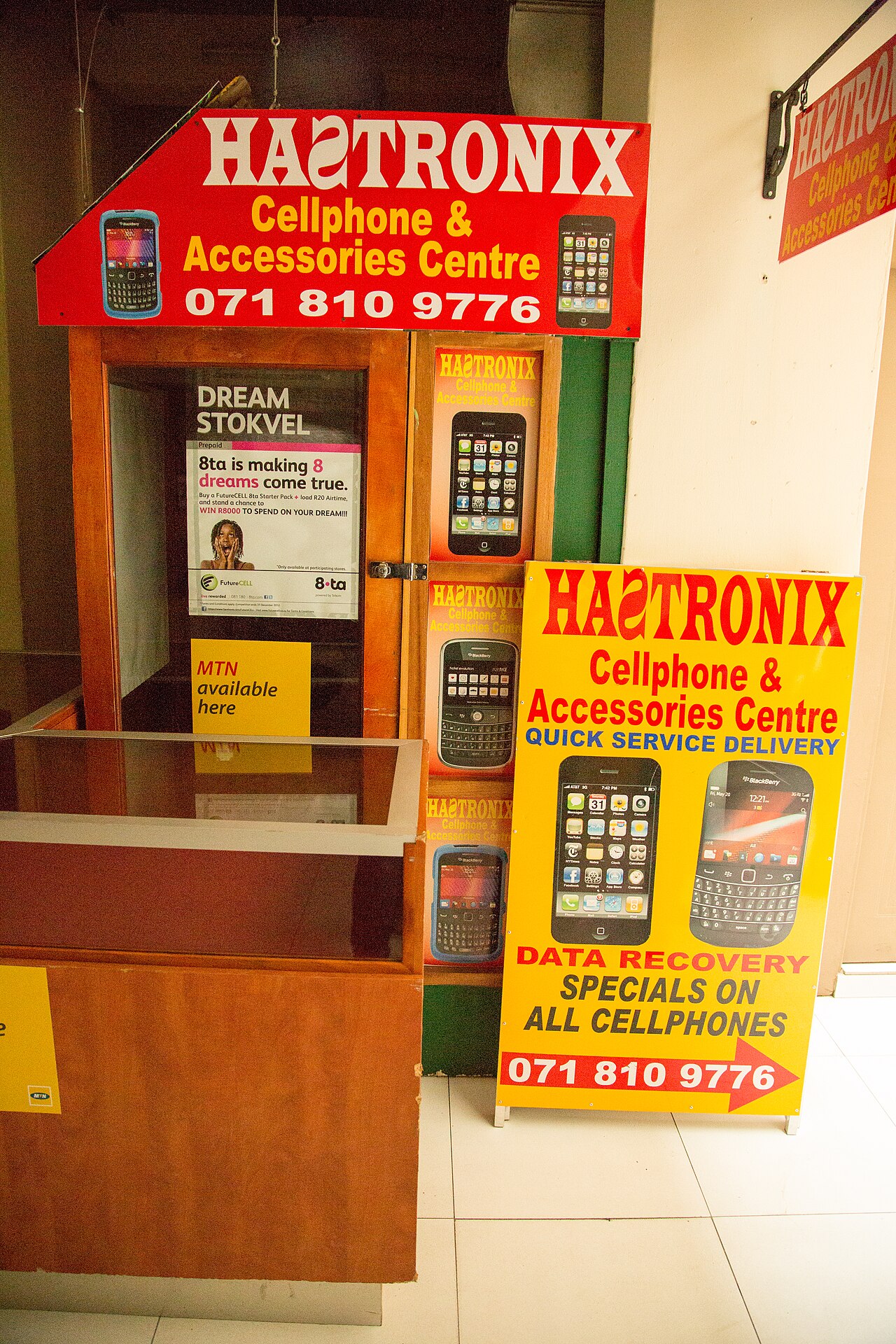
- In-article image: a cellphone and accessories kiosk in Cape Town, South Africa, by Vgrigas via Wikimedia Commons, licensed under CC BY-SA 3.0.