Ohio residents in 18 municipalities voted on 21 data center ballot measures on November 3, 2026, "more than half of the 41 data center-related ballot measures across the country," according to Fortune. At least 14 municipalities passed bans or other restrictions. The next day, shares of several listed data center operators fell sharply, as summarized by AI Weekly from Reuters reporting.
What the ballots showed
Fortune reported results from several places:
- Central Ohio: all five communities with data center measures on the ballot voted against data centers.
- Sunbury: a charter amendment banning data centers that use 25 megawatts or more passed, with the unofficial count complete.
- Trenton: a ban passed 80% to 20%.
- Perry: more than 87% of voters approved a requirement that tax-break seekers offer financial guarantees.
- Wilmington: around 80% of voters rejected rezoning across four referendums.
- Ashville: voters favored blocking a campus already under construction.
Fortune also noted more than 200 operational data centers in Ohio and 125 local moratoriums already in place. Results in Oregon were not available as of its publication.
Public opinion before the vote
Fortune cited an ICAPP/SurveyUSA poll of 1,650 Ohio adults published in October. A Gallup poll from May, per the same article, found about 70% of Americans opposed local data center construction.
Ohio opinion on data centers, percent of respondents
For the third question, "support" is the share who would vote for the proposed amendment and "oppose" the share who would vote against; about 21% were undecided.
Spending was lopsided in one visible respect. DeSmog found that Build American AI, which Fortune says is linked to the Leading the Future super PAC, spent at least $2.54 million on television ads in Ohio between September 7 and October 21, across 16 channels. The ads claimed "$40 billion in investments" and "more than 95,000 jobs."
The market reaction
On November 4, AI Weekly, summarizing Reuters, reported that Hut 8 fell 23%, IREN 11%, Core Scientific 10% and Applied Digital 6.7%, while Microsoft rose 6.7%, Amazon 6.1%, Alphabet 3.2% and Meta 1.4%. The summary said operators fell even as the broader market rallied on the election result, and that Democrats took both chambers of Congress. We could not read the Reuters article directly, so these figures are secondhand.
Share-price moves on November 4, 2026
Data center operators fell while large cloud buyers rose. Percent change, as reported via Reuters.
AI Weekly also quoted a Goldman Sachs view that states likely to tighten data center rules account for about 45% of planned US capacity, and that Goldman expects Democrats in Texas, Georgia and Michigan to impose temporary pauses on new data centers. The summary's two descriptions of Texas's share were inconsistent, so we do not repeat that figure. We did not verify Goldman's note itself.
Analysis: three ways to read it
Local rules bind where federal debate does not. Ballot measures act on zoning, charters and tax incentives, the levers municipalities control. The result is a patchwork: Sunbury's 25 MW threshold, Perry's guarantee requirement and Wilmington's rezoning rejections are different instruments. A developer faces many small decisions rather than one national rule, which is hard to price into a long construction schedule.
The stock split is consistent with a developer-versus-buyer reading, not proof of one. Operators that build and host capacity fell, while large cloud companies that rent or own capacity rose. One reading is that investors saw new-build restrictions as hurting developers more than established hyperscalers. Another is that the same-day broader rally lifted large caps regardless. The data in hand cannot separate these, and one day of trading is a thin basis.
Opinion and spending point in different directions. The ICAPP poll shows majority opposition to construction and tax breaks, while industry-linked advertising emphasized investment and jobs. That the measures passed in many places suggests the advertising did not decisively shift outcomes locally, though a comparison to a no-advertising counterfactual is not available.
A ballot measure sets a rule for one town. A pattern of them sets a planning assumption for an industry.
Analysis
What to watch
- Whether Goldman's anticipated state-level pauses materialize, and in which states.
- How existing projects under construction, such as the Ashville campus, are treated when voters favor stopping them.
- Whether capacity shifts to jurisdictions without local moratoriums. We have covered the electricity bill debate, European grid constraints and New York's tax break changes, which show the same tension elsewhere.
For people who use AI models rather than build capacity, the effect is indirect: compute supply influences model availability and pricing. A model-agnostic workspace such as Metir AI lets users switch providers as capacity and prices shift.
Sources:
- Ohioans overwhelmingly oppose data centers. 21 ballot measures just put their ire to the test (Fortune, Nov 4, 2026)
- Hut 8 falls 23% as data center stocks slide on Dem sweep (AI Weekly, summarizing Reuters, Nov 5, 2026)
Image credits
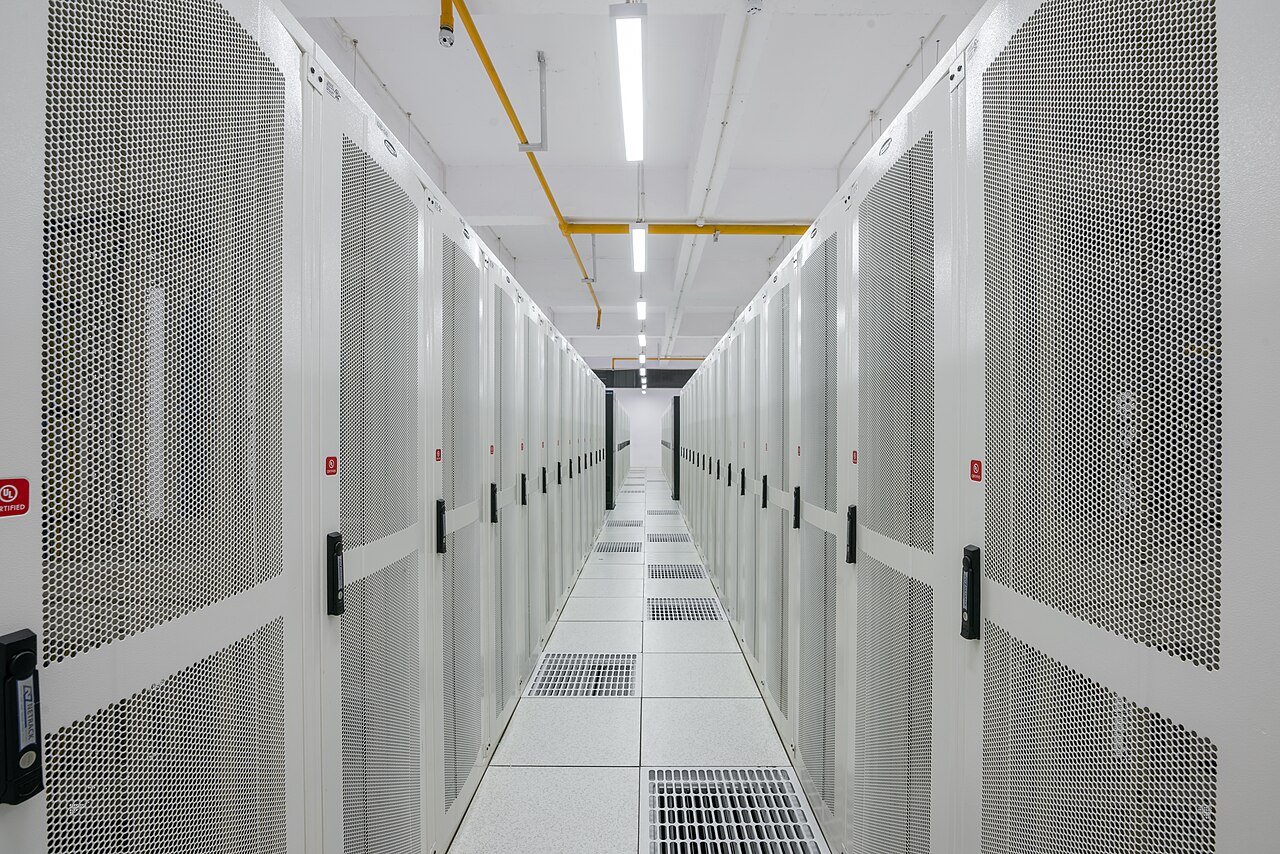
Header and in-body photograph: "Racks Amravati Data Center" by PiDatacenters, via Wikimedia Commons, licensed CC BY-SA 4.0. Illustrative only; it does not depict an Ohio facility.