New York Gov. Kathy Hochul is pursuing two linked changes aimed at the AI infrastructure boom: ending data center tax breaks for the largest facilities, and requiring those facilities to pay more for electricity or generate their own. A governor's office release dated October 6, 2026 restated the tax piece, but the underlying plan is older than this week's headlines, and several details are still unwritten.
This post separates what has been confirmed from what remains open, then places New York in the wider state picture, where lawmakers are rethinking incentives that were once close to automatic.
What Hochul has actually proposed
The plan has arrived in stages, which is why the timeline matters.
- January 2026: Hochul said large energy users would be made to cover the cost of their own demand. In February, the governor's office announced a Public Service Commission proceeding called Energize NY, reviewing interconnection, cost allocation and tariff structures for large loads. The stated standard: these customers must pay more, or supply their own energy.
- Mid-July 2026: Hochul signed an executive order creating what her office calls the first statewide moratorium on new hyperscale data centers. State environmental regulators pause discretionary permits for up to a year while a generic environmental impact statement is prepared. Her office also said it is pursuing legislation to repeal state sales tax exemptions for massive data centers.
- July 21, 2026: Hochul said "there should not be any tax breaks" for these companies, which she called "very successful, very profitable." According to Investigative Post, she backed a narrow exclusion that would stop the state's 106 industrial development agencies (IDAs) from granting property tax abatements, sales tax breaks or mortgage recording tax reductions to hyperscale projects, defined there as facilities needing 50 megawatts or more.
- October 6, 2026: A governor's office release highlighting the moratorium repeated that the governor is pursuing legislation to repeal state sales tax exemptions for large data centers.
There should not be any tax breaks. These are very successful, very profitable companies.
Gov. Kathy Hochul, July 21, 2026, as reported by Investigative Post
What "premium rates" means, and what it does not
The phrase "premium rates" is shorthand in press coverage. The official language is narrower: data centers should "either pay more for their energy or supply their own." No rate, surcharge percentage or tariff schedule has been published that we could find. The mechanism is the Energize NY proceeding at the Public Service Commission, which sets tariffs through a regulatory process rather than a statute.
That distinction affects timing and legal form:
| Piece | Vehicle | Status as reported |
|---|---|---|
| Higher power costs or self-supply | Public Service Commission proceeding (Energize NY) | Proceeding opened in early 2026; no final tariff reported |
| Repeal of sales tax exemptions | Legislation | Governor says she is pursuing it; E&E News reported a plan for next year's session |
| Ban on IDA breaks (property, sales, mortgage recording) | Legislation, per Investigative Post | Proposed for inclusion in next year's state budget, per that report |
| Permit pause | Executive order | In effect for up to one year |
Because two of the four pieces need the Legislature, the tax changes are not law today. No bill text had been reported at the time of writing.
Why a state would act now
The pending projects explain some of the urgency. Investigative Post reported that the Stream US data center proposal in Genesee County has requested $1.46 billion in tax breaks, while other proposals in Western New York have not yet sought subsidies. The governor's argument, in her own words, is that companies of this size "will still come" without incentives.
Supporters of the incentives make a different case: data centers bring construction jobs, local tax revenue and capital investment that rural counties struggle to attract. Critics counter that facilities employ relatively few permanent workers for their size and draw heavily on shared grid capacity.
The state incentive landscape
New York is moving against a long-standing pattern. Good Jobs First has found roughly three dozen states offering sales tax exemptions on data center equipment and building materials, often awarded almost automatically once investment and job thresholds are met. Bloomberg Tax puts the count of states with some data center incentive at 38 and says 24 states have seen proposals to repeal or curtail them.
The costs have grown quickly. In Virginia, the exemption cost $1.6 billion in fiscal 2025, a 118% rise from the prior year, according to the state's annual financial report as cited by The Register. Eligibility there requires $150 million in capital investment and 50 new jobs. Virginia officials defend the program, citing 74,000 supported jobs and $9.1 billion in state GDP contribution.
Reported revenue forgone to data center sales tax exemptions
US dollars. Each state reports on a different basis, so compare scale, not exact totals.
Source: Bloomberg Law, "Data Centers Won Billions in Tax Breaks. Some States Are Balking."
Bloomberg Tax also reports that governors in Ohio and Illinois suspended new exemption approvals and that Arizona approved a three-year pause on new exemptions. Repeal efforts have failed elsewhere: Georgia Republicans rejected one, and Maine's governor vetoed a statewide moratorium. As one economist quoted by Bloomberg put it, an exemption that survives one session "will be back next session." The National AI Association's chief executive said repeal "would've been unthinkable three years ago."
For a wider view of how industry is responding to local opposition, see our earlier coverage of the American Infrastructure Alliance and its data center standards.

The ratepayer cost-shift debate
The electricity half of the plan responds to a different concern: who pays when a single customer needs the output of a small city. Grid upgrades for large loads are built into rates, and critics argue other customers can end up covering them if a project is delayed or cancelled. Large-load tariffs try to prevent that by making the customer commit to paying regardless of actual use.
Two precedents show how this works in practice.
AEP Ohio. The Public Utilities Commission of Ohio approved a tariff requiring new large data center customers to pay for at least 85% of their subscribed demand even if they use less, up from a 60% floor historically applied to such users. The terms run 12 years, including a four-year ramp-up, and include financial-viability proof and an exit fee for cancelled projects. The order, issued July 9, 2025, said it ensures costs are borne by those causing them rather than shifted to others.
Minimum share of contracted power a data center must pay for
Percent of subscribed demand billed regardless of actual use, AEP Ohio.
Source: POWER Magazine and Renewable Energy World, reporting on the PUCO order of July 9, 2025.
Georgia. In January 2025 the Georgia Public Service Commission unanimously approved a rule letting Georgia Power bill new customers above 100 megawatts based on project risk, with contracts of up to 15 years, minimum billing and PSC review of each contract.
Neither is a "premium rate" in the sense of a higher price per kilowatt-hour. They are commitment-based protections. Whether New York's version resembles them, charges a higher rate, or leans on self-supply is the central open question in the Energize NY proceeding.
Arguments on both sides
- For repeal: The facilities are profitable and capital-rich, subsidies cost states billions, and exemptions that lack caps or review mechanisms have repeatedly exceeded projections. Good Jobs First executive director Greg LeRoy has said "trillion-dollar internet giants don't need the tax breaks."
- Against repeal: Incentives may influence where capacity is built. If New York is less competitive, projects could move to neighbouring states, taking local tax revenue with them.
- Unknown: How many projects are truly incentive-sensitive, versus driven by power availability, fibre and land, is difficult to measure from outside.
What to watch
- Bill text. Whether repeal covers only sales tax, or also property and mortgage recording taxes, and whether existing agreements are grandfathered.
- The 50 MW line. Thresholds shape which projects are caught and invite splitting of facilities.
- The PSC tariff. A published rate design will show whether "pay more" means higher charges, minimum commitments, exit fees or self-supply mandates.
- Moratorium end date. The permit pause runs up to a year, so legislation and regulation may arrive in the same window.
- Other states. With 24 states seeing curtailment proposals, New York may be an early example rather than an outlier.
For AI teams, the practical takeaway is that compute costs are increasingly shaped by power policy, not only chip prices. Tools that give access to many models across providers, such as Metir, make it easier to shift workloads as infrastructure economics change.
Sources:
- Investigative Post: NY Gov. Hochul says she wants to ban tax breaks for data centers
- E&E News: Hochul goes after tax incentives for data centers
- Governor Hochul: Representatives Ocasio-Cortez and Ryan highlight New York's nation-leading moratorium (October 6, 2026)
- Governor Hochul: Highlights first statewide moratorium on new hyperscale data centers (July 2026)
- Governor Hochul: PSC proceeding on her plan to ensure data centers pay their fair share (February 12, 2026)
- Bloomberg Tax: Data Center Tax Breaks at Risk as States Rethink Cost and Impact
- Bloomberg Law: Data Centers Won Billions in Tax Breaks. Some States Are Balking.
- The Register: Virginia's datacenter tax breaks cost state $1.6B in 2025
- POWER Magazine: Regulator approves AEP Ohio's landmark data center tariff
- Renewable Energy World: Ohio utility regulators approve AEP's contested data center tariff proposal
- Data Center Dynamics: Georgia PSC approves new billing rules for data centers and large load customers
Image credits
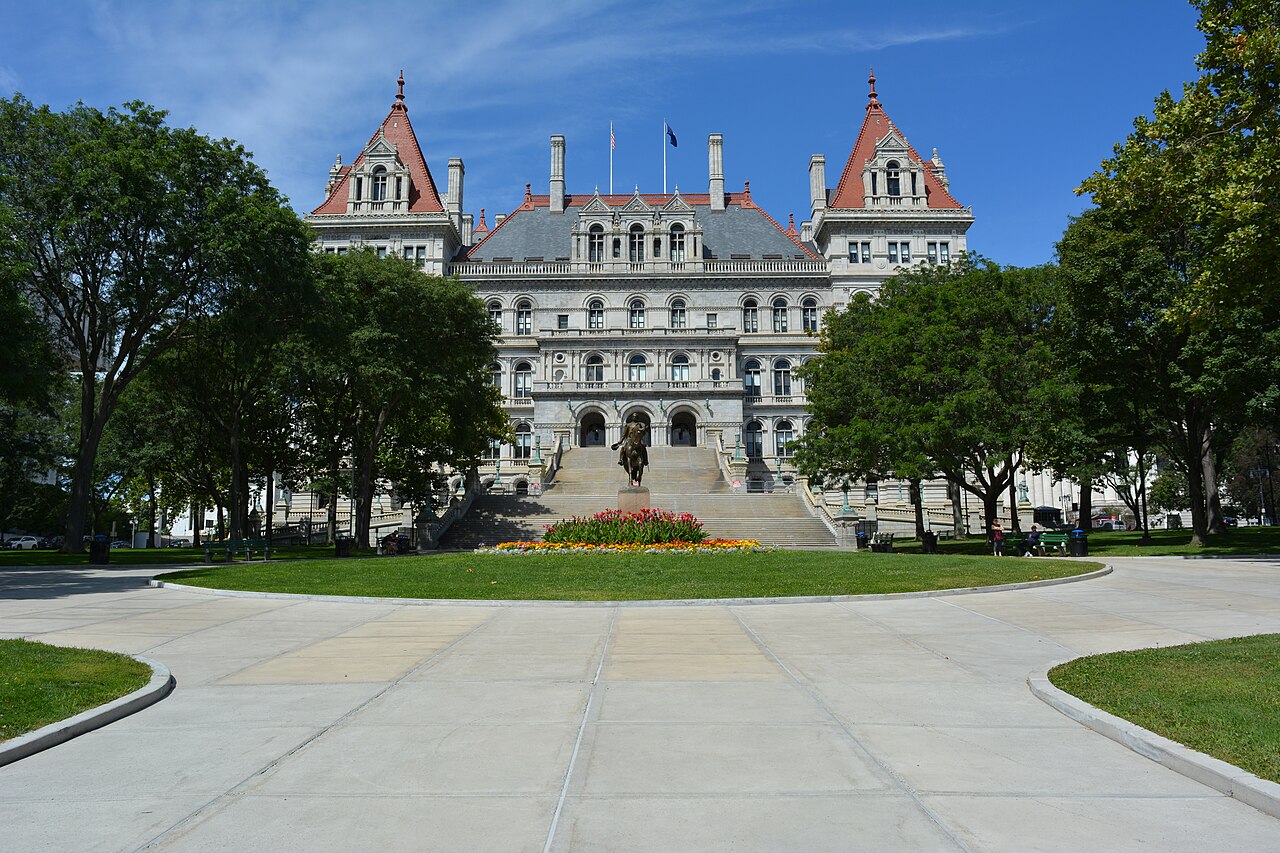
- Hero: New York State Capitol, Albany. Author: Shaunfrombrooklyn. Licence: CC BY-SA 4.0. Wikimedia Commons file.
- Ashburn figure: Data centers in Ashburn, Virginia. Author: Theodore Christopher. Licence: CC0 1.0. Wikimedia Commons file.