On September 28, 2026, Blackstone, OpenAI, QTS and SoftBank Group announced they were joining forces with major US labor unions, including the International Brotherhood of Electrical Workers (IBEW), to launch a new coalition called the American Infrastructure Alliance. Its stated goal is narrow and specific: work with state and local officials to write standards and guardrails for data center construction, targeting a 2027 rollout, in part to head off the wave of local moratoriums that has been slowing new projects across the country. The news was first reported by Axios's Hans Nichols and quickly picked up across the tech press.
 OpenAI
The alliance is not a lobbying group in the traditional sense of one industry pushing one message. It pairs the capital that funds data centers (Blackstone, SoftBank), the company buying the most compute to train and run frontier models (OpenAI), the company that operates the physical buildings (QTS), and the unions whose members wire, cool and maintain them (led by the IBEW). That combination is itself the story: it tells you which pressure point the industry believes is now the binding constraint on the AI buildout, and it is not chips or capital. It is local permission.
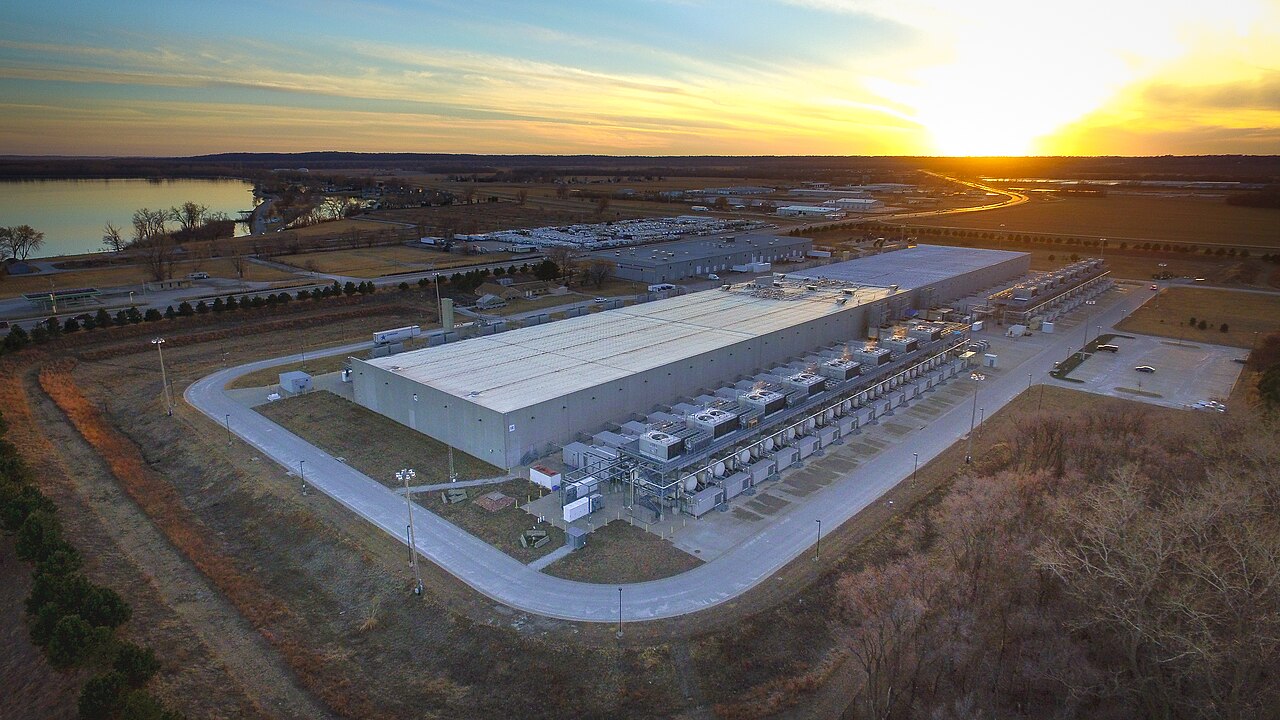
What the American Infrastructure Alliance actually is
Based on the reporting so far, the alliance is a standards-and-advocacy campaign rather than a construction project or a fund. Its members want to sit at the table with state and local officials as those officials write the rules that will govern where, how, and under what conditions new data centers can be built: noise limits, water use, setback distances, tax treatment, labor requirements, and grid-interconnection expectations. The explicit trade the coalition is offering local governments is standards in exchange for predictability: adopt a workable rulebook now, the pitch goes, rather than reach for an outright building pause later.
The IBEW's involvement is the clearest signal of what the group is selling politically. Kenneth Cooper, the union's international president, was quoted saying blanket bans on "necessary infrastructure projects would set back our economy and threaten good middle-class jobs." That is a jobs argument aimed squarely at the same city councils and state legislatures currently weighing bans, not a technology argument aimed at Washington. It also explains the timing: state and local bodies, not Congress, are where most of this fight is actually happening.
Blanket bans on necessary infrastructure projects would set back our economy and threaten good middle-class jobs.
Kenneth Cooper, IBEW International President
The initial campaigns target seven states: Texas, Georgia, Ohio, Iowa, Pennsylvania, Indiana and South Carolina. These are not a random sample. All seven have significant existing or announced hyperscale data center capacity, active electricity-rate or grid-capacity debates, and, in several cases, live moratorium bills or local pauses already on the books. Georgia, Pennsylvania and South Carolina all have state-level moratorium legislation that has been introduced in 2026. Choosing the states where the fight is already underway, rather than the states with the most capacity in the abstract, is consistent with a defensive rather than expansionary strategy: this is triage, aimed at the fronts where projects are actually at risk of being paused or cancelled.
Why now: the collision between buildout and backlash
To understand why an alliance like this exists, it helps to see the two curves that are colliding. One is the pace of data center construction, driven by AI training and inference demand. The other is the pace of local opposition to that construction, which has accelerated sharply through 2026.
Local building pauses have exploded in 2026
New local moratoriums or building pauses enacted per year on data centers, battery storage, solar, wind and crypto mining combined, across US cities, counties and townships.
*2026 figure runs through September 23. Source: Moratorium Nation tracker (independent project, pulled 2026-09-23); covers five infrastructure types, not data centers alone.
The independent Moratorium Nation tracker, which follows local building pauses on data centers, battery storage, solar, wind and crypto mining, recorded 21 new local moratoriums in 2023, 61 in 2024, 121 in 2025, and 882 in the first nine months of 2026 alone, as of a September 23 pull. That is not a gradual trend; it is an inflection. As of the same date, the tracker counted 1,291 local moratoria across 47 states, with 1,063 still in force, plus a further 440 separate state-level restrictions. Data centers are only one of the five sectors covered, so this is not a data-center-only count, but multiple independent trackers, including Good Jobs First and the Rockefeller Institute of Government, describe the same shape: a slow trickle of local pauses through 2024 that turned into a flood in 2026, with at least 14 states considering statewide moratorium bills as of mid-2026.
Public opinion tells a similar story. Gallup's first poll asking Americans about data center construction specifically in their own area, fielded in March 2026, found 71 percent opposed, including 48 percent strongly opposed, versus about a quarter in favor. That is higher than the 53 percent who told Gallup they oppose a nuclear plant nearby, historically one of the most resisted infrastructure types in America. Roughly half of opponents point to electricity and water consumption as their top concern; the rest cite noise, pollution, and the prospect of higher utility bills.
The utility-bill concern has a real mechanism behind it. In the PJM Interconnection, the regional grid operator covering 13 mid-Atlantic and Midwest states, the market monitor attributed 63 percent of the 2025/26 capacity auction's price increase to data center demand, a jump that added an estimated $9.3 billion in costs recovered from ratepayers across the region in a single year. At the national level, the Department of Energy and Lawrence Berkeley National Laboratory have estimated that data centers consumed about 4.4 percent of total US electricity in 2023 and could reach roughly 6.7 to 12 percent by 2028 under different forecasts, a two-to-threefold jump in five years. When a single class of customer is plausibly responsible for a meaningful share of a rate increase everyone pays, "not in my backyard" becomes "not on my bill," and that is a harder objection for an industry to talk its way around.
How data center siting and moratoriums actually work
It's worth being precise about the mechanics, because "moratorium" covers a range of very different actions. Most of what trackers count are temporary pauses: a city council, county board, or township stops accepting or approving a specific kind of development, usually data centers above some size threshold measured in megawatts of power draw, while it writes permanent zoning or environmental rules. Some pauses run for a fixed period, like six months or a year; others are open-ended until new rules are adopted. A handful of jurisdictions have gone further and enacted outright bans, but pauses pending rulemaking are the more common instrument, and several trackers count them alongside permanent restrictions.
The reason local governments reach for a pause rather than simply saying no is that data center proposals move faster than most zoning codes were built to handle. A single hyperscale campus can require hundreds of megawatts of new grid capacity, which can force a utility to build new transmission lines or substations, plus enough water for cooling that a small town's existing supply was never sized for. Many local codes have no specific data center category at all; the projects get evaluated as generic industrial or warehouse uses, under rules written before anyone anticipated a single building drawing power comparable to a small city. A moratorium buys a local government the time to write a rulebook that actually accounts for the water, power, noise and traffic impacts of a modern data center, rather than approving or rejecting one under a zoning code that was never designed for it.
That is the gap the American Infrastructure Alliance says it wants to fill: showing up before the rulemaking process starts, rather than after a moratorium is already in place, with a model set of standards that local and state officials can adapt instead of writing from scratch under public pressure and a ticking clock.
The coalition's structure is the argument
It is worth noting how tightly integrated the alliance's founding members already are with each other, because it changes how the coalition should be read. Blackstone acquired QTS outright in a roughly $10 billion deal that closed in 2021, so two of the four founding companies are, functionally, the same balance sheet: Blackstone supplies the capital, QTS operates the buildings it capitalizes. SoftBank Group and OpenAI are separately linked through the Stargate data center program and related financing and compute commitments. In other words, this is less four independent companies discovering a shared interest than two capital-and-operator pairs, one financial and one AI-and-infrastructure, deciding to combine their political weight and add organized labor to it.
That structure is also the honest answer to what the alliance is optimizing for. A capital provider wants predictable permitting timelines because delay is a financing cost. An AI lab wants compute capacity to keep shipping on schedule. An operator wants a repeatable playbook it can take from state to state instead of relitigating zoning fights from scratch every time. A union wants a steady pipeline of unionized construction and maintenance jobs, and wants that pipeline protected from bans that would eliminate it entirely. None of those interests requires bad faith, and none of them is identical to the interests of a resident weighing higher electricity bills, a new substation nearby, or a rezoned lot on their street. A neutral read of the alliance is that it is a real attempt to write workable rules, and also a well-resourced effort by parties with a direct financial stake to shape those rules before city councils and state legislatures write something less to their liking on their own.
The case each side is making
The alliance's case rests on three claims: unmanaged local moratoriums will slow AI infrastructure investment and the jobs that come with it; a negotiated standard is better for communities than an ad hoc patchwork of bans and building codes reached under pressure; and organized labor's presence signals the buildout can be a source of stable, well-paid construction and maintenance work rather than only a burden on host communities.
The opposing case, made by many of the residents and local officials behind the moratorium wave, is that data centers deliver relatively few permanent jobs once construction ends, that the industry has moved faster than utilities and regulators can responsibly plan for, and that a company-funded coalition negotiating "standards" is still the affected industry writing rules for itself, whatever the specifics turn out to be. Community and environmental groups involved in these fights have generally argued for public and independent-of-industry rulemaking processes rather than an industry-and-labor coalition setting the starting terms.
Both positions are defensible from the facts on the table. The alliance is right that the moratorium wave is real, large, and accelerating; the pace of new local pauses in 2026 alone is an order of magnitude higher than in 2023. Critics are right that a coalition funded by the companies seeking permits is not a neutral party, whatever standards it ultimately proposes. Which reading proves more accurate in practice will depend on details reporting has not yet surfaced: what the actual proposed standards look like, whether independent technical or community voices get a seat at the table alongside the alliance, and whether state and local officials treat the coalition's proposals as a starting draft or as the final word.
What to watch through 2027
The alliance's own timeline points to 2027 for delivering standards, which means the next several months will show whether this is a genuine negotiating process or a public-relations campaign ahead of legislative sessions. A few concrete things to watch: whether the seven target states see moratorium bills slow, stall, or pass despite the alliance's involvement; whether the coalition publishes an actual model ordinance or standard that other states can adopt, the way model legislation typically spreads; and whether any additional unions, companies, or community organizations join, which would say something about how broad a coalition this can become versus how narrow.
The deeper story here is not really about any one deal or any one state. It's about an industry that spent the first phase of the AI buildout racing to secure chips and capital discovering that the binding constraint has shifted to power, water, and the patience of the communities hosting the buildings that hold the chips. How that gets resolved, through negotiated standards, continued local bans, or something in between, will shape how fast, and where, the next wave of AI infrastructure actually gets built.
Sources:
- Techmeme: Blackstone, OpenAI, QTS, and SoftBank partner with key US unions to launch the American Infrastructure Alliance
- Axios: Exclusive: AI advocacy group launches data center push in battleground states
- Axios: The data center era that's reshaping America
- Blackstone: QTS Realty Trust to Be Acquired by Blackstone Funds in $10 Billion Transaction
- Gallup: Americans Oppose AI Data Centers in Their Area
- Rockefeller Institute of Government: Updates on the Cloud: More Moratoriums on Data Centers
- Good Jobs First: Data Center Moratorium Bills Are Spreading in 2026
- Moratorium Nation: U.S. Infrastructure Moratorium Tracker
- Utility Dive: Data centers 'primary reason' for high PJM capacity prices, market monitor says
- Data Center Dynamics: DOE: Data centers consumed 4.4% of US power in 2023, could hit 12% by 2028
Image credits
- Hero and body photograph of the Council Bluffs, Iowa data center: Chad Davis, Google Data Center, Council Bluffs Iowa, CC BY 2.0, via Wikimedia Commons.
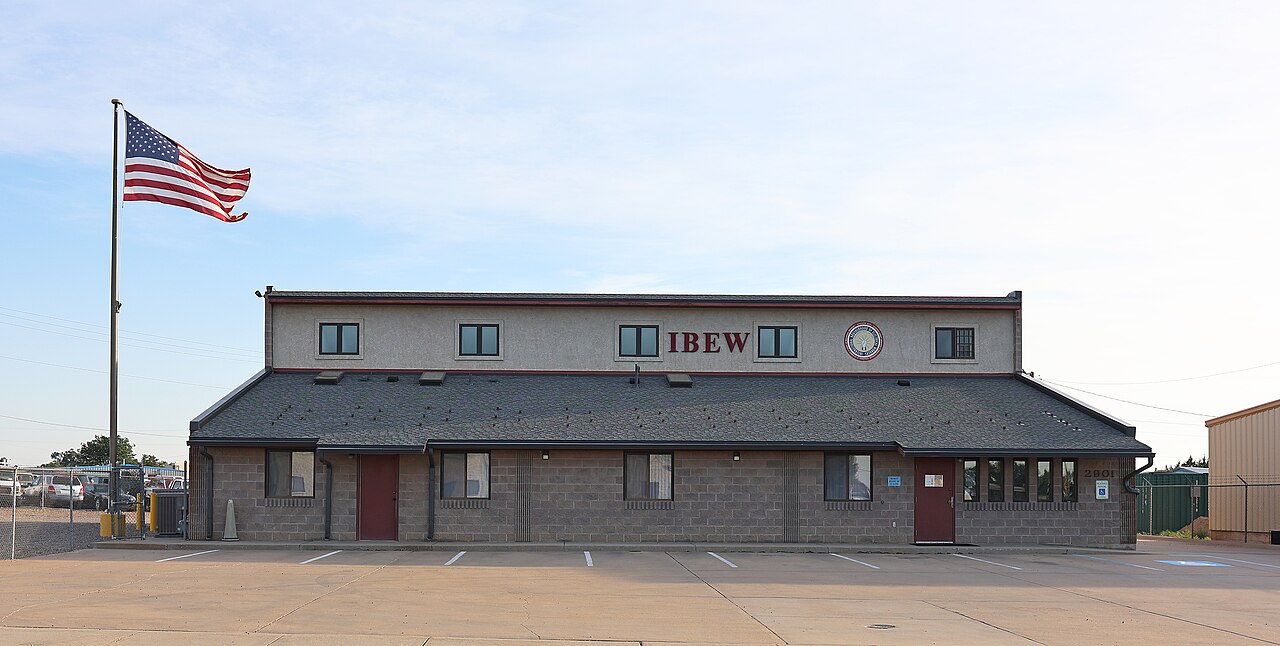
- IBEW Local No. 12 union hall, Pueblo, Colorado: Jeffrey Beall, International Brotherhood of Electrical Workers Local no. 12 building, CC BY 4.0, via Wikimedia Commons.