
Chinese developers released 16 AI models in September 2026, according to a Nikkei Asia report dated October 7, even as Anthropic CEO Dario Amodei was asking the industry to slow down. The same report puts a number on the broader acceleration: across the US and Chinese labs Nikkei sampled, the average gap between model releases fell from 125 days to 44 days. This article separates what Nikkei and its secondary summaries confirm from what is still unreported, then explains the mechanics behind the number: why open-weight release economics reward speed, what the pacing proposal actually asks for, and why the problem looks like a coordination game.
 DeepSeek
 Alibaba
 MiMo
MiMo Z.ai
Z.ai Moonshot AI
 MiniMax
 Anthropic
What Nikkei reported about the 16 AI models
The Nikkei Asia piece, datelined Guangzhou and Tokyo, says China's AI push shows no sign of slowing despite safety-related calls for a pause. Its summary names DeepSeek and Xiaomi among the developers that rolled out models last month. A summary of the report by AI News Weekly also names Alibaba and Z.ai (the maker of the GLM series), and says Moonshot AI is part of the comparison sample. Nikkei did not publish a model-by-model list in the text we could read, and none of the coverage explains how the 16 models were counted, so treat the total as Nikkei's own tally rather than an independently verified census.
The cadence figures come from Nikkei's sample of five US firms (including Anthropic and OpenAI) and four Chinese firms (including Alibaba and Moonshot AI). Per the AI News Weekly summary, the average interval between releases was 125 days from January 2023 to March 2026 and 44 days from April to September 2026. That is the sample's average, not a statement about any single lab, and a nine-firm sample over six months is small enough that one lab's burst of point releases can move it. The summary adds that DeepSeek has shipped model updates monthly since July.
 OpenAI
Average days between model releases
Nikkei's sample of five US and four Chinese labs. A shorter bar means a faster release cycle.
The later interval is about 35% of the earlier one (44 divided by 125), roughly a threefold speed-up.
Why open-weight release economics favour speed
The September count is dominated by labs whose business model leans on open weights, meaning developers can download and run the model themselves. The 10bmnews write-up of the story notes the link directly: DeepSeek and its peers built their following on open-weight models. Three mechanics explain why that rewards a faster cadence.
- Distribution is the product. A closed lab sells access through an API and can hold a model back until it is polished. An open-weight lab earns attention by being downloaded and benchmarked, and attention decays quickly when a rival ships. Frequent releases keep a lab visible in the rankings developers consult.
- Incremental releases are cheap to ship. A point release that improves coding or long-context behaviour on an existing architecture costs far less than a new pretraining run. Faster cycles can therefore come from post-training refinements rather than from new frontier-scale training, which also means a higher count of models does not by itself mean a higher count of capability jumps.
- Capital rewards momentum. Bloomberg, as relayed by the 10bmnews article, reported that Moonshot AI closed a funding round at a valuation of about $50 billion and that DeepSeek was close to completing a $12 billion raise. Those are reported figures, but they illustrate why a visible release rhythm matters to investors.
A second factor applies to both countries: AI doing more of the development work. If automated research is compressing cycle times, shorter gaps would be a structural trend rather than a Chinese-specific one, which fits the fact that Nikkei's sample includes American labs. For a broader view of the automation loop, see our coverage of the narrowing US-China gap on LiveBench and of Xiaomi's MiMo V2.6 open-weight release.
What Amodei actually asked for
Amodei's September 12, 2026 essay, titled "We Must Pace the Frontier," is the call Nikkei refers to. The description below draws on published coverage of the essay, including Cyber Magazine and NYU Shanghai RITS. Per AI News Weekly, he wrote that "pacing does not mean halting model training or technical progress." The reported proposals are embedded third-party evaluators inside frontier labs, safety-standard coordination among democracies, and compliance verification that involves authoritarian governments. The essay refers to authoritarian governments without naming China, according to that summary.
Reactions were split. AI News Weekly reports that Sam Altman and Elon Musk publicly agreed, while David Sacks, a Trump administration AI official, said: "If the unreleased models are scary enough that you think you should slow down, I support your decision," while rejecting the altruistic framing and pointing to product-liability exposure. Employees at several labs have also pressed the issue, as covered in our post on the Pacing the Frontier letter, and the legal risk of coordinating is examined in the antitrust suit over alleged pacing collusion.
Pacing does not mean halting model training or technical progress.
Dario Amodei, September 12, 2026, as quoted by AI News Weekly
The Chinese response, as relayed by 10bmnews, was skeptical. A DeepSeek engineer who worked on the V4.1 models said he did not trust Anthropic or OpenAI to keep advanced AI open and affordable, and the South China Morning Post reported that other Chinese observers questioned the motives behind the slowdown calls. The same article recalls that in February Anthropic accused DeepSeek, Moonshot AI and MiniMax of distillation campaigns involving about 24,000 fraudulent accounts and more than 16 million exchanges with Claude, an allegation that colours how the pacing request is received.
The coordination problem
Pacing is easier to state than to hold, and game theory explains why. This section is our analysis, not a finding from Nikkei.
- A prisoner's dilemma with a verification gap. Each lab does better by releasing if it expects rivals to release. Everyone does better if all slow down, but only if slowing is verifiable. Embedded evaluators are an attempt to supply that verification inside a lab, and the third step of the reported plan extends it across borders.
- Unequal incentives break symmetric deals. A lab that sells closed API access can afford to delay a release. A lab whose reputation and fundraising depend on public, downloadable weights pays more for each month of silence. The same pacing rule therefore costs different actors different amounts.
- Open weights cannot be recalled. Once weights are public, a pause by the original developer does not stop fine-tuning or redistribution. That is a reason some safety advocates focus on pre-release evaluation, and a reason open-weight developers argue that evaluation gates function as de facto licensing.
- Domestic law adds friction. In the US, agreements among competitors to limit output raise antitrust questions, which is why voluntary, unilateral commitments such as embedding evaluators are structurally easier than a negotiated industry-wide speed limit.
The unresolved empirical question is whether the 44-day figure reflects real capability growth or a higher volume of smaller updates. Benchmark gaps help here: the roughly 3% LiveBench gap discussed in our earlier piece suggests Chinese open models are close to the frontier, but it does not show that each of 16 releases moved the frontier.
What to watch next
- Methodology. Whether Nikkei or others publish the sample and the model list behind the 16-model count and the 44-day average.
- Whether the cadence persists. One quarter of shorter gaps is a trend line, not a settled pattern. A DeepSeek monthly rhythm since July is the clearest test.
- Verification experiments. Whether embedded evaluators actually start at Anthropic and are matched by other labs, and whether any Chinese lab or government engages with the proposal.
- Funding closes. The reported Moonshot and DeepSeek rounds, which would show whether investors price speed.
- US-China channels. Whether incident-reporting or dialogue mechanisms discussed in our US-China dialogue post gain traction.
For teams building on these models, a faster release rhythm means the best model for a task changes more often. Platforms such as Metir that give access to many models behind one interface make it easier to swap in a new release without rebuilding a workflow, though each new model should still be evaluated on your own tasks.
Sources:
- Nikkei Asia: China's DeepSeek, peers launch 16 AI models in a month despite Anthropic warning (Oct 7, 2026)
- AI News Weekly: DeepSeek, Xiaomi ship 16 AI models in a month as US labs urge pacing
- 10bmnews (via NDTV Profit): 16 AI models in one month, Chinese AI firms step up launch race despite Anthropic warning
- AI News Weekly: Amodei urges AI slowdown; Altman and Musk in, Sacks dissents
Image credits
- Hangzhou skyline across West Lake (hero): "20260424 West Lake and Hangzhou Skyline.jpg" by Windmemories, CC BY-SA 4.0, via Wikimedia Commons. Illustrative of the city only; it does not depict any lab or model named here.
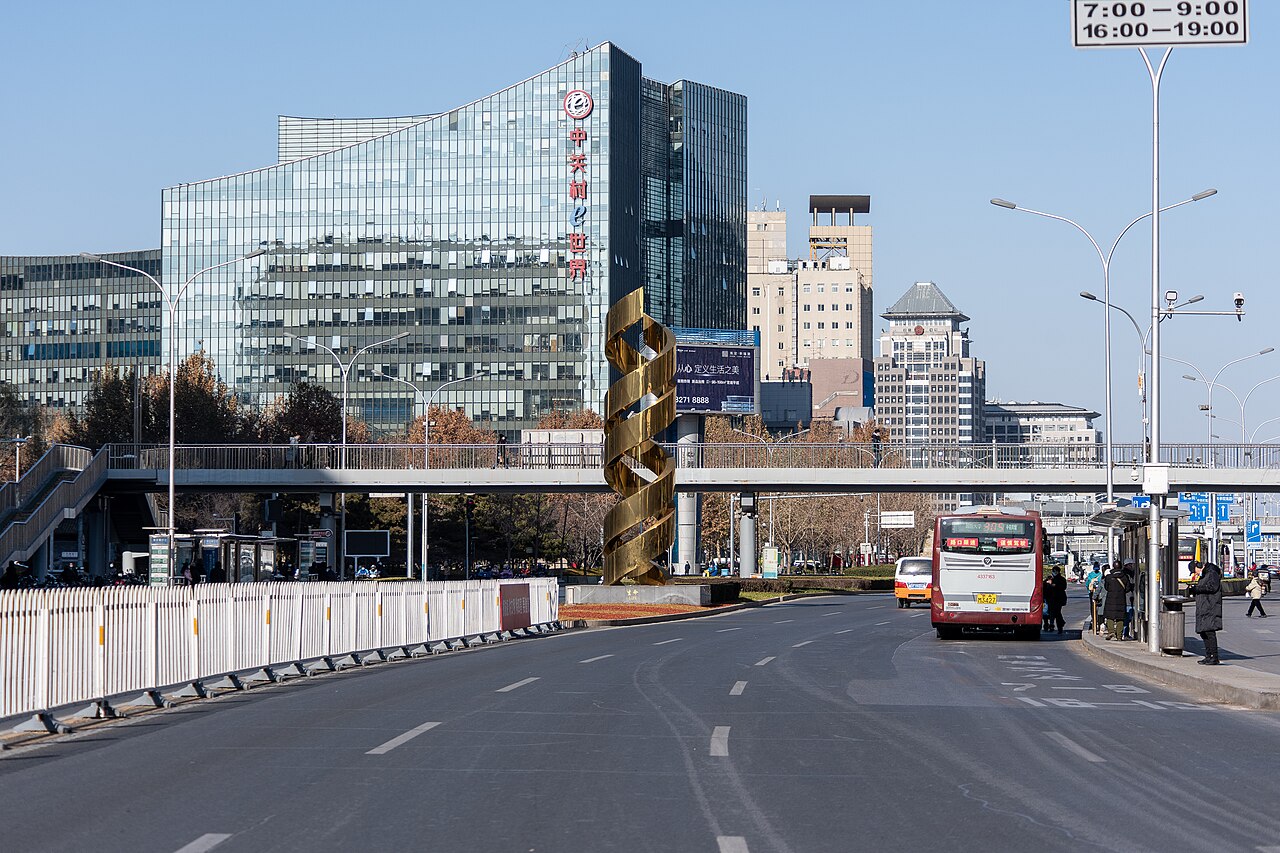
- Zhongguancun Street: "Zhongguancun Street from Haidian Huangzhuang North (20201214123508).jpg" by N509FZ, CC BY-SA 4.0, via Wikimedia Commons.