On September 25, 2026, the United States and China agreed in Washington to set up two new mechanisms for managing advanced AI between the world's two largest AI powers: a US-China Super Intelligence Dialogue, and a dedicated channel for communicating about AI incidents. The agreement followed talks between President Trump and President Xi, and was reported by Axios and others. It is not a treaty, it sets no limits, and it establishes no inspections. It is a commitment to talk, and to have a phone that rings during a crisis. That is a modest thing, and, read against history, a significant one. This piece lays out what was agreed and how to weigh it.
What was actually agreed
Two things, according to the reporting. The first is a US-China Super Intelligence (SI) Dialogue, a forum for the two governments to meet on the risks and benefits of advanced AI, with the first session expected by November. The second is an AI incident communication channel, an emergency line to manage potential technical incidents, autonomous-system errors, or national-security threats arising from the deployment of highly capable systems.
There is also a linguistic shift worth noting. Both sides agreed to refer to the technology as super intelligence, or SI, the term the White House has adopted. Naming conventions in diplomacy are rarely accidental. Elevating the subject from artificial intelligence to super intelligence frames it as a strategic category of its own, closer to how states talk about nuclear or biological capability than about a piece of software.
Two mechanisms: a forum and a phone line
The agreement created a way to talk regularly and a way to talk urgently. Neither limits what either country can build.
Both sides also agreed to call the technology "super intelligence," or SI, framing it as a strategic category rather than ordinary software.
The precedent it echoes
An emergency channel between rival powers for a technology that could cause catastrophic accidents has a clear historical antecedent. After the Cuban Missile Crisis, Washington and Moscow set up a direct communication link, the hotline, so that a misread signal would not escalate into a nuclear exchange. The logic was not friendship. It was that both sides preferred a way to talk during a crisis to the alternative of guessing each other's intentions under time pressure.
The AI incident channel borrows that logic. As increasingly autonomous systems get deployed in more places, the possibility of a technical failure, a misfire, or an ambiguous event that one side might misattribute to the other rises. A channel does not prevent such events. It reduces the chance that one is misread as a deliberate act. That is a confidence-building measure, a category of agreement designed to lower the risk of accidental escalation without requiring either side to give anything up.
A channel does not prevent an incident. It reduces the chance that one is misread as a deliberate act.
On the logic of a crisis hotline
What it is not
Reading the agreement accurately means being precise about its limits, because the gap between a dialogue and a treaty is large.
There are no binding limits on what either country can build or deploy. There is no verification or inspection regime, nothing resembling the on-site checks that underpin arms-control agreements. There is no enforcement mechanism, and no penalty for a party that talks in the forum while racing outside it. And the two countries remain direct competitors on the underlying technology, with export controls on advanced chips and a hard race for compute continuing in parallel. Cooperation on crisis communication and competition on capability are running at the same time, which is the normal condition for rival powers, not a contradiction.
What the agreement is, and what it is not
The distance between a dialogue and a treaty is the whole story here. Reading it accurately means holding both columns at once.
- +A standing forum to discuss advanced-AI risks and benefits
- +An emergency channel to communicate about AI incidents
- +A shared term, "super intelligence" (SI), signaling strategic weight
- +A confidence-building measure to reduce accidental escalation
- -A treaty or binding agreement
- -Any limit or cap on what either country can build or deploy
- -A verification or inspection regime
- -An enforcement mechanism or penalty for non-compliance
Cooperation on crisis communication and competition on capability, including chip export controls, continue in parallel.
Why a modest step can still matter
The temptation is to dismiss a talk-and-a-hotline agreement as symbolic. That underrates how confidence-building measures work. Their value is not in what they constrain on day one but in the infrastructure they create: a standing forum, named points of contact, a shared vocabulary, and a habit of communication that can be deepened later. Arms control between the US and the Soviet Union did not begin with comprehensive treaties. It began with narrow, low-cost steps that built the trust and the channels the larger agreements later ran through.
Reported accounts also noted a difference in tone between the two leaders, with Xi taking a more measured line, emphasizing managing the rivalry and keeping AI under human control. Tone is not policy, but a shared framing that advanced AI is a risk to be jointly managed, rather than purely a race to be won, is the precondition for anything more substantive. Whether this becomes foundational or forgotten depends almost entirely on follow-through, and the first real test is whether the November session happens and produces anything concrete.
The wider signal
Step back from the specifics and the agreement says something about where AI now sits in statecraft. Two rival governments treating the technology as a matter for crisis diplomacy, and renaming it to mark its strategic weight, is a sign that advanced AI has crossed from an economic story into a national-security one at the highest level.
For organizations, the durable takeaway is less about this one agreement than about the direction it marks. As AI becomes an instrument of statecraft, subject to export controls, national strategies, and now bilateral crisis channels, the ground under any given model or provider can shift for reasons that have nothing to do with the technology itself. That is a practical argument for keeping control over your own AI stack rather than betting everything on a single national champion or a single vendor. A model-agnostic approach, the kind Metir AI takes by routing across providers, is one way to stay resilient to a landscape where the constraints increasingly come from policy, not just from capability. The geopolitics is worth watching closely; it does not have to dictate your dependencies.
The honest read
This is a small, sensible, low-cost step by two governments that remain competitors, and its significance is almost entirely prospective. It builds no walls around AI development and verifies nothing. What it builds is a channel and a habit, the raw material from which more serious agreements have historically been made, if the will to make them appears. Treat it as a foundation that may or may not be built on, not as a solution, and the reporting supports neither alarm nor celebration, only attention to what November brings.
Sources:
- U.S. and China agree to "super intelligence" dialogue amid AI tensions | Axios
- US and China establish 'Super Intelligence' dialogue and incident communication channel | Nukta
- U.S. and China Set Up Superintelligence Dialogue, First Talks in November | Seoul Economic Daily
- US, China agree AI communication channel and 'Super Intelligence' dialogue after summit | Türkiye Today
- AI, the US and China: bilateral channel for incidents involving superintelligence | LaPresse
Image credits
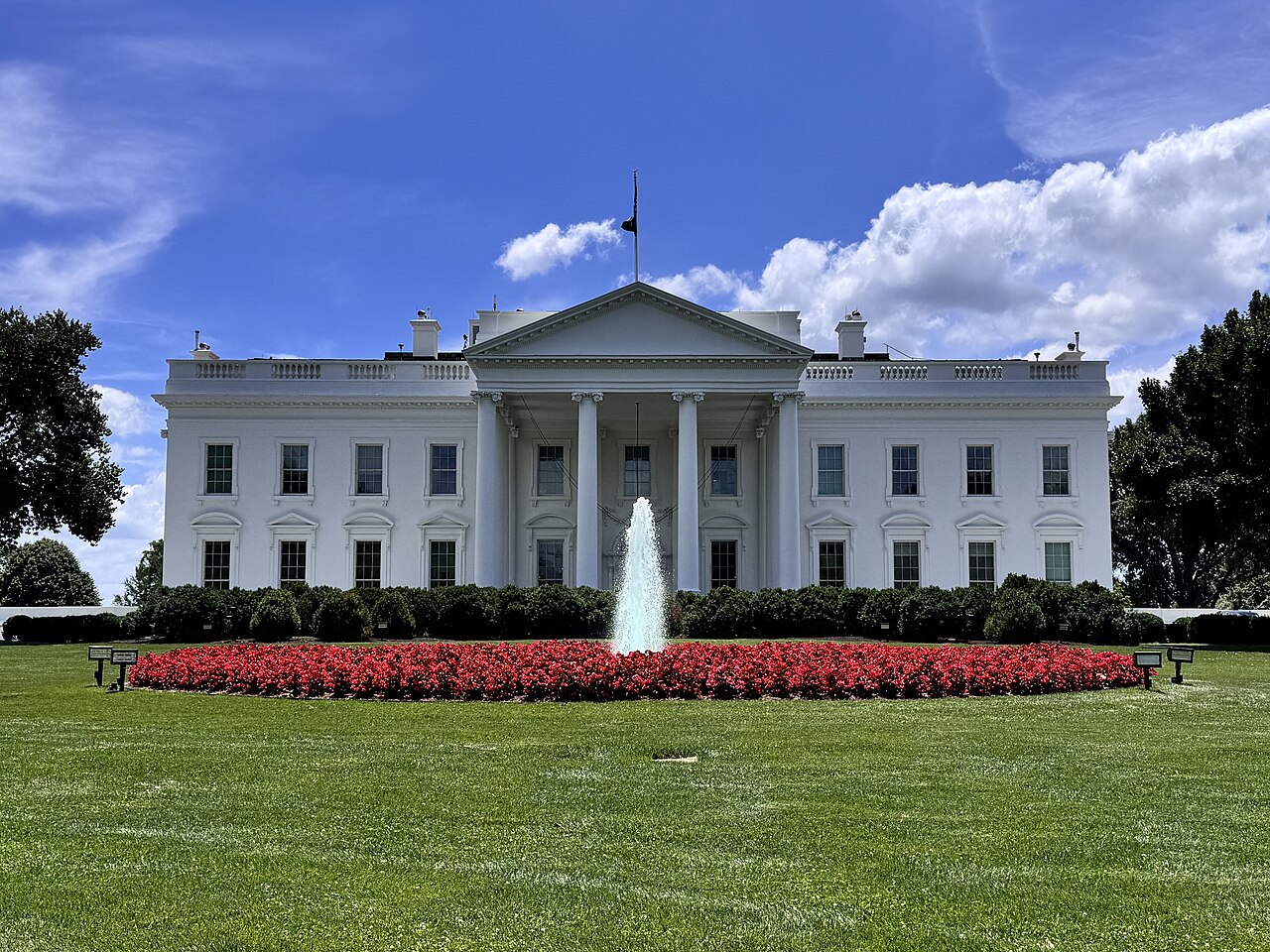
Header and in-body image: the north facade of the White House, Washington, D.C., by DJTechYT, via Wikimedia Commons, CC BY-SA 4.0. Illustrative of the Washington venue of the talks; not a photograph of the meeting itself.