Amazon Web Services CEO Matt Garman announced on October 2, 2026 that Amazon has stopped using nondisclosure agreements with government agencies on its data center projects, and that the company will spend more than $1 billion over five years in communities that host its facilities under a program called Built Together. The announcement, which TechCrunch covered on October 3, is the clearest sign yet that data center secrecy has become a cost the largest builders are willing to pay to reduce. This piece checks the announced details against Amazon's own post, explains why NDAs were standard, and sets the $1 billion beside Amazon's capital spending and the tax breaks data centers receive.
 AWS
AWS Microsoft
 Google
 Meta
MetaWhat Amazon announced
In Garman's post on aboutamazon.com, the NDA line is short: "We no longer use nondisclosure agreements" with the government agencies Amazon works with on its projects. The same post commits Amazon to:
- Publish its energy use, energy efficiency, water use and water efficiency each year.
- Build new sites with backup generators that meet the EPA's Tier 4 emissions standard.
- Put more than $1 billion over five years into Built Together, which Amazon describes as letting "communities in the driver's seat."
According to the post, Built Together has three strands. Education and workforce funding is projected to give about 300,000 students access to free degree programs, and Amazon plans to grow its Modular Training Centers from three operating today to 25 by the end of 2028, with a goal of training up to 100,000 workers a year. Energy and water funding targets efficiency upgrades at more than 300 schools and community buildings and more than 30,000 homes. A third strand funds locally chosen priorities.
Two details matter for interpretation. First, the NDA change is forward-looking only. Implicator reported that it does not cover past agreements or those signed by contractors. Second, Garman told Newsweek the funding is added "to what we're already doing," and Amazon's post says it has already put more than $1 billion into data center communities over the past three years.
Why NDAs were standard in site selection
NDAs were a routine part of large site searches long before this announcement. Microsoft, explaining its own change, said it used them "during early stages of data center development to help protect sensitive commercial information, address early security considerations, and ensure we can comply with local regulatory and permitting processes," and called them a common industry practice. Those three reasons are the stated ones: commercial confidentiality, security, and permitting.
The cost side is the community's. Hoodline's summary of a University of Mary Washington study says 25 of 31 Virginia localities with data center projects had signed NDAs. Activist Erin Brockovich, quoted in coverage of the announcement, named transparency as the top complaint she hears: projects announced after permits are secured, and officials who signed NDAs. The practical tension is timing. An NDA can keep a project quiet while terms are negotiated, but it also means residents first hear about a facility after decisions have narrowed.
Microsoft moved first among the large builders. Virginia Business reported on March 18, 2026 that Microsoft would coordinate termination of existing NDAs with local governments, while reserving the right to protect proprietary information where the law allows. Amazon's version is narrower in one respect, since it applies going forward, and wider in another, since it commits to annual public energy and water reporting.
The opposition behind the shift
The timing follows measurable pushback. Data Center Watch's Q1 2026 report counted at least 75 projects worth approximately $130 billion blocked or delayed by local opposition in January to March 2026, roughly matching all of 2025 in three months. It also found active opposition groups more than doubled since the end of Q4 2025, now spanning 49 states, and more than 300 state data center bills filed in the first six weeks of 2026. Its earlier report put the total at $64 billion ($18 billion blocked, $46 billion delayed) for a period ending March 2025.
Data center projects blocked or delayed by local opposition
Value in billions of US dollars, as tallied by Data Center Watch in two reports covering different periods.
Source: Data Center Watch. The two reports cover different windows (the earlier report spans well over a quarter) and methods, so the comparison is indicative.
Reported coverage adds a political layer. Newsweek cited a Gallup survey in which 70% of Americans oppose AI data center construction locally. Implicator noted that Representative Jamie Raskin had demanded NDA information from Amazon, Google, Meta and Oracle. The two Data Center Watch reports use different windows and methods, so the comparison is indicative rather than exact.
This is not Amazon deciding what communities need, it is Amazon providing resources and letting communities decide.
Matt Garman, AWS CEO, as quoted by Implicator
How $1 billion compares with capex
Amazon said in its Q2 results on July 30, 2026 that it expects roughly $220 billion in cash capital expenditures in 2026, up from an earlier $200 billion plan, with the $20 billion increase attributed to higher memory costs. The arithmetic, which is ours:
- $1 billion over five years averages $200 million a year, about 0.09% of one year's $220 billion capex.
- The entire five-year pledge equals roughly 0.45% of that single year's spending.
Critics framed it similarly. Stand.Earth called the pledge "a drop in the bucket" and "damage control", and Tom's Hardware headlined that the spend is just 0.1% of its 2026 AI infrastructure investment. A fair counterpoint is that capex builds assets and Built Together is an operating-style community program, so the ratio says little about whether the program is meaningful to a given town. The more useful comparison is local.
Tax breaks: a different scale
Good Jobs First's June 2026 analysis, summarized by Tech Times, says Indiana lost about $655 million to data center sales and use tax exemptions in 2025, with roughly $561 million (83%) going to Amazon Data Services. The same summary puts Virginia's fiscal 2025 cost at $1.94 billion across all operators. Hoodline drew the comparison that these Indiana breaks are 2.8 times Built Together's annual average.
Built Together next to data center tax exemptions
Annual figures in millions of US dollars. The bars measure different things (a spending pledge versus tax revenue a state forgoes), so read them as scale, not as a like-for-like offset.
Sources: Amazon (Built Together), Good Jobs First figures as summarized by Tech Times. The $200M a year is an even split of the five-year pledge, not an Amazon-stated schedule.
The comparison has limits. Exemptions are revenue a state chooses not to collect, usually in exchange for investment and jobs, while Built Together is spending Amazon chooses to make. The figures also span different scopes: one company in one state, all operators in another, and a nationwide program. What the numbers do show is that the sums at stake in tax policy are larger than the pledge, which is why local officials and residents may focus on terms, not only grants.
Will others follow?
The evidence so far is partial. Microsoft has ended local-government NDAs and, per Taipei Times coverage, made earlier commitments to cover its power costs. We did not find a comparable NDA announcement from Google or Meta in the sources checked, so we make no claim about their policies. Raskin's inquiry named both, which keeps pressure on.
Three things to watch:
- Scope. Whether "government agencies" extends to contractors, which Implicator flagged as outside the change.
- Delivery. Annual energy and water disclosures are measurable, so the first report is a real test.
- Local reception. Whether communities treat grants and openness as sufficient where moratoriums are under consideration; coverage cites more than 100 under consideration nationwide.
For teams that rely on AI services, the practical read is that capacity depends on permits, and permits depend on local trust. Model-agnostic workspaces such as Metir are less exposed to any single provider's buildout, but the whole sector shares the same constraint.
Sources:
- TechCrunch: Amazon responds to data center backlash, says it no longer uses NDAs
- Amazon: Amazon's approach to data centers (Built Together), by Matt Garman
- Implicator: Amazon Drops Data Center NDAs, Pledges $1B to Host Towns
- Hoodline: Amazon drops data center secrecy deals, pledges $1B
- Yahoo Finance: Amazon responds to data center backlash
- Newsweek: Amazon pledges $1 billion for data center communities
- Taipei Times: Amazon makes vow to data center towns
- Tom's Hardware: Amazon promises $1 billion, critics push back
- Data Center Watch: Q1 2026 report
- Data Center Watch: $64 billion report
- Microsoft: Our decision to end NDAs with local governments
- Virginia Business: Microsoft vows to end secret data center agreements
- Level Headed Investing: Amazon Q2 2026 results
- MLQ: Amazon raises 2026 AI capex to $220B
- Tech Times: Data center tax breaks, states are losing billions
Related Metir reading: data center backlash beyond the US, who pays for data center electricity and data center standards from the American Infrastructure Alliance.
Image credits
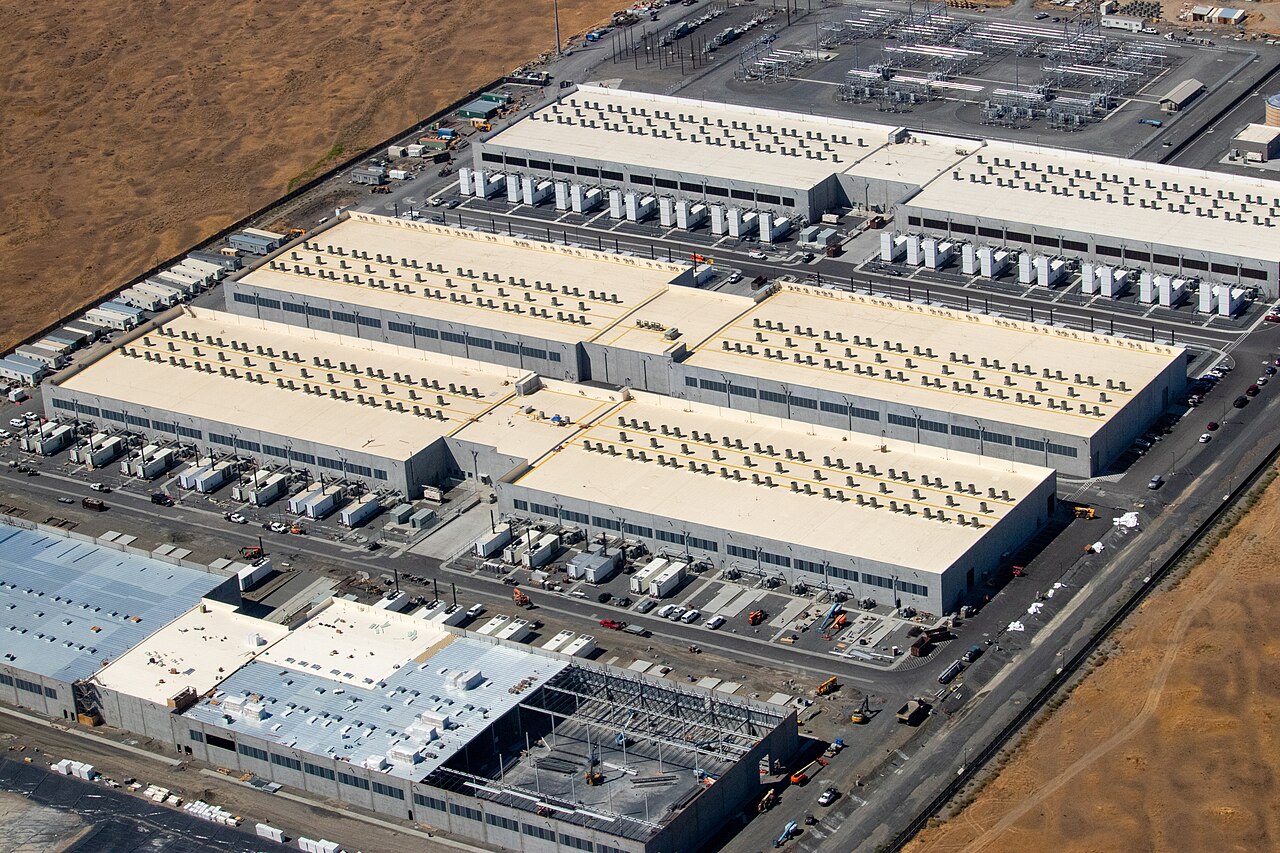
- Hero: aerial photograph of AWS data center buildings by Tedder, CC BY-SA 4.0, via Wikimedia Commons. Illustrative of AWS data center campuses; it does not depict a Built Together site.
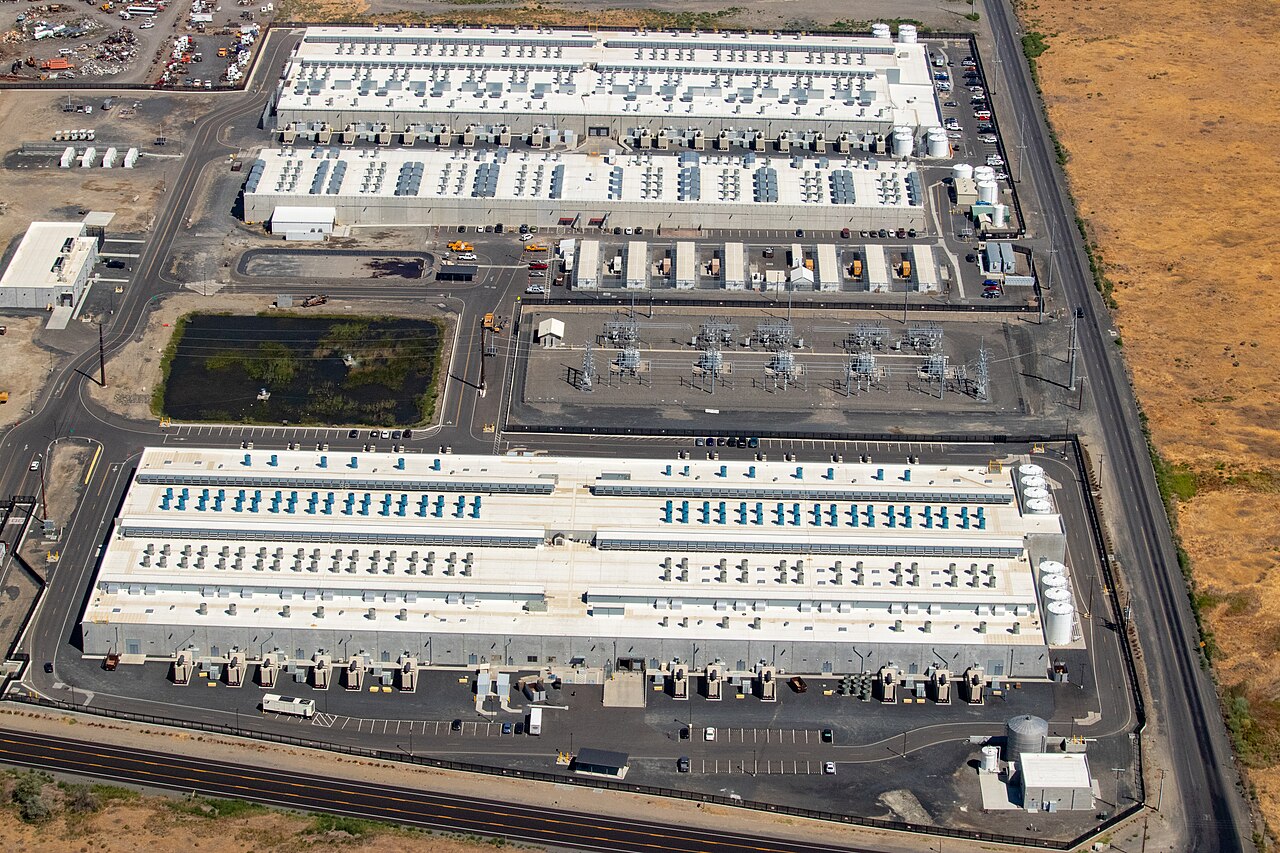
- In-body: aerial photograph of an AWS data center campus by Tedder, CC BY-SA 4.0, via Wikimedia Commons.