Toshiba plans to double its hard disk drive production capacity for AI data centers, investing about 60 billion yen (roughly $380 million) in its Philippine plant, according to TrendForce's summary of a Nikkei report published on October 2, 2026. One detail in the headline numbers deserves care: the 30% target is a share of the market by storage capacity, not by unit volume. This piece checks the reported facts, explains why AI buildouts lean on spinning disks, compares the three remaining HDD makers, and looks at the capacity roadmap that will decide whether the target is reachable.
What Toshiba announced
TrendForce reports that the money goes into the Philippine manufacturing facility and is the company's first significant HDD investment in about five years. The new production lines will build drives with up to 40% more capacity per unit, and Toshiba targets mass production of 65TB-class drives in 2030, followed by 100TB-class models. Investing.com's account places the doubling by the fiscal year ending March 2028 and quotes the share goal as rising "from just over 10% currently to around 30% over the medium term" by capacity.
Automation is part of the plan. Xenospectrum's coverage says inspection and cleanroom work will be automated to improve yields, cutting the additional staff normally needed for such an expansion by about 40%. Investing.com lists Toshiba's supplier base as TDK for heads, Resonac for media and HOYA for glass substrates.
Markets reacted immediately. According to Investing.com, Seagate and Western Digital shares fell about 10.2% each on the report.
Why AI buildouts pull in hard drives
AI infrastructure is often described through GPUs and high bandwidth memory, but the data around the models has to live somewhere. Training corpora, inference logs, model checkpoints and long-term archives are read in bulk or rarely, so they reward cost per terabyte over latency. In Seagate's fiscal third quarter of 2026, data center customers accounted for 88% of its exabytes shipped and 80% of its revenue, and the company said nearline capacity was nearly fully booked through calendar 2027.
Cost is the other half. TrendForce's piece states that solid state drives cost "around 20 times more" than HDDs, and ties HDD demand to the memory supply crunch: when flash and DRAM are scarce and expensive, bulk tiers shift toward disk. We covered the upstream squeeze in the AI memory supercycle and DRAM price surge and in Micron's Q4 FY2026 results. The two markets are linked: a shortage in memory makes the cheapest tier of storage more valuable, and it also competes for the same hyperscaler budgets.
The three-way market
Three companies make nearly all hard drives. The latest complete vendor breakdown we could verify is for the first quarter of 2025, from TrendFocus data reported by Blocks and Files: Western Digital shipped 12.1 million drives and 179.8 exabytes, Seagate 11.4 million and 143.6 exabytes, and Toshiba 5.2 million and 41 exabytes, with reported unit shares of 42%, 40% and 18%.
HDD market share by units, exabytes and revenue, Q1 2025
Percent of the three-vendor total. Unit shares are as reported; exabyte and revenue shares are derived from reported figures.
Source: TrendFocus data via Blocks and Files, first quarter 2025. Exabyte and revenue percentages computed by Metir from the reported vendor figures.
Dividing each vendor's exabytes by the three-vendor total of 364.4 gives derived capacity shares of roughly 49.3% for Western Digital, 39.4% for Seagate and 11.3% for Toshiba. That matches the "just over 10%" figure Toshiba cites, and explains why it quotes share by capacity: its 18% unit share overstates its weight in the data center because its average drive is smaller (about 7.9TB per drive, against about 14.9TB for Western Digital and 12.6TB for Seagate, both derived from the same figures). Capacity is where hyperscalers buy, so that is the share Toshiba needs to move.
As a rough illustration, 30% of that quarter's 364.4 exabytes would be about 109 exabytes, compared with 41 exabytes then, or about 2.7 times as much. That is a derived scale check on a 2025 base, not a forecast, and the total market has kept growing since.
From just over 10% currently to around 30% over the medium term.
Toshiba target by capacity, as quoted by Investing.com
Supply, allocation and prices
The supply side explains why Toshiba is spending now. Seagate had, per Evercore as quoted by Investing.com, allocated the majority of its nearline exabytes into calendar 2028, while Western Digital was negotiating long-term agreements extending to 2031. TrendForce adds that Western Digital has most of its 2027 supply committed, with portions of 2028 and 2029 covered, and notes Western Digital's planned investment of about $1 billion in Japan over five years through 2030.
For a customer that missed those agreements, a third supplier with new lines is the obvious option. For Toshiba, the harder part is that supply is only half of a sale. New drives must be qualified by each hyperscaler, which takes time, and the capacity race is moving quickly.
The capacity roadmap: HAMR versus conventional recording
Heat-assisted magnetic recording (HAMR) is the technology Seagate has built its Mozaic platform on. According to Blocks and Files, Seagate is shipping Mozaic to about 75% of its leading cloud customers, Mozaic 4+ at 4.4TB per platter is qualified with its two largest cloud providers and expected to dominate shipments by the end of 2026, and 5TB-per-platter Mozaic 5+ qualification begins in late 2027. Xenospectrum puts Seagate's HAMR drives at 44TB in volume.
Western Digital is taking a staged path. It said in May 2025 that it would start high-volume HAMR shipments in 2027, with 36TB, 40TB and 44TB variants. At its Innovation Day 2026, it said it was qualifying a 40TB UltraSMR drive for volume production in the second half of 2026, with roadmaps to 60TB on conventional ePMR and 100TB on HAMR.
Toshiba's own stated goal is 65TB-class in 2030 and 100TB-class later. The coverage we reviewed does not specify which recording technology that class will use, and we have not verified claims about microwave-assisted recording (MAMR), so we leave that question open. On the near term, Xenospectrum compares Toshiba's M12 series: 28TB conventional drives need 36 units per petabyte, while 34TB shingled models need 30, about 17% fewer.
What to watch
- Qualification timing: whether hyperscalers certify Toshiba's new drives in time to use the added capacity.
- Share by capacity, not units: TrendFocus quarterly exabyte data will show whether Toshiba's roughly 11% moves.
- HAMR ramps: Seagate's Mozaic 4+ volume and Western Digital's 2027 HAMR start set the density bar.
- Memory prices: easing DRAM and flash supply would change the cost gap that favours disks, though the gap TrendForce cites is large.
Teams that run model-agnostic AI workspaces such as Metir see the same dynamic from the other side: model choice changes quickly, while the data underneath keeps growing and has to be stored somewhere affordable.
Sources:
- TrendForce: Toshiba to Double AI Data Center HDD Capacity by FY2027
- Investing.com: Toshiba plans to double AI data center hard drive production, Evercore comments
- Xenospectrum: Toshiba to Invest 60 Billion Yen to Double AI-Focused HDD Production Capacity
- Blocks and Files: Disk drive capacity shipments out to 2030 forecast to rocket upwards
- Blocks and Files: Spinning disks generating massive revenue for Seagate
- Blocks and Files: Western Digital blows hard disk drive future wide open
- Yahoo Tech: Western Digital still plans to start shipping 36TB HAMR hard drives in 2027
Image credits
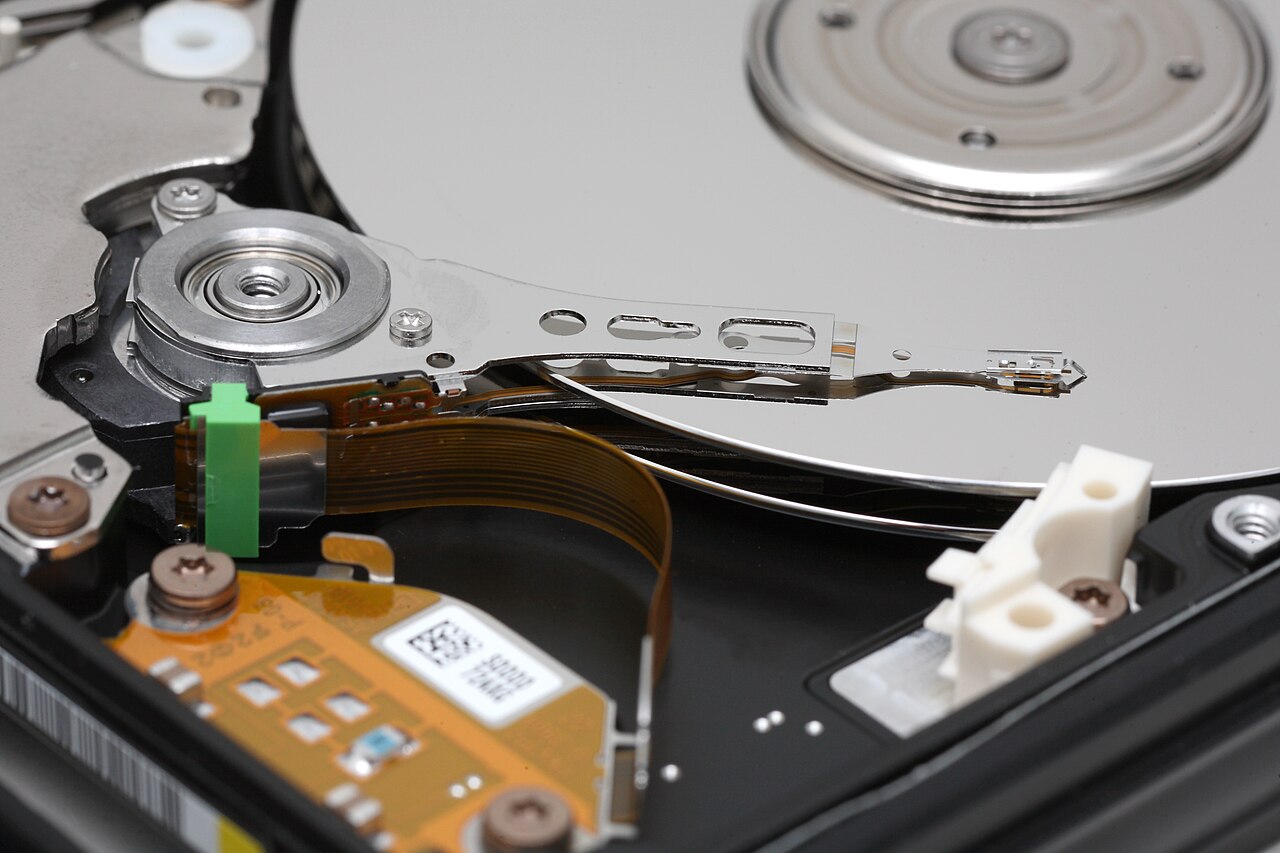
- Hero: close-up of the inside of an opened 3.5 inch hard disk drive showing a platter and read/write head arm. Hard disk platters and head, photo by Mfield, licensed CC BY-SA 3.0, via Wikimedia Commons. A generic drive, not a Toshiba product.
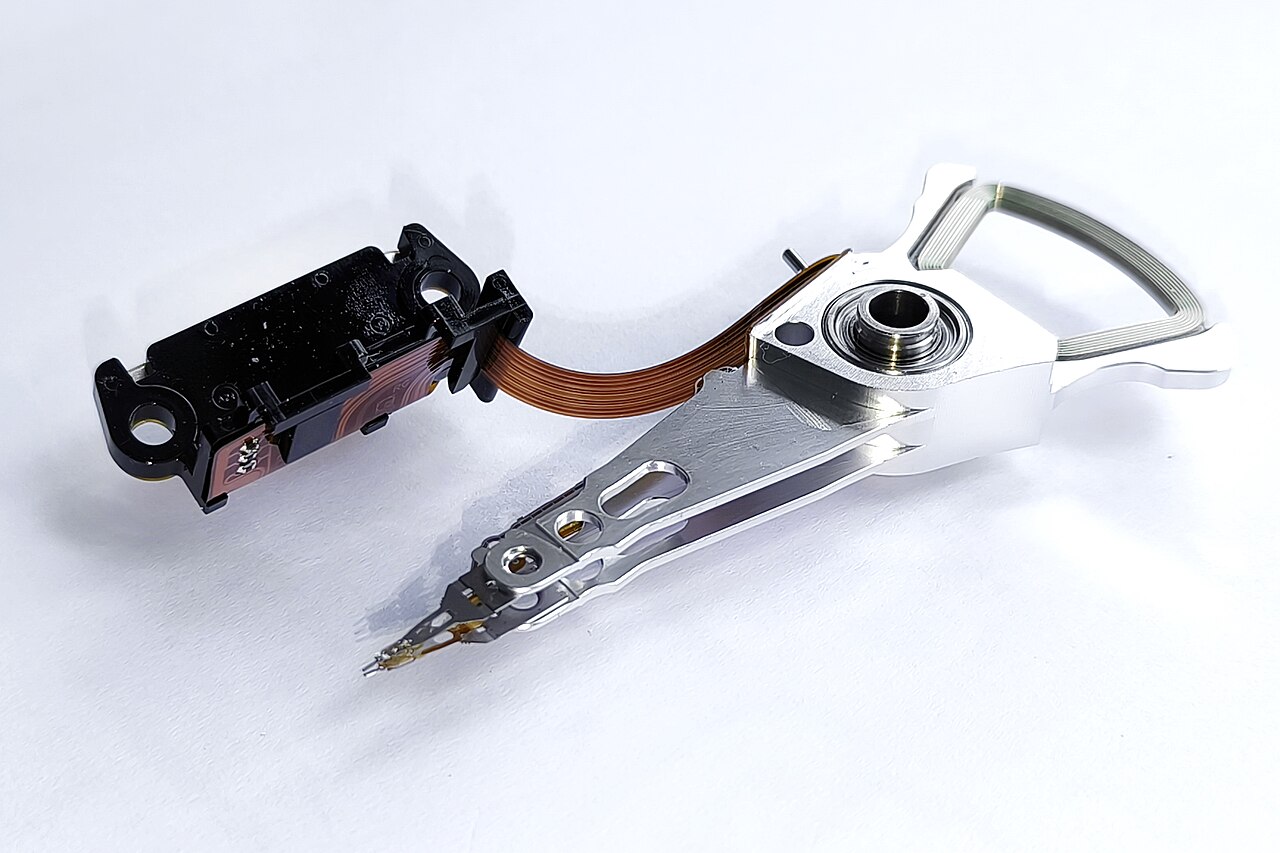
- In-body: removed actuator arm assembly of a hard disk drive. Actuator arm assembly of a hard disk drive, photo by Mk2010, licensed CC BY 4.0, via Wikimedia Commons.