The Schneider Electric PTC acquisition went from a leak to a signed deal in about a day. On October 4, 2026, Seeking Alpha relayed reports from Bloomberg and the Financial Times that Schneider was nearing a deal worth more than $20 billion. On October 5, Schneider's own announcement set the terms: $205 per share in cash, an equity value of about $22.6 billion and an enterprise value of $23.7 billion. The "more than $20 billion" in the first reports turned out to be conservative. This piece separates what is confirmed from what is analysis, then compares the price with earlier industrial software deals.
What Schneider and PTC announced
According to Schneider's release, the $205 price is a 42.3% premium to PTC's last closing price and 46.1% above its 30-day volume-weighted average. One summary of the deal puts that last close at $144.03, which is consistent with the arithmetic ($205 divided by 1.423 is about $144). Both boards approved the deal unanimously, PTC shareholders must still vote, and the expected closing is the third quarter of 2027.
Financing is large relative to Schneider's size. The release describes about 22 billion euros of cash consideration, funded by 5 to 6 billion euros of new shares through an accelerated bookbuild and 16 to 17 billion euros of new debt, backed by a committed bridge facility from Morgan Stanley and Societe Generale. Techzine's summary adds that Schneider plans a 600 million euro buyback in 2026 and a pause in 2027 and 2028.
The portfolio being bought matters as much as the price. Per the same summary, it covers Creo, Windchill, Onshape, Codebeamer, ServiceMax and Arena. It does not include Kepware and ThingWorx, which PTC sold to TPG in March 2026. That is a correction to a common assumption: PTC is no longer the owner of its best-known industrial IoT platform.
PTC's financials, and what the price implies
PTC's fiscal 2025 results showed revenue of $2,739 million, up 19%, and annual recurring revenue (ARR) of $2,478 million, up 10% as reported or 8.5% in constant currency. Free cash flow was $857 million, up 16%. Guidance in that release for fiscal 2026 called for roughly $1 billion of free cash flow and 7% to 9% constant currency ARR growth.
Schneider frames the business on a calendar basis: calendar 2025 revenue of 2.4 billion euros, an adjusted EBITA margin of about 40% and expected growth of about 10% a year through 2029, with more than 30,000 customers.
Three derived figures help calibrate the price (our arithmetic, not company statements):
- About 8.7x enterprise value to fiscal 2025 revenue ($23.7 billion divided by $2.739 billion).
- About 9.6x enterprise value to year-end ARR ($23.7 billion divided by $2.478 billion).
- About 22.6x equity value to the roughly $1 billion fiscal 2026 free cash flow guidance.
Schneider itself cites 21x enterprise value to 2027 adjusted EBITA on a standalone basis, falling to 13x with full run-rate synergies. Those synergies are 250 million euros of annual cost savings by year three and about 800 million euros of revenue synergies. The company expects the deal to be low single-digit accretive to adjusted EPS in year one, and mid to high single-digit accretive with synergies.
There is also a price-context point. Before the leak, PTC's market value was about $15.6 billion, down roughly 34% from its July 2025 peak. The offer therefore reverses a drawdown as much as it adds a premium to a steady price.
The industrial AI logic
Schneider's stated pitch is a "digital thread." CEO Olivier Blum said the combination creates "the industry's most complete Software & AI powerhouse" and a "unique digital thread for the next generation of Industrial AI." Techzine reports the idea is a continuous record from product design through manufacturing to maintenance that gives AI agents context, and that Schneider expects its addressable market in discrete and hybrid manufacturing to triple.
Together, we are creating the industry's most complete Software & AI powerhouse.
Olivier Blum, Schneider Electric CEO
The structural argument, offered here as analysis, is about where data originates. CAD and PLM systems such as Creo and Windchill hold the authoritative description of what a product is: geometry, bills of materials, revision history. Automation and operations software, such as the AVEVA platform Schneider bought out fully for about 9.5 billion pounds, holds what a plant actually did. A digital twin needs both sides, and models that reason over a factory work better when design intent and operating data are linked rather than exported between vendors. The same coverage notes that Schneider's separate 3.1 billion dollar Cognite deal for an industrial data and AI platform is still awaiting regulatory approval, so the pieces are being assembled in parallel.
Schneider also made a customer-facing commitment: the combination "preserves an open-by-design approach across vendors and hardware." The announcement, as one analysis notes, contains no enforceable terms on pricing, data export or roadmaps, so how that openness is implemented is something to watch.
Why data center demand matters to this deal
Schneider's core business is booming on AI infrastructure, which gives it the balance sheet appetite and a strategic reason. In its first half 2026 results, revenue was 21.2 billion euros, up 14% organically. Second quarter revenue of 11.5 billion euros (up 17%) was the highest in company history, data centers and semiconductors both saw triple-digit demand growth, and Schneider raised its 2026 organic growth outlook to 10% to 13% from 7% to 10%. It also developed an 800 VDC power portfolio for AI racks, with systems of up to 1.2 MW per rack.
Software is the smaller and slower part of that picture. In the same quarter, software and services were 18% of revenue and grew 6% organically. By Schneider's projection in the PTC announcement, they would reach 24% of group revenue after the deal. That is a derived reading of the mix: the acquisition would lift the share of recurring, design-linked revenue in a group whose growth currently comes from hardware and infrastructure. For data center customers, a design thread that reaches from a rack's CAD model to its service records is plausible value, though Schneider has not published data center specific plans for PTC.
How the price compares with earlier deals
Industrial and engineering software deals by headline value
Headline value in billions of US dollars as stated by the companies. Bases differ (equity, enterprise or full-company value), so treat it as an order-of-magnitude comparison.
Schneider / PTC shown at $22.6B equity value ($23.7B enterprise value). Emerson / AspenTech shown at the $17.0B fully diluted equity value; Emerson already owned about 57%.
Three recent deals frame the size:
- Synopsys and Ansys. Announced January 16, 2024 and completed July 17, 2025 at $35 billion, after roughly 18 months of approvals, including a divestiture to Keysight and a final clearance from China.
- Emerson and AspenTech. On January 27, 2025, Emerson offered $265 a share, or $7.2 billion, for the shares it did not own, with Emerson already holding about 57%. The company was valued at $17.0 billion fully diluted.
- Siemens and Altair. Announced October 30, 2024 at $113 a share and about $10 billion enterprise value, a 19% premium, with Siemens citing a combined AI-powered design and simulation portfolio.
Two comparisons stand out, with the caveat that bases differ. First, the premium: 42.3% for PTC against 19% for Altair, consistent with PTC's earlier share price drop. Second, timing: Schneider guides to closing by the third quarter of 2027, roughly 9 to 12 months from announcement (our estimate), against about 18 months for Synopsys and Ansys. Schneider and PTC overlap far less than two EDA and simulation companies, which may ease review, but regulators in the US and Europe still have to clear it.
For readers following related consolidation, our earlier coverage of Synopsys and OpenAI on chip design AI and of Europe's AI data center power bottleneck covers adjacent parts of the same industrial AI story.
What to watch
- Shareholder vote and approvals. The deal needs a PTC majority and regulatory clearance, with Q3 2027 as the stated target.
- Funding execution. The 5 to 6 billion euro equity raise and 16 to 17 billion euros of debt determine how much leverage Schneider carries into 2027.
- Openness in practice. Whether Creo, Windchill and Onshape stay interoperable with competing automation and cloud stacks.
- AI products on the thread. Whether Schneider ships agents that reason across design, plant and service data, and how they are priced.
- Integration with AVEVA and Cognite. Three acquired platforms must be unified without disrupting existing customers.
Industrial buyers increasingly want the AI layer to work across vendors, a theme shared by model-agnostic tools like Metir on the knowledge work side.
Sources:
- Seeking Alpha via TradingView: Schneider Electric is said to near deal to buy PTC for more than $20B
- Briefs: Schneider to Buy PTC in Deal Over $20B
- Schneider Electric announcement (via WebDisclosure): Schneider Electric to acquire PTC
- Techzine: Schneider Electric acquires PTC for $22.6 billion
- BERI: Schneider Buys PTC for $22.6B With an Openness Pledge but No Terms
- Martin Cid: Schneider Electric nears $20bn PTC deal
- Yahoo Finance: PTC stock soars over 15% overnight
- PTC: Fourth fiscal quarter and full fiscal year 2025 results
- Investing.com: Schneider Electric H1 2026 slides
- Siemens: Acquisition of Altair Engineering
- Manufacturing Dive: Synopsys completes $35B Ansys deal
- AspenTech: Emerson to acquire remaining shares
Image credits
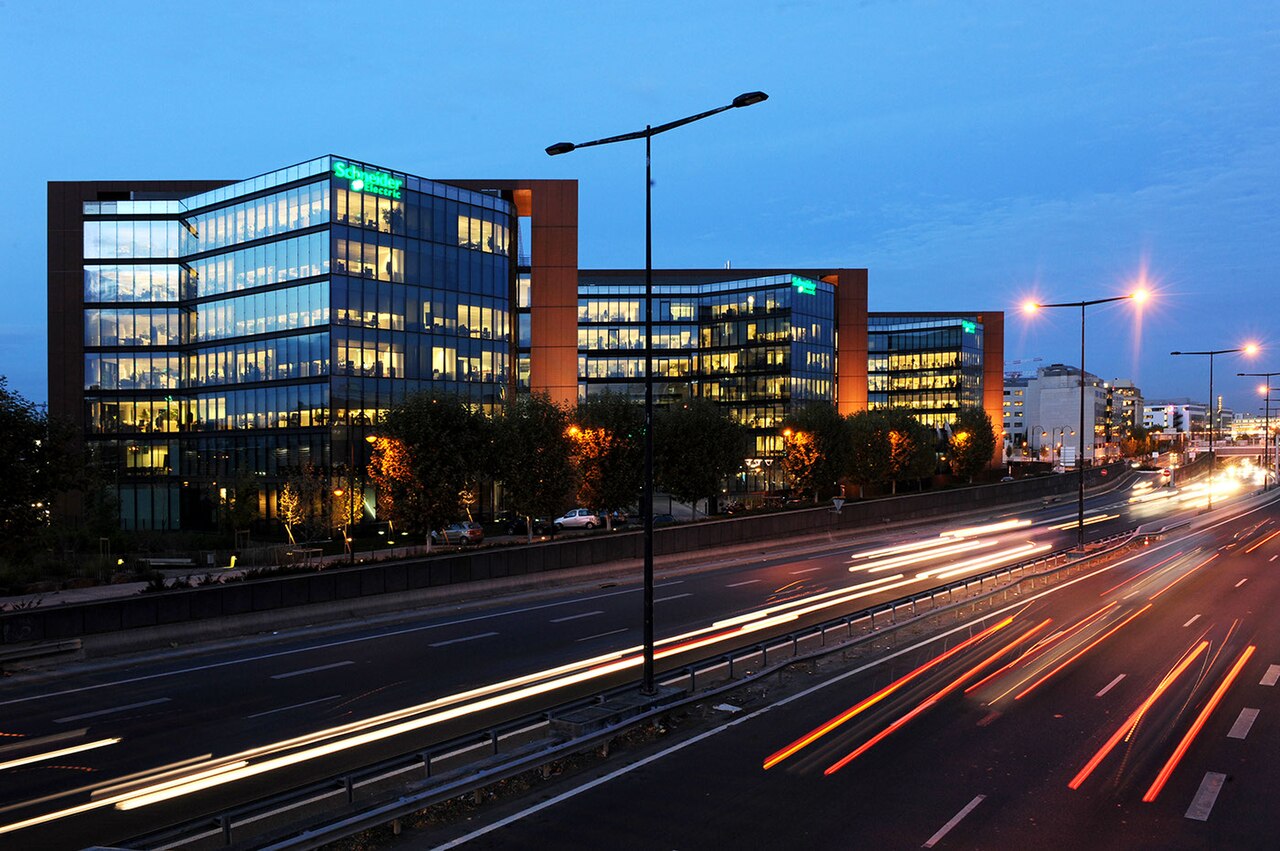
- Hero: "Schneider Elec HQ.jpg" by Wilmotte & associes architectes, licensed CC BY-SA 4.0, via Wikimedia Commons. It shows a Schneider Electric headquarters building at night and does not depict PTC or the deal.
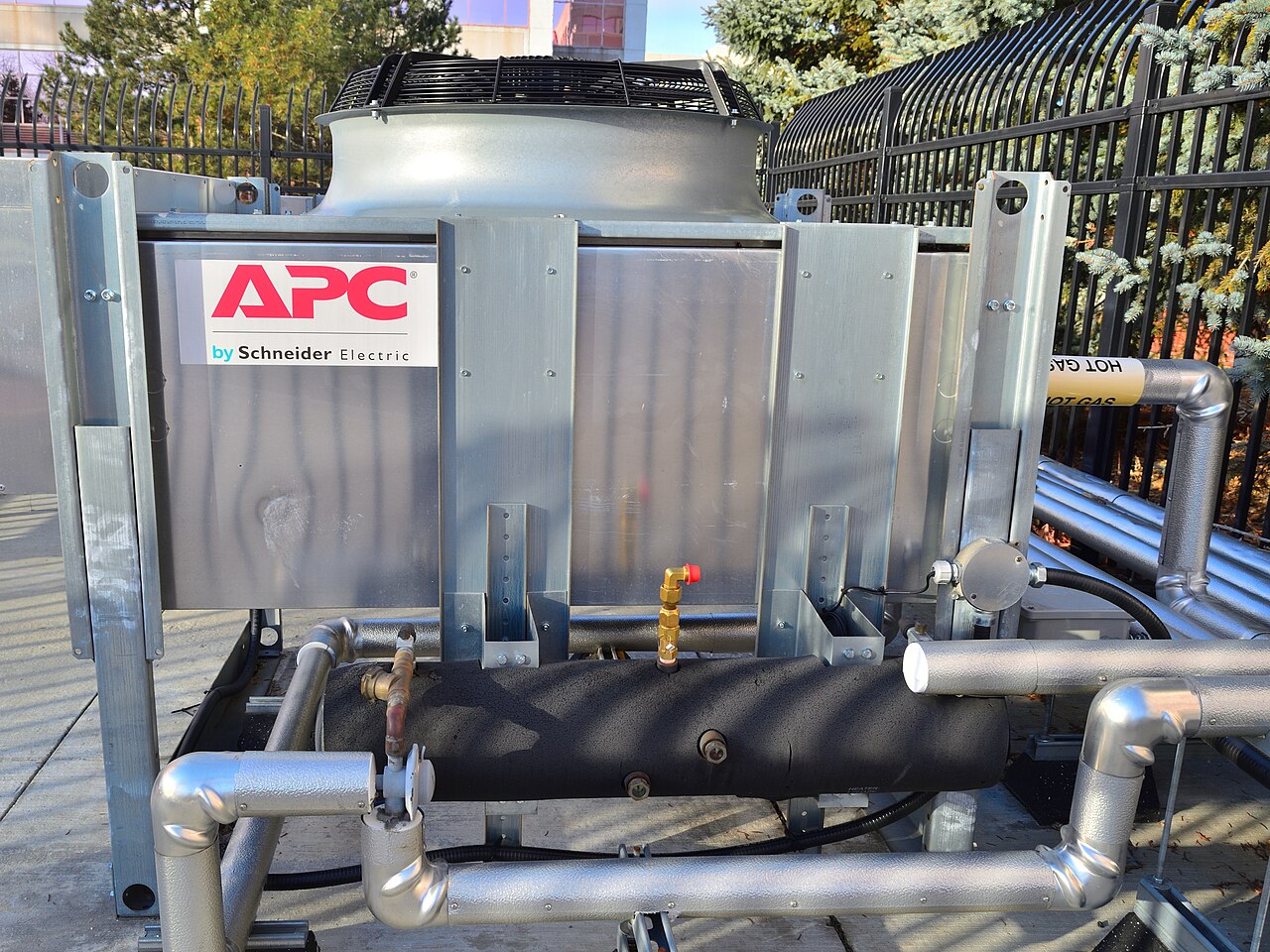
- In-body: "APCDatacenterCooling.jpg" by Raysonho @ Open Grid Scheduler / Scalable Grid Engine, released under CC0, via Wikimedia Commons.