
Global venture funding reached $159 billion in the third quarter of 2026, according to Crunchbase data published on October 5, with close to 6,000 startups funded. That is the smallest quarterly total of 2026, down 25% from the $212 billion raised in Q2, yet it is up 53% from the $104 billion raised in Q3 2025. Two other numbers frame the quarter: AI startups took $102 billion, or 64% of all venture capital, and a record 27 companies raised rounds of $1 billion or more.
This piece walks through what the Q3 2026 venture funding data shows, how it compares with the first half of the year, and what the mix of mega-rounds, stage data and exits suggests about where the market is heading.
The Headline Numbers in Context
The quarter-over-quarter decline needs context. The first half of 2026 was dominated by a handful of frontier lab financings. Crunchbase's Q1 report counted OpenAI ($122 billion), Anthropic ($30 billion), xAI ($20 billion) and Waymo ($16 billion) together raising $188 billion, or 65% of all global venture investment that quarter. In Q2, Crunchbase reported that Anthropic raised around $65 billion on its own, as we covered in our H1 2026 funding analysis.
Q3 had no single round of that scale. The largest were $5 billion each. Against that backdrop, a 25% decline is less a sign of investors pulling back than a sign that the outsized lab rounds did not repeat. The year-over-year comparison, up 53%, and the record 27 billion-dollar rounds both point to a market that is still deploying capital at a very high rate, just spread across more companies.
Global venture funding by quarter
Billions of US dollars, Crunchbase data as of Oct. 2, 2026. Q1 2026 is implied from the year-to-date total. Q4 2025 is not shown.
Source: Crunchbase News Q3 2026 global funding report. Hover a bar for AI share and billion-dollar round counts.
One methodological note matters for anyone tracking these numbers. Crunchbase data is based on reported rounds and is revised as new deals surface. Its April report put Q1 2026 at $300 billion, and the $679 billion year-to-date figure in the October report implies roughly $308 billion for Q1 once Q2 ($212 billion) and Q3 ($159 billion) are subtracted. Q2 itself was first reported at $205 billion in July and now stands at $212 billion. Early quarterly totals tend to drift upward, so the $159 billion Q3 figure may also rise.
Mega-Rounds: More Companies, Smaller Checks
The most distinctive feature of Q3 2026 is breadth at the top. Crunchbase counted 27 companies raising rounds of $1 billion or more, up from the previous record of 16 in Q2 and 14 in Q1. Those 27 companies took around a third of all global venture capital in the quarter.
That compares with Q2, when 16 billion-dollar rounds totalled $108.6 billion, or 53% of the quarter's funding, according to Crunchbase's July report. Put simply, the count of mega-rounds rose sharply while their combined share of the pie fell. That is a meaningful shift in concentration: capital is still flowing in very large blocks, but to more recipients.
Eight companies raised $3 billion or more. Databricks and Safe Superintelligence (SSI) each raised $5 billion, according to Crunchbase. Close behind, Crusoe, Moonshot AI, Mistral AI, Nscale, The Boring Company and Kling AI each raised more than $3 billion. Readers following individual deals can find more detail in our posts on Databricks' valuation and Crusoe and the neocloud buildout.
 Mistral AI
 Moonshot AI
 NVIDIA
 AMD
AMDThe composition of that list is worth reading closely. It includes model developers (SSI, Moonshot AI, Mistral AI, Kling AI's video generation), a data and AI platform (Databricks), and compute infrastructure (Crusoe, Nscale). Crunchbase reports that five of the eight $3 billion-plus raisers were founded within the past four years, and that half of all startup capital invested in Q3 went to companies founded since 2022. That age profile is unusual for late-stage capital, which historically flowed to companies with a decade or more of operating history.
The count of billion-dollar rounds rose from 16 to 27 while their share of total funding fell from 53% to about a third. Capital is still arriving in large blocks, just to more recipients.
Reading the Crunchbase Q3 2026 data
AI at 64%: Lower Share, Broader Base
AI's 64% share is down from the two previous quarters, Crunchbase notes. Its Q1 report put AI at 80% of global funding and the July report put Q2 above 70%. Yet 64% is still 14 percentage points above Q3 2025, implying an AI share of roughly half a year earlier.
Two readings of the decline are compatible with the data. The first is mechanical: when one or two labs raise tens of billions in a quarter, AI's share spikes, and in a quarter without such rounds it settles back. The second is diversification. Crunchbase highlights that physical AI categories, namely aerospace, robotics, data centers, semiconductors and energy, each raised $10 billion or more in Q3. Some of those dollars are counted as AI and some are not, depending on how a company is classified, which means sector shares are sensitive to taxonomy as well as to capital flows.
For the non-AI part of the market, simple arithmetic from the reported figures gives about $57 billion in Q3 ($159 billion minus $102 billion). That is a derived figure, not one Crunchbase states, and it implies AI absorbed nearly two dollars for every one that went elsewhere.
Stage Breakdown: Where the Money Landed
Crunchbase's stage data shows late-stage funding at $105 billion, down 23% quarter over quarter but up 73% year over year. Early-stage funding was $40.6 billion, up 25% year over year, and half of that came in rounds of $100 million or more. Seed funding totalled $13 billion, of which $2.6 billion went to seed rounds of $100 million or more.
The stage figures reinforce the concentration theme from a different angle. Late-stage money makes up about two thirds of the total (derived: $105 billion of $159 billion). At the early and seed stages, the presence of nine-figure rounds blurs the traditional definitions: a $100 million seed round is a bet on a founding team's ability to train or build something capital-intensive from day one, a pattern associated with AI research labs and hardware companies rather than software startups of earlier cycles.
Geographically, US companies raised $91 billion, about 57% of the global total, and the San Francisco Bay Area alone accounted for 24%. That US share is notably lower than in Q1, when Crunchbase reported US companies took 83% of global venture capital. Several of the largest Q3 raisers are based outside the US, including Mistral AI in France and Moonshot AI and Kling AI in China, which may help explain the shift.
Exits: Large IPOs and Strategic AI Acquisitions
The exit side of the ledger is where venture returns are realised, and Q3 produced several large transactions. According to Crunchbase:
- ChangXin Memory Technologies, the Chinese memory chipmaker, was the largest IPO of the quarter, raising $8.6 billion at an $85.5 billion value.
- Shein, the Singapore-based fast fashion company, listed at a $26.3 billion valuation.
- Bending Spoons, based in Milan, raised $1.6 billion on its debut at an $18.4 billion value.
- Enflame, a Shanghai-based AI chipmaker, raised $912 million at a $25.5 billion valuation.
- Unitree Robotics, the Hangzhou humanoid robotics company, raised $905 million, debuting at a $9 billion valuation.
On the M&A side, Crunchbase lists three large AI deals: Nvidia's bid to acquire Hugging Face for $12.9 billion, AMD's announced intent to acquire World Labs for $8.2 billion, and Stripe's acquisition of OpenRouter for $7.5 billion. The first two are described as a bid and an announced intent, so they may still be subject to closing conditions or regulatory review.
These deals share a pattern: hardware and infrastructure companies buying software layers that sit close to how developers use AI models. Hugging Face hosts open models and datasets, World Labs builds spatial world models, and OpenRouter routes requests across many model providers through one API. That last category, model-agnostic access, is also the approach multi-model assistants such as Metir take for end users, and Stripe's purchase suggests that the routing layer has become strategically valuable in its own right.
Two points about the exit list stand out. First, four of the five IPOs Crunchbase highlights were by companies based in China or Singapore, and the fifth is Italian, which reflects an exit market that extends well beyond US exchanges. Second, the presence of chip and robotics companies (ChangXin, Enflame, Unitree) among the top IPOs mirrors the physical AI strength visible in the funding data.
Concentration Risk: What It Means for the Market
Concentration in venture capital is not new, but its degree in 2026 is. Several second-order effects follow from the data:
- Outcomes hinge on a small number of companies. When around a third of a quarter's capital goes to 27 companies, and half goes to companies founded since 2022, the performance of venture funds raised in this period will depend heavily on how a relatively young cohort executes. Young companies have short operating histories against which to judge valuations.
- Compute is a large share of what the money buys. Rounds for Crusoe and Nscale, and the capital needs of model developers, mean a significant share of venture dollars flows through to data centers, chips and energy. That ties venture returns more closely to infrastructure costs and utilisation than in software-led cycles.
- Exit capacity has to keep pace. Strong Q2 exits, which Crunchbase put at a record $113 billion across 32 billion-dollar IPOs and 24 billion-dollar acquisitions, and the large Q3 listings suggest the exit window is open. Whether it can absorb the much larger volume of capital raised at high valuations in 2026 is the open question.
- Data revisions can change the story. Because totals are revised upward as rounds are disclosed, quarter-over-quarter declines in early reports can narrow later. Comparisons are most reliable once a quarter has had time to settle.
What to Watch in Q4 2026
- Whether a frontier lab round returns. A single raise on the scale of Q1 or Q2 would push Q4 totals and AI's share sharply higher.
- The count of billion-dollar rounds. Holding near Q3's 27 would confirm the broadening trend. A drop back toward the mid-teens would suggest Q3 was an outlier.
- Closing of the announced AI acquisitions. The Nvidia bid for Hugging Face and AMD's planned purchase of World Labs are the deals to track for regulatory and closing updates.
- The US share. Q3's 57% is far below Q1's 83%; whether non-US capital formation in AI holds at this level will shape the global picture.
FAQ
How much venture funding was raised in Q3 2026? Crunchbase reports $159 billion globally in Q3 2026, with close to 6,000 startups funded, as of data through October 2, 2026.
What share of Q3 2026 venture funding went to AI? AI startups raised $102 billion, or 64% of global venture capital, down from the previous two quarters but 14 percentage points higher than in Q3 2025.
How many billion-dollar rounds were there in Q3 2026? A record 27 companies raised rounds of $1 billion or more, up from 16 in Q2 and 14 in Q1. Databricks and Safe Superintelligence led with $5 billion each.
How much venture funding has been raised in 2026 so far? Crunchbase puts global venture funding at $679 billion for Q1 through Q3 2026, the highest total on record for the first three quarters of a year.
What were the largest startup exits in Q3 2026? The largest IPO was ChangXin Memory Technologies, raising $8.6 billion at an $85.5 billion value. The largest M&A deal listed was Nvidia's $12.9 billion bid for Hugging Face.
Sources:
- Q3 2026 Global Startup Funding: AI, Billion-Dollar Rounds and Exits | Crunchbase News
- Q1 2026 Shatters Venture Funding Records As AI Boom Pushes Startup Investment To $300B | Crunchbase News
- Crunchbase Data: Global Startup Investment Hit Record $510B In H1 2026 As AI Boom Accelerates Funding And Exits | Crunchbase News
Image credits
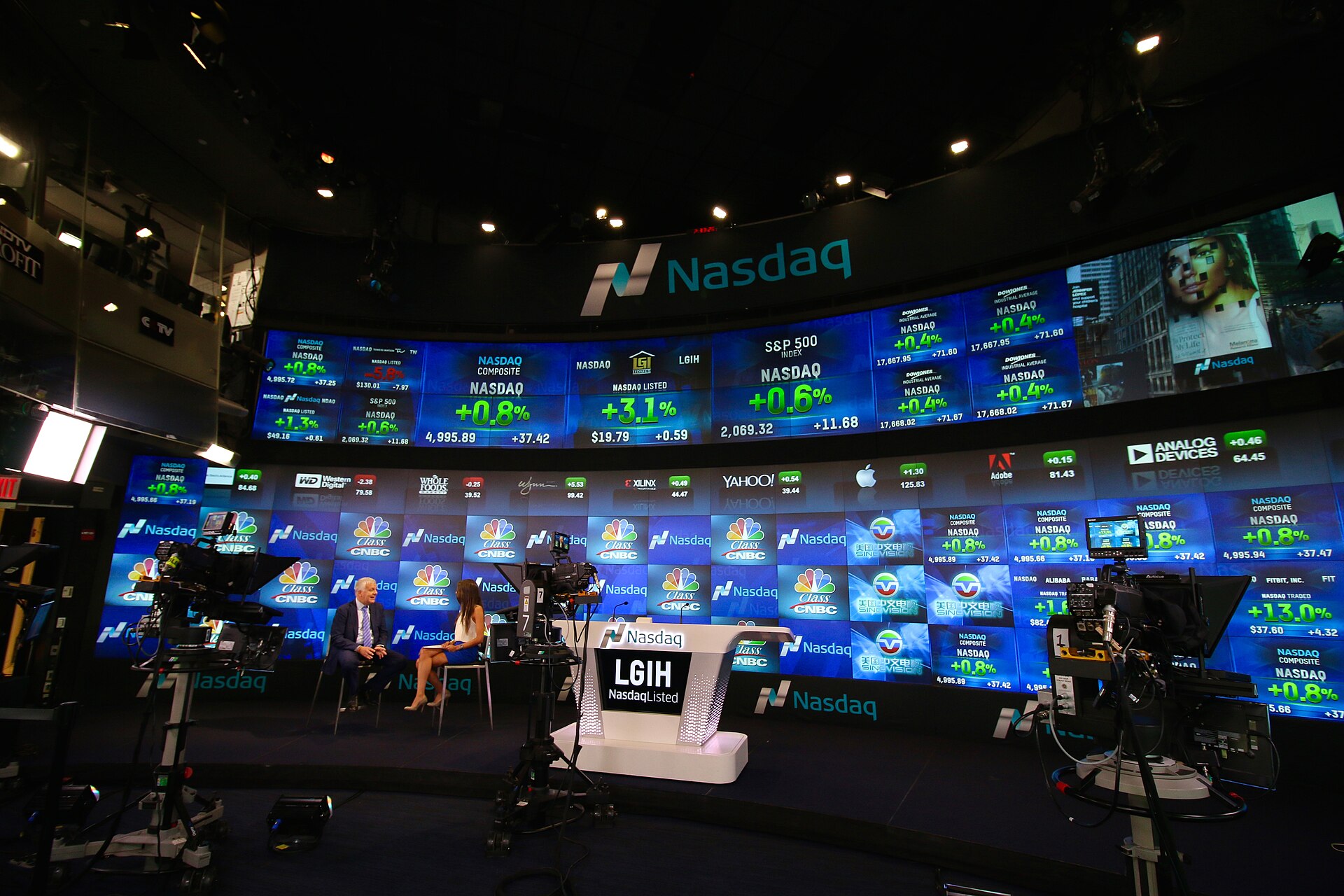
Header image: the Broad Street facade of the New York Stock Exchange, photographed on October 2, 2023 by Jakubhal, via Wikimedia Commons, licensed under CC BY 4.0. In-body photograph of the Nasdaq MarketSite studio in Times Square by Luca Marfè, via Wikimedia Commons, licensed under CC BY 2.0.