
On October 1, 2026, the Nebius GPU price hike took effect: the neocloud raised on-demand rates for Nvidia H100, H200, B200 and B300 instances by roughly 17% to 21%. Nebius's own pricing page now lists the new rates with that effective date and notes that prices exclude taxes and may change at any time (Nebius pricing). It is the second increase in a few months, and it runs against the story most people remember from 2024 and 2025, when GPU rental prices mostly fell.
 NVIDIA
 AMD
AMDWhat changed in the Nebius GPU price hike
Nebius's pricing page lists these on-demand rates per GPU-hour, before and from October 1: H100 $3.85 to $4.50, H200 $4.50 to $5.40, B200 $7.15 to $8.50, and B300 $7.85 to $9.50 (Nebius pricing). Our arithmetic on those figures gives 16.9%, 20.0%, 18.9% and 21.0%, matching press coverage.
Nebius on-demand price per GPU-hour, before and after October 1, 2026
List prices from Nebius's pricing page, in USD per GPU-hour, excluding taxes.
The increase is not limited to GPUs. Stocktwits, citing a notice to customers, reports that AMD EPYC Genoa vCPU pricing rose from $0.012 to $0.015 per vCPU-hour (25%) and Genoa memory from $0.0032 to $0.0045 per GiB-hour (about 41%) (Stocktwits). Silicon UK adds that customers who reserve large clusters for several months can still receive discounts, and that the cumulative B300 increase across the two hikes is 56% (Silicon UK).
The earlier move came in May 2026. Yahoo Finance reported that Nebius would lift on-demand H100 rates from $2.95 to $3.85 per hour, about 29%, and that preemptible capacity rose 51% (Yahoo Finance). Put together, an H100 hour that cost $2.95 in spring costs $4.50 today, a rise of about 53% by our arithmetic.
A note on confirmation
Early coverage disagreed about sourcing. Stocktwits said the details came from Nebius's communication to customers, reshared on Reddit and X, with no official public statement in its report. Silicon UK treated the rates as a Nebius announcement. The question is now largely settled by the company's own pricing page, which shows the October 1 rates. The two reports also differ slightly on timing: Stocktwits was published late on September 16, while Silicon UK dated its report September 18 and said Nebius announced the change "on Thursday."
Why GPU rental prices are rising when they fell before
Through 2024 and much of 2025, new capacity came online faster than demand for it, and older GPUs such as the H100 were widely expected to keep getting cheaper. Several things pulled the other way in 2026, and the sources available point to a mix rather than a single cause:
- Demand outrunning supply. Nvidia CFO Colette Kress said on an earnings call that rental prices for older Hopper GPUs had risen about 20% year to date, and that rental demand still exceeded supply (Yahoo Finance). Silicon UK quotes Nebius calling the move "an indication of sustained demand for training and deploying AI models," and notes CoreWeave said the same day it was signing new contracts at higher prices (Silicon UK).
- Memory costs. The 41% memory increase fits the wider shortage in DRAM and HBM, which we covered in our memory supercycle analysis. Nebius has not, in the sources we reviewed, said how much of the increase is cost pass-through versus pricing power.
A rate card changes slowly. When a provider moves it twice in a few months, it usually means the old price was clearing the market too easily.
Our reading, not a sourced quote
Investors read the move as pricing power. According to Stocktwits, Futurum Group CEO Daniel Newman wrote on X that "AI demand remains off the charts," and Morningstar analysts reportedly said higher GPU spot prices would significantly improve profitability in late 2026 and 2027. Nebius also reported Q2 revenue up 454% to $582.3 million and reaffirmed 2026 revenue guidance of $3 billion to $3.4 billion (Stocktwits). For the company's own build-out, see our look at its Vera Rubin and earnings update.
What it means for AI startup budgets
List prices are an input to a budget, not the budget itself, but the arithmetic is worth doing. Take 1,000 H100-hours:
| Scenario | Price per GPU-hour | Cost of 1,000 H100-hours |
|---|---|---|
| Spring 2026 (before May hike) | $2.95 | $2,950 |
| Summer 2026 (before October) | $3.85 | $3,850 |
| From October 1, 2026 | $4.50 | $4,500 |
The October step alone adds $650 per 1,000 hours. Counting both hikes, the same hours cost $1,550 more than in spring. For a Blackwell workload, 1,000 B300-hours moves from $7,850 to $9,500, an extra $1,650.
The impact differs by workload:
- Training runs that rent a large cluster for weeks or months can usually negotiate reserved or committed pricing below on-demand list rates, though that requires a commitment and a sales process.
- Bursty inference and experimentation typically sits on on-demand rates, so it takes the full increase and has the least room to plan around it.
- Spot or preemptible capacity is cheaper but, per the May report, has also been repriced upward.
How other providers compare
Like-for-like comparisons are harder than they look. Providers sell different products (single GPUs, full 8-GPU nodes, fixed-window reservations, marketplaces), bundle networking and storage differently, and publish rates that change often, so a list price on its own says little about the total cost of a workload. Teams comparing providers generally get a clearer answer by pricing their own workload, including interconnect, storage and contract terms, than by comparing headline hourly rates.
The tension with falling per-token prices
Rising GPU rents sit awkwardly beside the headline trend in model APIs, where some vendors keep cutting per-token prices. We examined that split in our inference price war analysis: per-token price is a strategic lever on top of capacity, and when capacity is scarce some providers raise prices instead of cutting. Rented hardware is the cost floor for anyone serving open-weight models themselves, so higher GPU-hour prices narrow the margin of self-hosting relative to buying tokens, at least where API prices keep falling. Whether API prices can keep falling if the underlying hardware keeps getting dearer is an open question.
One practical response is to avoid tying a product to a single model or a single compute vendor. Teams using a multi-model tool such as Metir can shift workloads between providers as relative prices move, though the saving depends on the workload.
What to watch
- Whether other neoclouds follow with their own list-price rises, or hold rates to win customers.
- Whether Nebius's new Blackwell capacity relieves the pressure, since the company has raised capex guidance more than once this year.
- Whether memory prices ease, which would remove one stated cost driver.
- Whether committed-use discounts widen as providers try to lock in demand.
The central lesson is narrow but useful: in 2026, GPU-hour prices are a moving input, and budgets built on 2025 rates may need revisiting.
Sources:
- Nebius pricing page
- Silicon UK: Nebius prices AI
- Stocktwits: NBIS stock rallies as neocloud operator hikes prices
- Yahoo Finance: Nvidia says H100 GPU prices
Image credits
- Hero: Arkady Volozh, CEO of Nebius. Photo by Mark David, Wikimedia Commons, CC BY-SA 4.0. A portrait of the CEO, not an image of the price change.
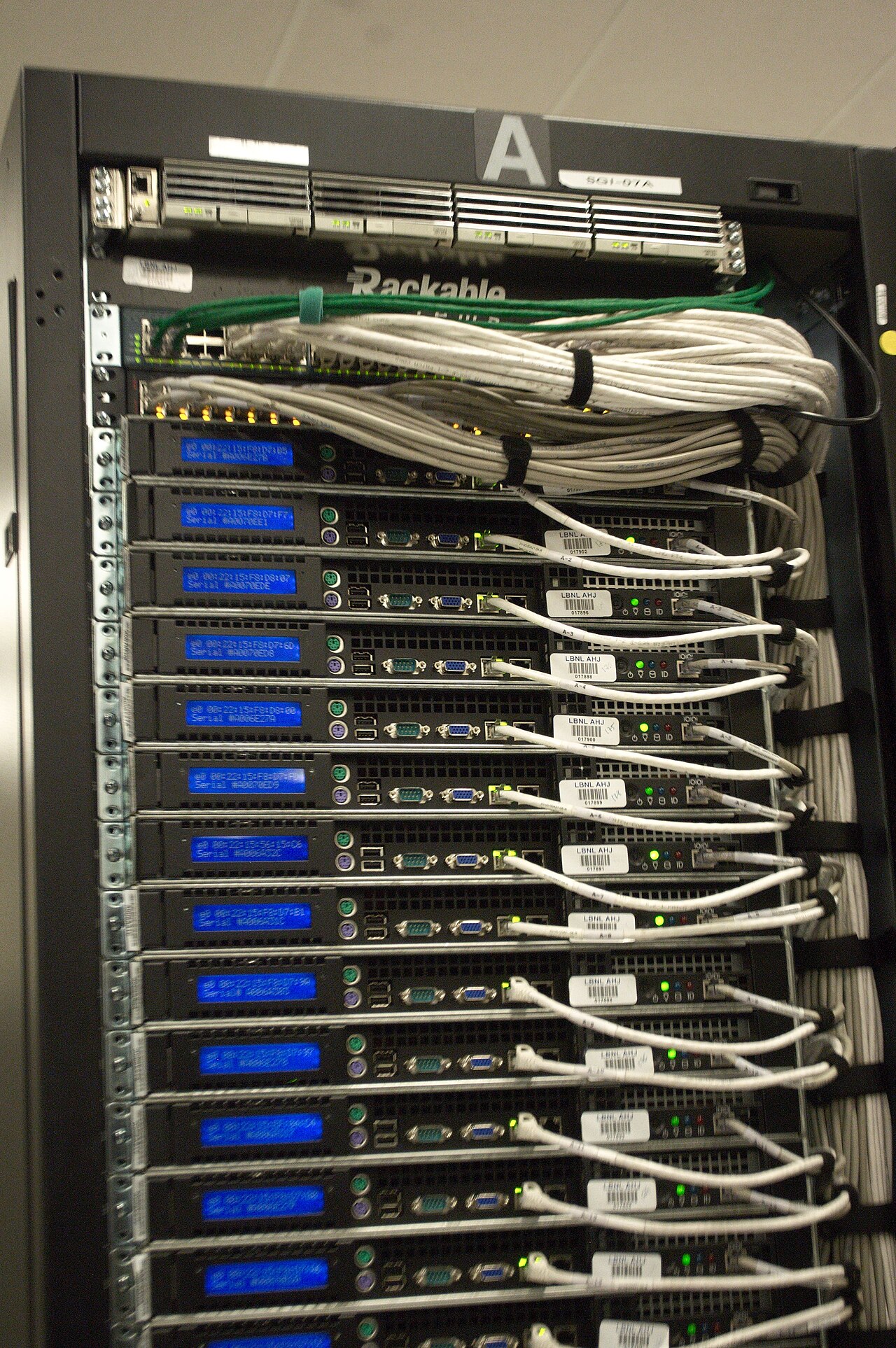
- Figure: Rear of rack at NERSC data center. Photo by Derrick Coetzee, Wikimedia Commons, CC0.