Modal Labs announced on October 14, 2026 that it raised $750 million in a Series D led by Accel, with Kleiner Perkins and about six existing investors also participating, at a valuation of $15.75 billion. The company says annualized revenue has more than tripled since May to over $1 billion. Last month's reports described the round as being in talks; this announcement confirms it and adds the revenue figure and a product breakdown that were missing then. This article looks at what the numbers imply, what Modal actually sells, and what remains uncertain.
What was announced
According to SiliconANGLE's report on the announcement, Modal will put part of the new capital into product development, with planned launches including services for reinforcement learning and post-training. The company runs its services on hardware rented from more than 20 cloud providers, and workloads can keep running on the others if one cloud has technical problems. Modal reports that nearly a third of revenue now comes from Sandboxes, a service that provides hosted containers for AI workloads. We covered the earlier reports of the round, alongside Baseten, in Modal at $15B, Baseten at $26B.
The multiple barely moved
The most useful analytical step is to compare valuation with revenue at both points. Modal told Reuters in May that its annual recurring revenue had exceeded $300 million, and the prior round was reported at a $4.65 billion valuation. Now the company reports revenue above $1 billion at $15.75 billion.
Modal: valuation and revenue, before and after
Valuation in billions of dollars. The earlier round is the reported figure from about four months before.
Earlier valuation of $4.65B is as reported by press; the $15.75B post-money valuation was announced October 14, 2026. Sources: SiliconANGLE, TechCrunch, Reuters via press reports.
Dividing valuation by run-rate revenue gives roughly 15.5 times in May (4.65 over 0.3) and no more than 15.75 times now (15.75 over 1.0, which is an upper bound because revenue is stated as "over $1 billion"). Both are approximations using rounded figures, and the May revenue number is a floor, not an exact value. Even so, the comparison suggests the tripling of Modal's valuation tracked the tripling of its reported revenue rather than a rise in the price investors pay per dollar of revenue. That reading changes the headline: the step-up is less a repricing of the category than a company growing into a valuation at a roughly constant multiple. Annualized revenue is also a run-rate, not recognized revenue for a completed year, and can be sensitive to a few large customers or to usage spikes.
The valuation tripled, but so did the revenue it is measured against. The multiple is the part that stayed put.
Reading the Series D against May's figures
Why Sandboxes matters
Sandboxes are isolated hosted containers that an AI system can start on demand, typically so an agent can run code, browse or manipulate files without touching the user's own machine. Modal says they can provision tens of thousands of containers per second and that an internal test ran 1 million concurrent containers. It also describes Secret Injection, which lets agents use login credentials without seeing them, and sidecar containers that run on the same physical server as the containers they support to cut latency.
If nearly a third of revenue is Sandboxes, then roughly $300 million of annualized revenue by simple arithmetic comes from a product line beyond plain model serving. That is consistent with a broader pattern: as AI products shift from single model calls to agents that execute many steps, the demand is for places for those steps to run safely, not only for model serving. The security features Modal highlights reflect the same shift, since an agent with credentials is a different risk profile from a chatbot. Our coverage of agent memory poisoning and prompt injection describes why isolation and credential handling are now first-order concerns.
A multi-cloud model without owning the chips
Modal rents capacity from more than 20 providers instead of owning data centers. The trade-offs are visible in the announcement. The upside is resilience and flexibility: workloads can move when one provider has problems, and Modal can chase available GPU supply wherever it appears. The exposure is that the company's margins depend on rental prices it does not control. Elsewhere in the market, cloud providers have raised GPU prices, as we noted in our look at Nebius's H100 and B300 price changes, which shows how input costs for a rented-capacity model can move. The announcement did not disclose gross margin, so the profitability of the $1 billion run rate cannot be assessed from public information.
How it compares
Public figures let us place Modal beside the other inference platforms covered in our earlier piece, with caveats about timing and status:
- Modal: $15.75 billion valuation announced October 14, with reported run-rate revenue above $1 billion.
- Baseten: reported by Bloomberg in September to be discussing a round near $26 billion, roughly double its value in June; a closed round and revenue were not part of that report.
- Different business models: Modal's growth is partly from Sandboxes and training clusters, while serving-only platforms are more directly tied to inference volume.
Because Baseten's round was still in talks at last report and no revenue figure was disclosed, a revenue-multiple comparison between the two is not possible from public data.
What remains unknown
- Customer concentration. The announcement names no customers, so dependence on a few large accounts is unknown.
- Retention and margins. Neither gross margin nor net revenue retention was disclosed.
- Durability of Sandboxes. A third of revenue from one product raises the question of how much of it comes from a few agent-heavy customers, and how quickly hyperscalers and competitors offer equivalents.
- Run-rate versus revenue. A run-rate extrapolates a recent period, so growth that tripled in five months may not repeat.
For builders, the useful takeaway is that the infrastructure layer is differentiating into serving, training and agent execution. Model-agnostic products, such as Metir AI, benefit when that layer is competitive, since the same application can run on whichever provider is fastest or cheapest.
The takeaway
Modal's $750 million Series D confirms the reported $15.75 billion valuation and adds a revenue figure that makes the round easier to interpret: valuation and run-rate revenue both roughly tripled since May, leaving the implied multiple near 15 to 16 times. The distinctive detail is Sandboxes at nearly a third of revenue, which ties the company's growth to agents that run code, not just models that answer questions. Margins, customer concentration and retention are the open variables that will determine whether the multiple holds.
Sources:
- AI cloud startup Modal raises $750M at $15.75B valuation | SiliconANGLE
- Modal Labs to get $750 million led by Accel, post-round $15.75B | NewsBytes
- Source: inference provider Modal Labs closing in on $750M round at $15.75B valuation | AI Chief
- Modal Labs Reportedly in Talks to Raise $750M at $15.75B Valuation | citybiz
- Startups Modal, Baseten in Funding Talks to Help Businesses Run AI | Bloomberg
Image credits
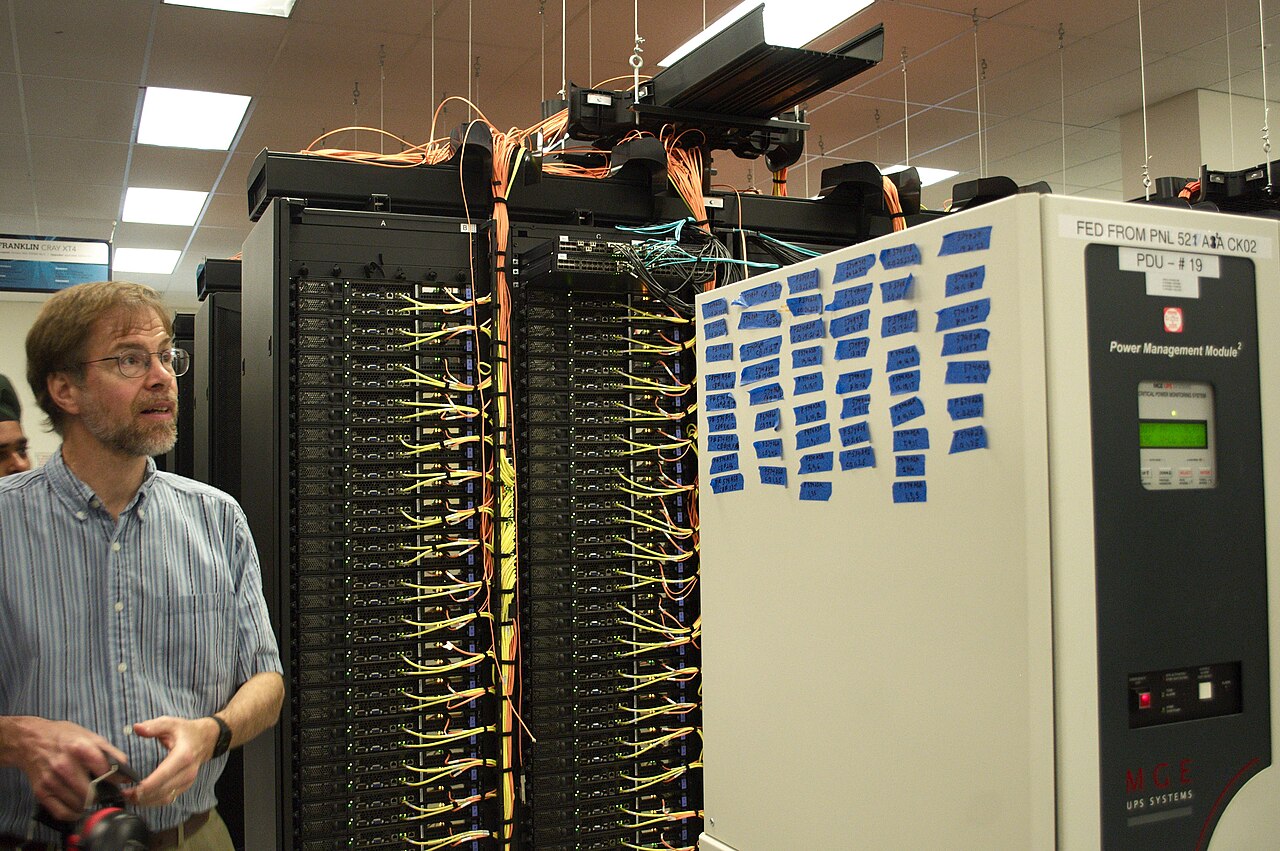
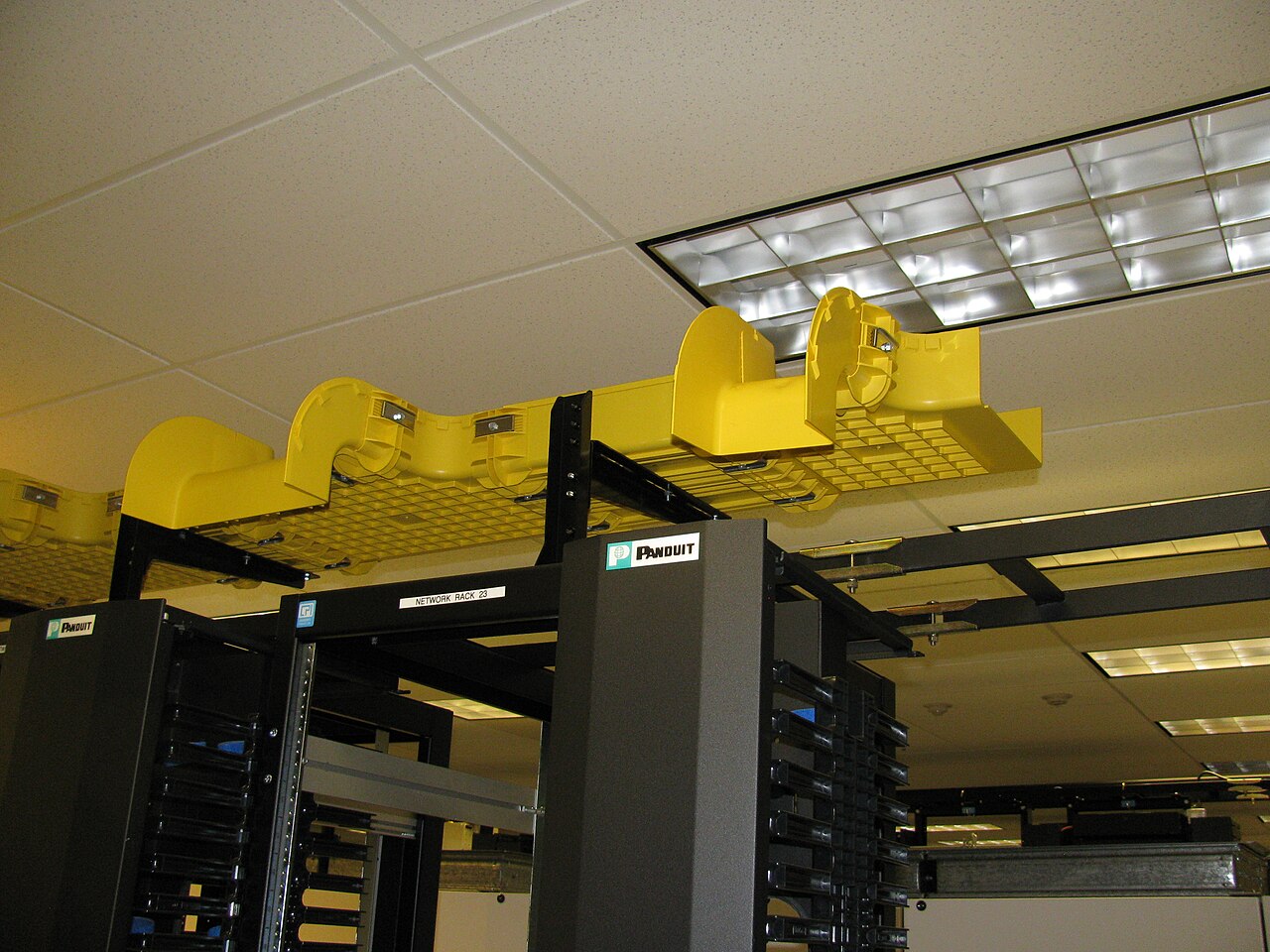
Header image: supercomputer racks with network cabling in the NERSC data center, by D Coetzee, via Wikimedia Commons, released under CC0. In-body photograph of yellow fiber-optic cable management, by Robert.Harker, via Wikimedia Commons, licensed CC BY-SA 3.0. Both illustrative of data-center infrastructure; neither shows Modal's own facilities.