On October 2, 2026, Meta published a research post titled Solving Open Research Problems Together. It describes six mathematics papers produced by human mathematicians working with its Muse Spark model, and states that "five present answers to previously open research questions." This is the latest entry in a crowded 2026 conversation about AI mathematics, following reports from Anthropic, OpenAI and Google DeepMind. This piece goes through what Meta claims, what its own disclosures let a reader verify, and how mathematicians usually judge whether an "open problem" is a significant one.
 Meta
Meta Anthropic
 OpenAI
 Google
What Meta actually announced
Meta says a team of mathematicians guided the research and worked with Muse Spark, and that a second group of mathematicians then reviewed each paper. The researchers used Muse Spark 1.1 and 1.2 "in Thinking Mode through the regular meta.ai chat interface, with no custom research scaffold," according to the post. Each paper marks which passages were drafted primarily by researchers and which by AI, and each carries a Statement of AI Use, as the abstract pages for the group theory paper and the ellipsoid paper both note.
Our goal here wasn't to mass-produce papers, but to empower researchers and help them develop mathematical insights.
Meta research blog, October 2, 2026
The post also recalls earlier results from Meta's models, citing gold-medal-level performance across five competitions in mathematics, physics and chemistry. That claim sets the framing, but the six papers are the part that can be inspected.
The six papers
Meta's six Muse Spark papers at a glance
Five papers are presented as answers to previously open questions. Three of those five acknowledge independent work on the same problem by others.
Sharp threshold near n = d^2/4 for fitting Gaussian points to an ellipsoid; the exact critical point is left open
Finite-time blow-up for radial solutions of a biharmonic nonlinear Schrodinger equation; question open since 2015
Counterexample of order 384 to a 2024 conjecture of M. Kida
Answers a 2026 question of Del Pia and Khajavirad on a cycle-based relaxation
Three-dimensional counterexample to a conjecture about evolution algebras
Links a string two-point function to a height function, extending the Tate curve case
Summarized from Meta's October 2, 2026 post. Meta lists human authors and separate reviewers for each paper.
The five papers Meta presents as open-problem answers span probability, differential equations, group theory, optimization and non-associative algebra. In more detail, based on the Meta post and the linked abstracts:
- Probability. Aykut Arslan, with Muse Spark, proves a sharp threshold for fitting random Gaussian points exactly to an ellipsoid. The abstract page states that a fit exists with high probability when n/d^2 is below 1/4 and does not when it is above, while behavior exactly at 1/4 is undetermined. Meta acknowledges three papers posted in August 2026 by Misiakiewicz and Wen, De la Cerda and coauthors, and Koehler and Sohn.
- Differential equations. Leonard Dinh, with Muse Spark, proves finite-time blow-up for radial negative-energy solutions of the mass-critical biharmonic nonlinear Schrodinger equation, which Meta says settles a question left open in 2015.
- Group theory. Joseph Phillip Brennan and Milana Golich disprove a conjecture first proposed by M. Kida in 2024. The paper gives a finite semiabelian group of order 384 that is not monomial, identified as SmallGroup(384, 20127) in the GAP library. Meta says Muse Spark generated the GAP search program that found it. Meta also acknowledges a separate counterexample reported by the AI agent Nilradical on September 16, 2026.
- Optimization. Arslan, with Muse Spark, answers a question first posed by Del Pia and Khajavirad in 2026 about a cycle-based relaxation for binary polynomial optimization. Kien Trung Le is listed as reviewer.
- Non-associative algebra. Andres Barei, with Muse Spark, disproves a conjecture of García-Martínez and Pérez-Rodríguez on solvable evolution algebras, with a three-dimensional counterexample. Meta acknowledges independent work by Hu and Wen.
- Arithmetic physics. The sixth paper does not claim to settle an open question. It connects number theory and p-adic string theory, following a direction Meta attributes to Yuri Manin in the 1980s and extending a connection already known for the Tate curve. Meta says Muse Spark generated candidate proofs and drafted three core technical sections.
One caution on secondary coverage: summaries differ on how they count the sixth paper. RuntimeWire and Superpower Daily disagree on which paper is the exception, and Meta's own post is the reference used here.
What is claimed, and what is checked
It helps to separate three layers of evidence.
- Meta's account of the process. Human selection of problems, human review by a second group, and labelled AI-drafted passages. These are disclosures by the author, not external audits.
- Checkable artifacts. A counterexample is the easiest result to trust: a group of order 384 can be tested by anyone with GAP. A probability threshold or a blow-up proof must be read and refereed in the ordinary way.
- External confirmation. For three of the five open-problem papers, other teams reached related results independently, which both supports that the questions were tractable and complicates any claim of AI-exclusive discovery. RuntimeWire notes that these acknowledgments make the papers "a less tidy demonstration of six exclusive AI discoveries."
Meta itself raises this point, writing that after completing the work it learned other teams had independently announced solutions to some of the same problems. That openness is useful. It also means that, at this point, the evidence is the papers plus Meta's process description, not a verdict from the wider community, and none of the six has yet been through journal refereeing as far as the sources show.
Where this sits in the AI-for-math trend
The 2025 to 2026 record shows several distinct modes, and the Meta papers resemble one of them more than the others.
- Search and optimization. In May 2025 DeepMind introduced AlphaEvolve and reported applying it to over 50 open problems, rediscovering state-of-the-art solutions in roughly 75% of cases and improving on them in about 20%, plus a 48-multiplication algorithm for 4x4 complex matrices. Meta's group theory counterexample is similar in spirit: a program searches, humans verify.
- Autonomous-style agents with formal proof. Anthropic reported that an unreleased Claude raised a proven bound related to the Riemann hypothesis from 41.6% to 67.2%, with a Lean proof and review by outside experts. Our earlier coverage of that result describes the multi-agent workflow. Meta's approach is deliberately lighter: a chat interface, no scaffold, and humans in the loop.
- Erdos problems. Terence Tao's wiki of AI contributions to Erdos problems sorts contributions into standalone AI work, AI alongside or building on literature, and human-AI collaboration, and separates literature search, formalization and verification as secondary contributions. It also warns that "absence of past progress may reflect obscurity rather than difficulty."
How mathematicians judge an "open problem"
"Open" is a statement about the literature, not about difficulty, and the Erdos wiki's warnings translate directly to Meta's list.
- Provenance. A 2026 question from Del Pia and Khajavirad and a 2024 conjecture from Kida are recent and narrow. A question left open since 2015 in a specific symmetric setting is also bounded. None is a famous named problem, and Meta does not present them as such.
- Type of answer. Counterexamples are cheap to confirm but may say little about structure. Thresholds and blow-up theorems add understanding but need careful refereeing.
- Priority and novelty. Concurrent work from other teams suggests the problems were within reach of current methods, a point worth weighing alongside the headline number.
- Understanding versus solutions. On September 11, 2026, 25 Fields Medalists signed a declaration arguing that "solving problems is only a tool and proxy for achieving the primary goal of conceptual understanding and insight." Meta's disclosure of drafting roles and prior work speaks to attribution, which is one of the concerns the declaration raises, though the declaration does not address Meta's papers specifically. See our analysis of that declaration.
What to watch next
- Refereeing. Whether the six papers are accepted in journals, and whether reviewers find gaps.
- Reproduction. Whether other groups can replicate the workflow with standard chat access, given Meta says no custom scaffold was used. A claim of this kind is stronger if it travels.
- Significance over time. Whether the results are cited and used, or remain one-off answers to narrow questions.
- Attribution norms. Whether labelled AI-drafted passages and a Statement of AI Use become standard practice.
Conclusion
The verified picture is narrower than a headline of "AI solves five open problems" suggests, and also more concrete than a vague claim of assistance. Meta released six papers with named human authors and reviewers, a disclosed toolchain, labelled AI contributions and acknowledged parallel work, and at least one result, the order-384 counterexample, is easy to check independently. What remains open is how significant the questions were and how the papers fare under normal refereeing. For readers comparing reasoning models across labs, as tools like Metir let teams do in one workspace, the useful lesson is that the human process around a model, selection, review and disclosure, is as informative as the model itself.
Sources:
- Solving Open Research Problems Together | Meta Research
- Semiabelian Groups Need Not Be Monomial | Meta AI Research
- The Strict Threshold for Gaussian Ellipsoid Fitting | Meta AI Research
- Meta publishes six math papers made with Muse Spark and human mathematicians | RuntimeWire
- Meta shares six AI-assisted math papers, saying five answer open questions | Superpower Daily
- AlphaEvolve: A Gemini-powered coding agent for designing advanced algorithms | Google DeepMind
- Learning more about Claude's mathematical capabilities | Anthropic
- AI contributions to Erdos problems | Terence Tao's erdosproblems wiki
- A severe misalignment of AI in mathematics | Terence Tao
Image credits
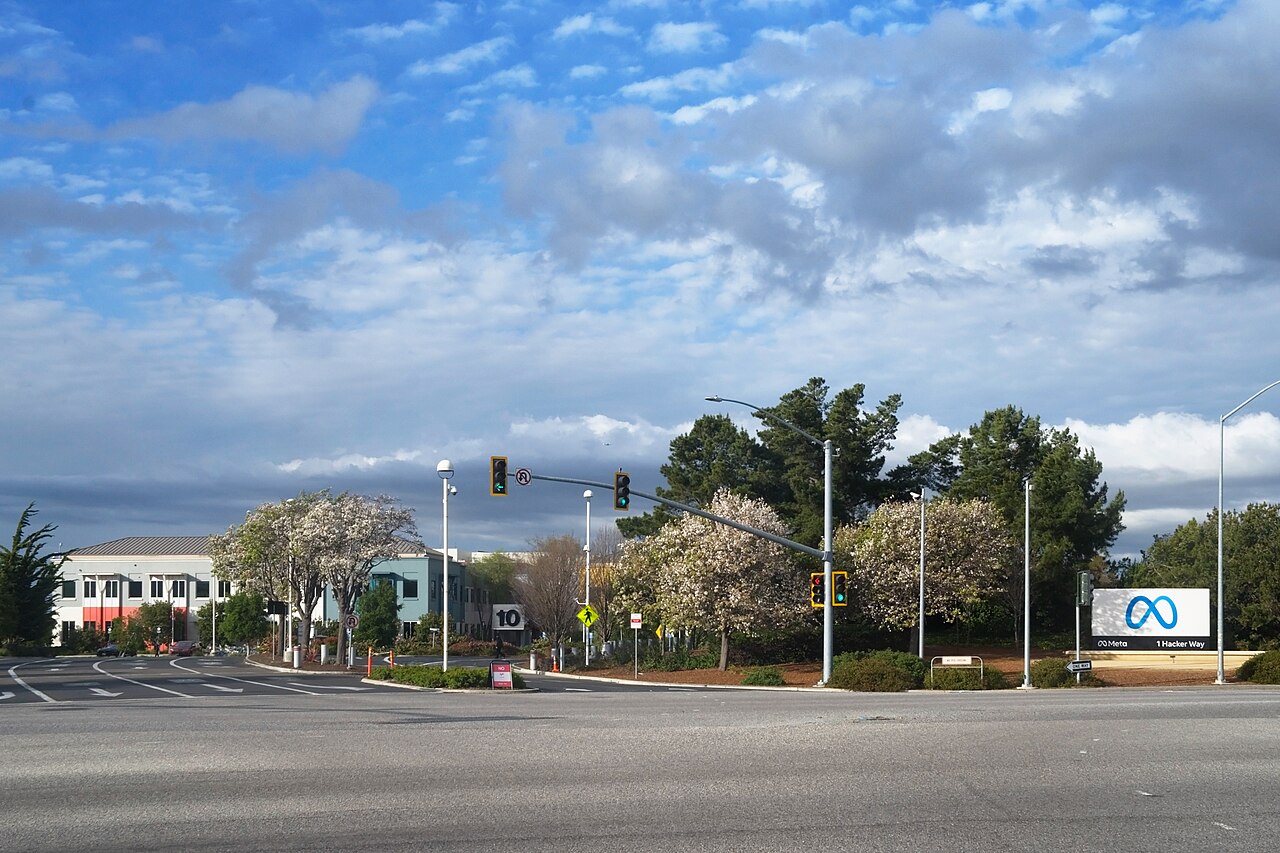
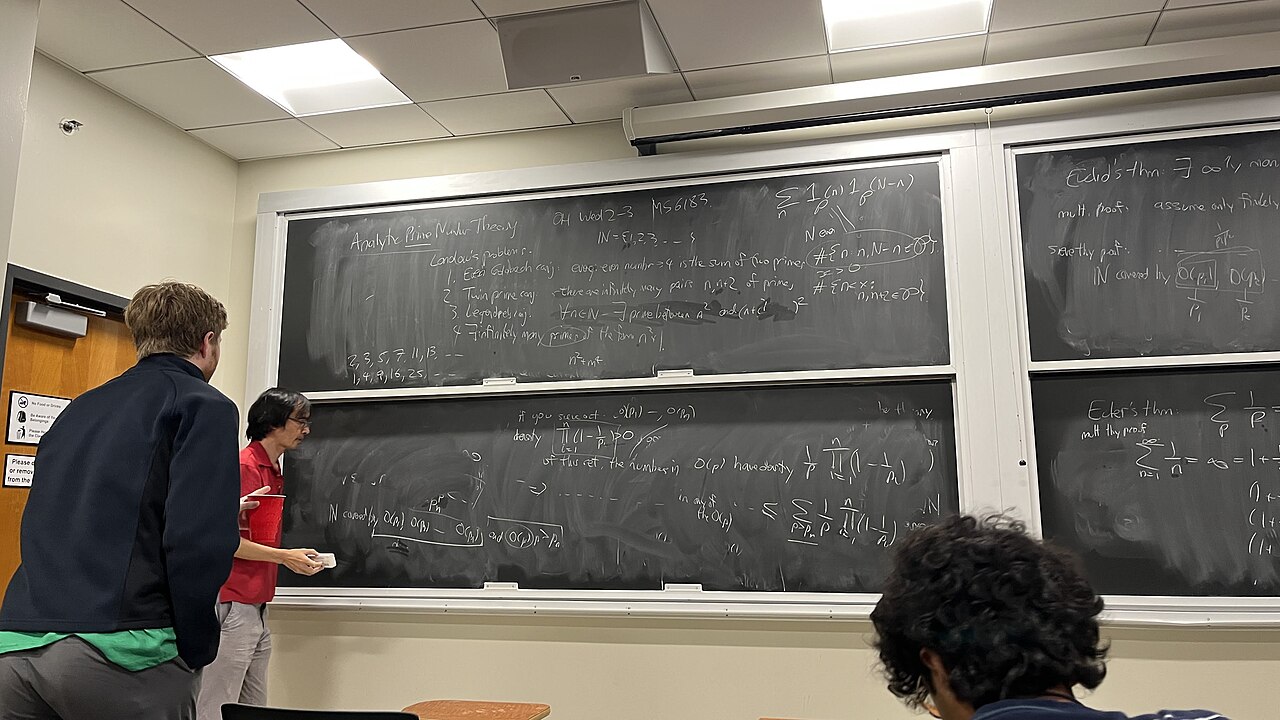
Header image: the entrance to the Meta Platforms headquarters complex in Menlo Park, California, photographed in March 2022 by LPS.1 via Wikimedia Commons, released under CC0. It shows the campus entrance sign, not any of the research described. In-body photograph of Terence Tao teaching analytic prime number theory in January 2025 by Natecation via Wikimedia Commons, licensed under CC BY-SA 4.0. Both images were reviewed before use.