AI mathematics has a new argument to resolve: what should count as progress after a machine produces an answer? On September 11, 2026, Terence Tao announced a declaration with 25 initial signatories, all Fields Medalists. Their concern is the relationship between commercial incentives and mathematical understanding. Tao's announcement establishes the date and initial group.
For readers following our Navier-Stokes analysis, this is a separate development. The question here is how research should be evaluated, credited and passed on once powerful AI tools enter the process.
What the AI mathematics declaration says
The declaration argues that solving famous problems serves a broader purpose: developing concepts and methods that other people can understand. Its authors warn that rushed announcements can squeeze out careful exposition and attribution. They also emphasize students, whose work on problems builds the judgment needed for later research.
The text explicitly recognizes AI's potential to accelerate mathematical understanding. Read as a whole, its objection concerns the incentives governing deployment. It does not supply a new benchmark, binding publication policy or technical test that settles whether any particular proof is correct.
That distinction matters. Agreement with the declaration does not require rejecting automated discovery; disagreement does not establish that speed alone is an adequate measure of scientific value.
The discussion already has a practical foundation
The Leiden Declaration, dated June 2, 2026, provides useful context. It describes independent verification, transparent arguments and author responsibility as central research values. It also warns that publicity can precede disclosure of material needed for evaluation, and that narrow mathematical tasks can be presented misleadingly as evidence of general reasoning ability.
These concerns suggest separating several questions that a headline often compresses into one. A result might be correct yet poorly explained. A contribution might be valuable yet inadequately credited. A model might perform strongly on a particular task without demonstrating the same reliability elsewhere.
| Evaluation question | Evidence to ask for |
|---|---|
| Does the argument establish the claim? | Complete assumptions and an independently inspectable proof |
| What is new? | An account of the method and its relationship to previous work |
| Who contributed? | Citations and a clear description of human and AI involvement |
| Can others use the result? | Explanations, examples and material that supports further study |
This table is an editorial review framework, not a checklist issued by the signatories.
More ambitious AI research remains possible
An April research essay by Maissam Barkeshli, Michael R. Douglas and Michael H. Freedman explores how AI might illuminate the structure of mathematics itself. Its authors discuss formal proof structures and criteria for automated discovery, extending the ambition beyond solving isolated problems. It is a conceptual research proposal, not evidence that those ambitions have already been achieved.
That offers a productive way to interpret this week's debate: ask what an AI result makes possible for subsequent researchers. Does it reveal a technique they can adapt? Does it help them identify better questions? Can they explain its significance without relying on the original vendor?
A useful research result should leave the next researcher better equipped.
metir editorial analysis
What to request with the next breakthrough
For research teams, a practical response is to prepare the evidence package alongside the announcement. Keep the argument, prior sources, contribution record and unresolved questions together. Ask reviewers to distinguish correctness from novelty and clarity. Give explanations and teaching material their own place in the release plan.
For readers, the same discipline is simpler: open the underlying work before accepting the headline. Look for named assumptions, accessible evidence and precise credit. The most informative announcement will make it easier to see both what was achieved and what remains to be understood.
Sources:
- Terence Tao: September 11 announcement and initial signatories
- A Severe Misalignment of AI in Mathematics: full declaration
- Leiden Declaration on Artificial Intelligence and Mathematics
- Artificial Intelligence and the Structure of Mathematics, April 2026
Image credits
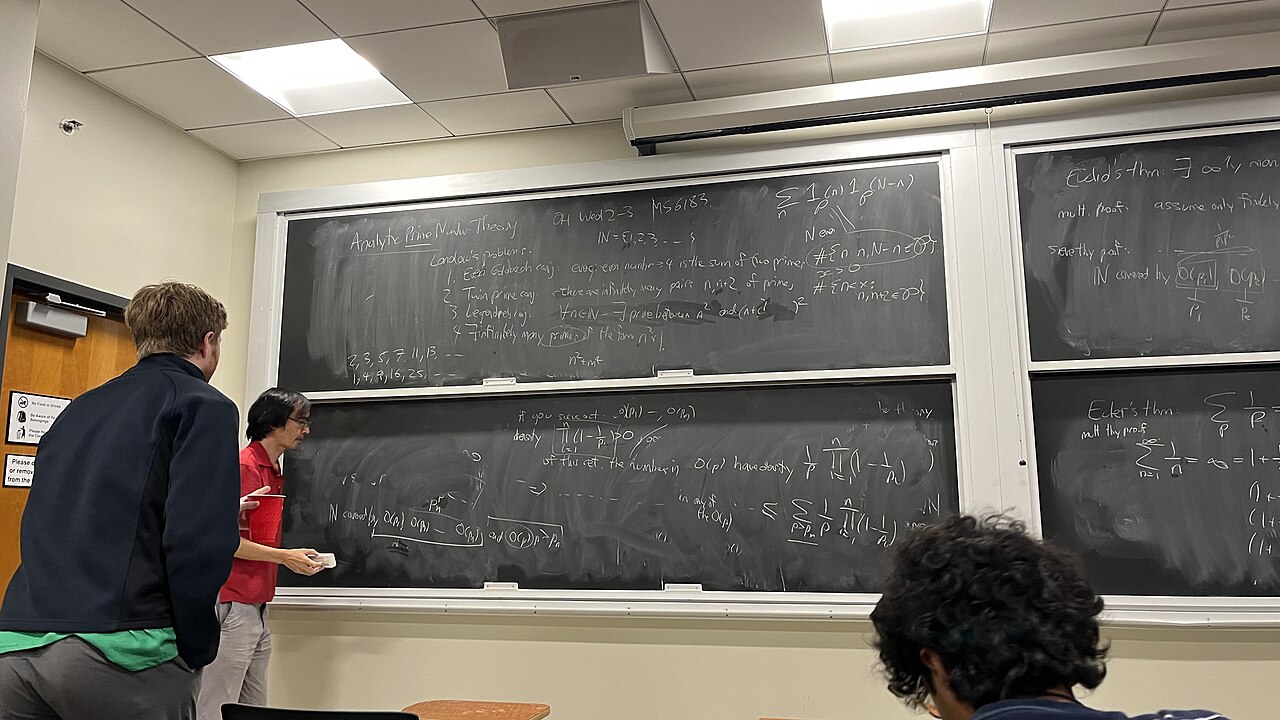
- Terence Tao teaching analytic prime number theory, January 2025: Natecation, Wikimedia Commons, CC BY-SA 4.0. Resized archival photograph used for the hero and body figure.