AI chip financing has moved from bond markets into private credit. The Wall Street Journal reported on October 7, 2026 that OpenAI's chip partner Broadcom is seeking more than $50 billion to fund a custom accelerator, that Oracle is negotiating an off-balance-sheet structure to buy chips for a 1 gigawatt data center, and that SpaceX is pursuing roughly $40 billion for Nvidia hardware. The WSJ story is paywalled, so the details below come from coverage that relays it, including Investing.com and Crypto Briefing. Every figure is a target under negotiation, not a closed deal.
 OpenAI
 NVIDIA
What was reported
| Company | Reported amount | Purpose | Named lenders | Structure |
|---|---|---|---|---|
| Broadcom | More than $50 billion | Custom chip built with OpenAI | Apollo and Blackstone, among others | Not described in the secondary coverage |
| Oracle | Not specified | Chips for a 1 GW data center | Apollo and Goldman Sachs | Investor-funded entity buys chips and leases them to Oracle |
| SpaceX | About $40 billion | Nvidia chips | Not named | Not described |
Several caveats apply. Crypto Briefing says the Broadcom talks are early and that no deal is expected before the end of 2026. The SpaceX talks were first reported by the Financial Times, per the secondary summaries of the WSJ piece. The reports do not give interest rates, maturities or collateral terms.
The OpenAI chip program is called Nexus internally, and its first generations are reportedly named Jalapeño and Serrano. OpenAI and Broadcom announced in October 2025 a plan to deploy 10 gigawatts of custom accelerators by the end of 2029 (Crypto Briefing). We covered the silicon in our look at the Jalapeño benchmarks.
AI chip financing: reported targets, not closed deals
Approximate size in billions of US dollars. Green bars are packages under negotiation; grey is the earlier June partnership. Oracle is omitted because no amount was reported.
Sources: WSJ via Investing.com and Crypto Briefing (Oct 7, 2026); Bloomberg via The Star and Dataconomy; Silicon UK. The OpenAI figure was reported as "more than $50 billion". Hover a bar for details.
The chart sets the new targets beside the roughly $60 billion package Bloomberg reported Broadcom seeking for Anthropic and the earlier $35 billion Anthropic compute partnership with Apollo and Blackstone (Silicon UK). Our earlier post on the Broadcom and Anthropic $42 billion convertible notes covers the related Anthropic structure.
Vendor financing and the SPV lease-back, explained
An AI lab that wants chips normally pays the maker, or rents the chips from a cloud. The reported deals add a financier between them. Two patterns recur:
- Vendor financing. The chip supplier helps arrange the money that pays for its own product. The supplier gets a sale; the buyer gets time to pay. Broadcom raising debt against a customer's chip purchases fits this pattern, and Seaport analyst Jay Goldberg described suppliers following Nvidia's lead here (Investing.com, via Reuters).
- SPV and lease-back. A special purpose vehicle, a separate legal entity, raises money from investors, buys the chips, and leases them to the user. The reports describe Oracle's talks this way. Lenders' claims sit on the vehicle and its lease income rather than on the user's whole balance sheet.
The mechanics matter. The vehicle's cash flows are the lease payments. If the lessee pays, lenders are repaid; if it does not, lenders look to the chips themselves and any guarantee. Whether a lease is accounted for off the lessee's balance sheet depends on the contract terms and accounting rules, and the secondary coverage does not say how Oracle's would be treated. Investing.com's commentary warned that such structures can obscure true leverage. That is an interpretation, but it explains why analysts read lease commitments closely.
Why private credit rather than public bonds
The WSJ context, as relayed by investingLive, is that cloud providers including Amazon Web Services and Oracle have issued hundreds of billions of dollars of bonds for AI infrastructure, which the report said pushed public debt markets to their limits. Our analysis of why borrowers still turn to private lenders:
- Size and speed. A single private lender group can commit a very large sum in one negotiation, instead of syndicating across many bond buyers.
- Custom terms. A deal can be tied to specific chips, a specific customer contract and a delivery schedule. Bond indentures are standardized.
- Balance-sheet separation. An SPV can hold the debt apart from the borrower's reported leverage and credit rating metrics.
- Borrower profile. Crypto Briefing and investingLive note that OpenAI and Anthropic rent most of their compute and lack balance sheets to buy hardware outright, so a vendor-and-lender package substitutes for corporate borrowing.
Private credit has its own costs: typically higher pricing and less public disclosure, and for investors, less liquidity. We covered the broader market in our AI leveraged-loan analysis.
The depreciation problem
The distinctive risk is the collateral. A data center shell can hold value for decades. An accelerator is replaced as new generations arrive, so a loan can outlast the economically useful life of what backs it.
Companies already disagree on how long servers last. Amazon changed the useful life of a subset of its servers and networking equipment from six years to five effective January 1, 2025, citing the pace of AI and machine learning development (Amazon Form 10-Q, Q2 2025). Meta moved the other way in the same period, extending the useful lives of certain servers and network assets to 5.5 years effective January 2025 (Meta Form 10-K, FY2024). If useful life is five years, a seven-year note is a mismatch; if the chip is custom, resale value outside its intended customer may be thin.
A loan can outlast the economically useful life of the chips that back it.
Metir AI analysis
Lenders typically manage this with some combination of:
- A lease or offtake contract from a creditworthy user, so repayment depends on the user rather than resale value.
- Short or amortizing terms that repay principal as the chips age.
- Cash reserves. Broadcom's Anthropic arrangement reportedly included restricted cash for Broadcom's benefit, per the filing coverage in our earlier post.
- Supplier guarantees, as Bloomberg reported Broadcom would provide for part of the senior layer of its Anthropic package.
Custom ASICs add a wrinkle. A standard Nvidia GPU can in principle be re-leased to another customer; a chip designed around one lab's models and software stack may have a narrower second market. How lenders price that is not public.
What to watch
- Whether the deals close. Reported targets often change. Broadcom's is expected by year-end, per the coverage.
- Disclosed terms: spreads, maturities, guarantees and who holds the junior tranche.
- Accounting treatment of the Oracle structure in its filings.
- Contract strength of end users. Repayment ultimately rests on AI revenue, which for some borrowers is still growing from a small base.
- Secondary markets. Whether this debt trades, and at what price, will signal how lenders view chip collateral.
For teams building on these models, the practical takeaway is portability: infrastructure costs and supply arrangements shift between providers, and a multi-model setup such as Metir's model-agnostic chat lets work move with them.
Sources:
- Investing.com: Broadcom, Oracle and SpaceX pursue blockbuster debt deals (relaying WSJ)
- investingLive: WSJ, Broadcom seeks over $50 billion for OpenAI chips
- Crypto Briefing: Broadcom $50 billion OpenAI chip financing
- The Star: Broadcom seeks more than $60 billion, Bloomberg
- Silicon UK: Apollo, Blackstone fund $35bn Anthropic chip deal
- Investing.com via Reuters: Broadcom to lend Anthropic up to $42 billion
- Amazon Form 10-Q, June 30, 2025
Image credits
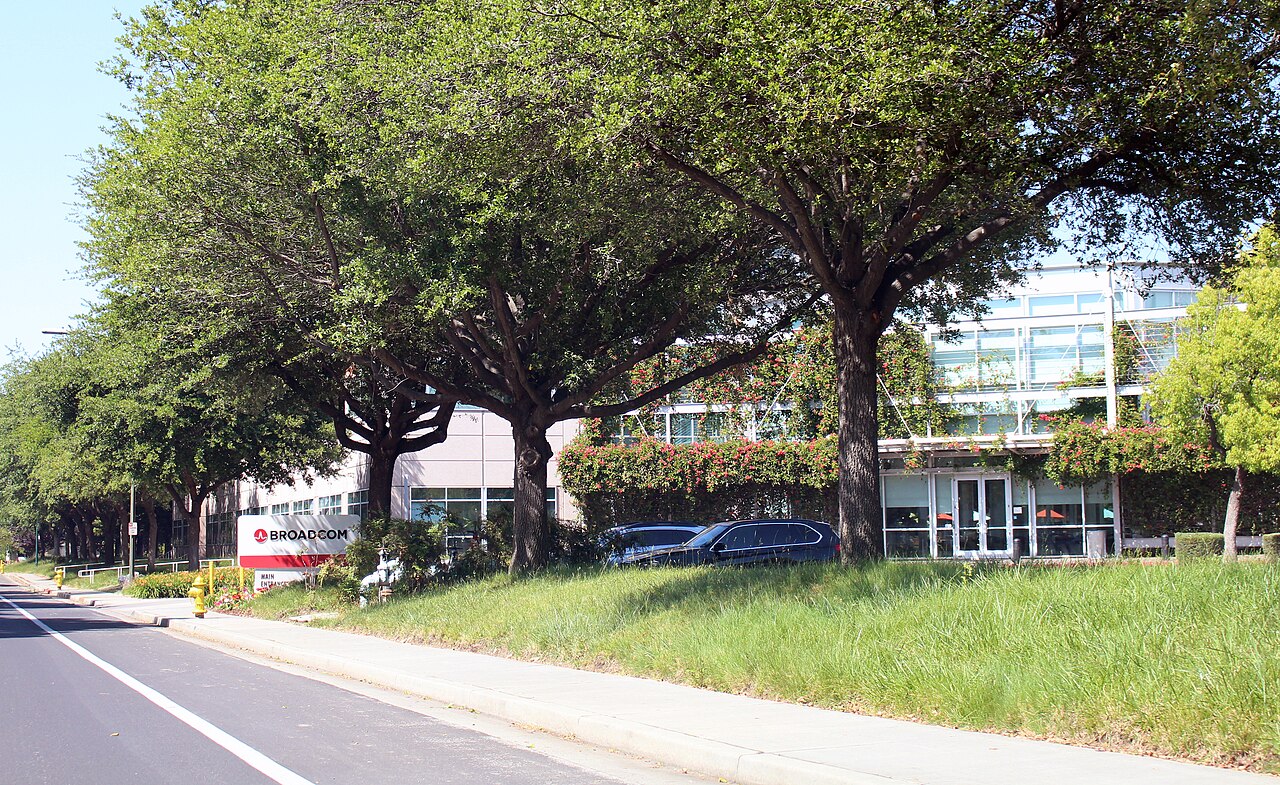
- Hero: Broadcom sign and office building, San Jose, taken June 1, 2019. Photo by Coolcaesar, CC BY-SA 4.0, via Wikimedia Commons.
- In-body: Broadcom office building with former logo, taken 2007. Photo by Coolcaesar, CC BY-SA 3.0, via Wikimedia Commons.