ASML, the Dutch company that makes the lithography machines every leading-edge chip factory depends on, reported record third-quarter 2026 net sales of EUR 11.7 billion on October 14, up from EUR 9.3 billion in the second quarter. It guided the fourth quarter to EUR 14.2 to 15.2 billion and told investors that its planned output for 2027 and 2028 "will not fully meet the demand of our customers." Because ASML sits upstream of TSMC, Samsung, SK hynix, Micron and Intel, its numbers are one of the earliest readings of how much AI-related chip capacity the industry intends to build. This piece walks through what was reported, what changed from the prior quarter, and what the figures do and do not establish.
What ASML actually reported
ASML's results release shows total net sales of EUR 11,662 million in Q3 2026 against EUR 9,326 million in Q2, a rise of about 25% in one quarter. Gross margin was 57.5% versus 54.0%, and net income was EUR 4,960 million versus EUR 2,918 million. Basic earnings per share were EUR 12.95. The company sold 113 new lithography systems in the quarter versus 86 in Q2, and Installed Base Management sales, which cover service and upgrades of machines already in the field, rose from EUR 2,762 million to EUR 3,289 million.
ASML net sales, quarter by quarter
Total net sales in billions of euros. Q4 is the midpoint of ASML's guided range, not a result.
Q2 and Q3 are reported figures (EUR 9.326B and EUR 11.662B). Q4 uses the midpoint of the EUR 14.2B to EUR 15.2B guidance range. Source: ASML Q3 2026 results.
Two items in the earnings call sit behind the headline. First, net income included roughly EUR 500 million from the revaluation of ASML's stake in Mistral AI, a non-operating gain. Stripping it out by simple arithmetic leaves about EUR 4.5 billion, still roughly 53% above Q2's net income. Second, management attributed much of the gross-margin beat to high-margin upgrade business, citing about EUR 400 million more of it than planned. Upgrades are lumpy, so the 57.5% margin is better read as a strong quarter than a new baseline, and ASML itself guided Q4 margin slightly lower, to about 57%, as ramp costs offset volume.
 Mistral AI
The guidance is the bigger signal
A quarter that already beat the guided range matters less to the AI-capacity story than what comes next. ASML guided Q4 net sales to EUR 14.2 to 15.2 billion, so the midpoint of EUR 14.7 billion would be about 26% above Q3. Full-year 2026 net sales are guided to EUR 44 to 45 billion at a gross margin around 56%, an increase in the sales range and the margin from the July outlook of EUR 43 to 45 billion and 54% to 56%.
Our supply as currently planned for both 2027 and 2028 will not fully meet the demand of our customers.
Christophe Fouquet, ASML CEO, Q3 2026 results
That statement is the part to weigh carefully. Planned output for 2027 is a roughly 30% increase in low-NA EUV and DUV immersion capacity, and ASML said it is now investigating more than the 30% it had previously discussed for 2028. Fouquet also said customers have expressed interest in placing orders for 2029 and even 2030, which ASML has not yet accepted because it wants to compare total demand with capacity first so no customer is shut out. A supplier saying demand exceeds its own supply for years is a different claim from a supplier reporting a strong quarter: it implies the constraint on chip capacity growth is, in part, the availability of lithography tools.
Memory has overtaken the narrative
For two years AI chip demand was shorthand for advanced logic: GPUs and accelerators built by TSMC. The Q3 mix shows the story broadening. ASML said net system sales in Q3 split 54% logic and 46% memory, and described full-year 2026 growth of about 10% in logic system sales versus about 75% in memory, with advanced logic growing more than 25%. For 2027, the CFO said memory "comes close" to logic, although logic should still be larger in total bookings.
Where ASML expects 2026 growth: memory leads
Approximate full-year 2026 growth in net system sales by end market, as described on the Q3 call.
Management described logic as about +10% and memory as about +75% for full-year 2026. Figures are approximate and from the earnings call transcript.
This lines up with what the memory makers have been reporting. The memory makers' own results point the same way, as covered in our look at Samsung's record Q3 profit and at TSMC's Q3 revenue. ASML's order book is the equipment-side confirmation that memory capex has moved from a recovery to an expansion phase. An important caveat is that equipment orders reflect customer intent, and customer intent can change faster than machines get built.
EUV in numbers
ASML said Q3 EUV system sales were EUR 4.1 billion, including one High-NA system, against EUR 4.3 billion of non-EUV system sales. It expects to ship about 65 low-NA EUV systems in 2026 versus 44 in 2025, EUV growth of more than 45%. On the roadmap, the NXE:3800F is rated at 260 wafers per hour with small-quantity introduction in early 2027, and a next-generation immersion DUV tool is rated at 330 wafers per hour from 2027. On High-NA, management said Intel has exposed over one million wafers, while Samsung and TSMC plan high-volume High-NA manufacturing in 2028 and 2030 respectively. ASML did not break out High-NA revenue separately, so the pace of that transition is still mostly visible through customer statements rather than ASML's own accounts.
China, pricing and shareholder returns
On China, management expects the region to account for around 20% of total net sales in 2026, consistent with prior expectations, and expects demand there to stay strong in 2027 and beyond without giving a share. On pricing, the CFO said ASML has raised prices on its most critical products, with the impact starting in 2027 and reaching full effect in 2028, and that it does not plan to repeat such increases every year. Capital returns were large: about EUR 4.1 billion of share buybacks in Q3 under the 2026 to 2028 program, and an interim dividend of EUR 1.88 per share payable November 4, 2026. Free cash flow was EUR 11.4 billion according to the call summary, and cash and short-term investments rose to EUR 12.7 billion from EUR 7.6 billion.
What this does and does not tell us
The results are strong evidence that the customers who buy lithography tools are committing capital against AI demand through at least 2028. They are weaker evidence about end demand for AI services themselves, because equipment orders are a derivative of customers' expectations. Several things are worth separating:
- Reported versus guided. Q2 and Q3 are results; Q4 and full-year figures are guidance, which can move with customer timing.
- Operating versus non-operating. Roughly EUR 0.5 billion of Q3 net income came from the Mistral revaluation, and EUR 0.4 billion of margin benefit came from upgrades, neither of which is repeatable at will.
- Constraint versus demand. A supply gap can mean unusually high demand, but it also means ASML's capacity decisions set a ceiling on how fast customers can add wafers.
For people building on AI models, the practical implication is indirect but real: the cost and availability of inference capacity two years out depends partly on how fast lithography capacity can grow. That is one reason model-agnostic tooling, such as the multi-provider setup used by Metir AI, tends to age better than a commitment to a single supplier's capacity.
The takeaway
ASML's Q3 2026 report combines a record quarter with a forward statement that supply, not demand, may be the binding constraint through 2028. Memory's rising share of system sales suggests the AI build-out is spreading beyond GPUs into the whole stack. The numbers are best read as customer intent expressed in equipment orders: strong, but only as durable as the AI revenue those customers expect to earn.
Sources:
- ASML reports EUR 11.7 billion total net sales and EUR 5.0 billion net income in Q3 2026 | Yahoo Finance (ASML press release)
- ASML Q3 2026 Earnings Call Transcript | The Motley Fool
- Earnings call transcript: ASML posts Q3 2026 profit beat on record demand | Investing.com
- ASML Reports Record EUR 11.7 Billion In Q3 Sales As AI Demand Drives Capacity Expansion | Pulse 2.0
- ASML Form 6-K, FY2026 | SEC EDGAR
Image credits
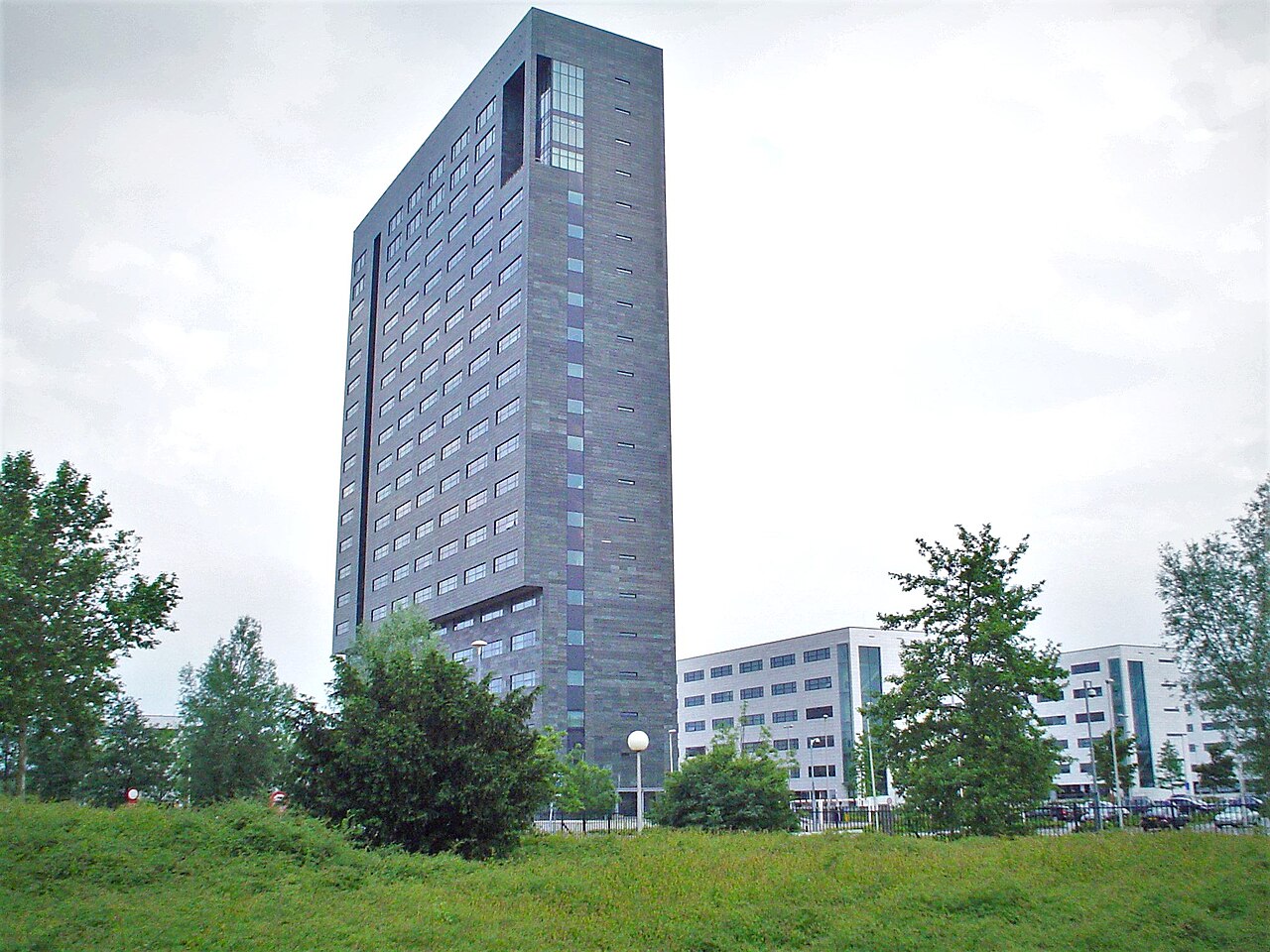
Photograph of ASML's headquarters building in Veldhoven, Netherlands (2008), "ASML headquarters Veldhoven.jpg", by A ansems, via Wikimedia Commons, marked public domain. Reviewed visually; shown as an illustration of the building only. See credits.md in the image folder.