
 NVIDIA
 Apple
AppleOn October 8, 2026, TSMC reported September revenue of NT$511.86 billion, which closed a third quarter of about NT$1.49 trillion. That is the company's record quarterly revenue, and the figure arrived a week before the full earnings release. Monthly sales are a coarse instrument, but for the world's largest contract chipmaker they are also the earliest hard read on AI chip demand each month.
What TSMC reported for Q3 2026
According to TSMC's filing with the SEC, September revenue was NT$511,857 million, down 0.6% from August's NT$514,806 million and up 54.6% from September 2025. Revenue for January through September was NT$3,898,727 million, up 41.1% from the same period of 2025.
Adding July (NT$467.58 billion), August and September gives roughly NT$1.49 trillion for the quarter. TrendForce puts that at US$46.71 billion, up 50% year over year. It compares with the LSEG SmartEstimate of NT$1.46 trillion and with TSMC's own guidance of US$44.6 to 45.8 billion, which implied about NT$1.427 to 1.466 trillion at an exchange rate of NT$32 per US dollar.
One caveat on the comparison: monthly figures are in New Taiwan dollars, while TSMC guides in US dollars. Currency movement between the guidance assumption and actual rates can add or subtract from a "beat" without any change in underlying demand.
TSMC monthly revenue, January to September 2026
Consolidated net revenue in NT$ billion, from TSMC's monthly 6-K filings. January is derived from the reported Q1 cumulative total.
What monthly revenue tells you about AI demand
The chart shows a steady climb: from roughly NT$400 billion a month in the first quarter to just above NT$500 billion in August and September. The filings let you separate two things that headlines often merge.
- Scale. Year-over-year growth of 54.6% in September is high for a company that already generates over NT$500 billion a month.
- Momentum. The month-over-month change in September was slightly negative. After August's 10.1% jump (as reported by Tech Insider), a flat month is consistent with either capacity-limited shipments or normal lumpiness.
Monthly revenue also has built-in limits as a demand signal. It records wafers and packaging shipped and invoiced, not orders placed. Timing of customer shipments, foreign exchange and product mix all move it. Central News Agency, via TrendForce, attributed the quarter to strong AI demand and inventory build ahead of new smartphone launches, so the total blends two different demand cycles.
Monthly revenue records what shipped, not what was ordered.
The packaging bottleneck behind the numbers
On its second-quarter call in July, TSMC's chairman and CEO C.C. Wei described advanced packaging as so tight that it limits customers' growth, according to a summary of the call. The same summary says CoWoS still makes up the majority of TSMC's advanced packaging, and that testers are also in short supply.
That matters for reading revenue. If packaging is the binding constraint, then reported sales partly reflect how much packaging capacity came online, not only how much silicon customers wanted. A supply-limited business can show smooth, rising revenue even while demand runs ahead, and a demand slowdown would be harder to see until backlog shrinks.
2nm ramp and the margin question
Revenue and profitability are moving differently. TSMC's second-quarter gross margin was 67.7% and its operating margin 60.3%. Its third-quarter guidance was 65% to 67% for gross margin and 56% to 58% for operating margin, as reported by TrendForce. In the July call coverage, management attributed the decline to the 2nm ramp, saying it would cut gross margin by about 3 to 4 percentage points in the second half, with overseas fabs adding a further 2 to 3 points of dilution early on (call summary).
Two readings are common. One treats this as a normal new-node pattern: yields and costs improve after launch, so early dilution fades. The other asks whether sustained overseas expansion and a larger capital budget (TSMC raised 2026 capex to US$60 to 64 billion, per Yahoo Finance) keep margins below the earlier peak. The data so far cannot settle that. N2 contributed about 3% of wafer revenue in the second quarter, which is a small base for a large effect.
What to watch on October 15
TSMC holds its full third-quarter earnings call on October 15, 2026. Useful things to check:
- Actual margins versus the 65% to 67% guide. LSEG analysts expect net profit of about NT$740.8 billion, up 64% year over year, according to TrendForce.
- Fourth-quarter guidance. Analysts cited by TrendForce expect further growth from demand for NVIDIA's Vera Rubin platform and TSMC's 2nm process.
- Full-year growth. In July, TSMC guided to growth slightly above 40% in US dollars. Nine-month revenue is up 41.1% in New Taiwan dollars, a different currency basis, so the two are not directly comparable.
- Packaging commentary. Any change in how management describes advanced packaging tightness or testing capacity.
- N2 share of wafer revenue. A rising share would explain more of the margin guide.
For teams that depend on AI compute, the practical takeaway is that supply-side constraints at the foundry level can shape pricing and availability downstream, which is one reason model-agnostic tools such as Metir are designed to let work move between providers.
Sources:
- TSMC Form 6-K, September 2026 revenue (SEC)
- TrendForce: TSMC Q3 revenue beats forecasts at record NT$1.49 trillion
- TSMC Form 6-K, June 2026 revenue (SEC)
- TSMC Form 6-K, May 2026 revenue (SEC)
- TSMC Form 6-K, March 2026 revenue (SEC)
- Yahoo Finance: TSMC July 2026 revenue
- Tech Insider: TSMC revenue hits record NT$514.8B
- TSMC Q2 2026 earnings call summary
Image credits
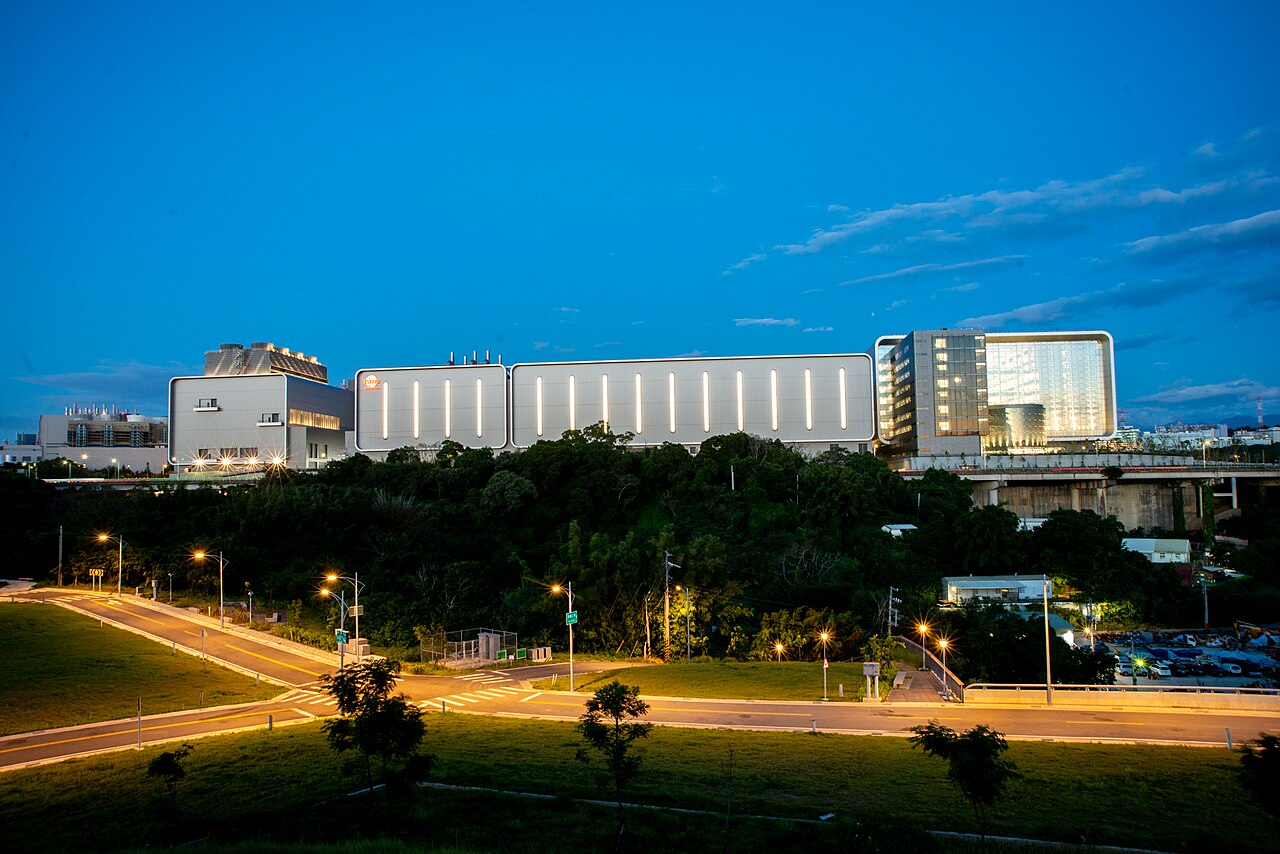
- Hero: TSMC fabs in Hsinchu, Taiwan, showing a TSMC-branded building on a street at dusk. Photo by 曾 成訓, Wikimedia Commons, CC BY 2.0.
- Figure: TSMC Global R&D Center, Hsinchu. Photo by 曾 成訓, Wikimedia Commons, CC BY 2.0.