A coalition of Canadian news publishers has sued Anthropic in an Ontario court, alleging that the company used their journalism to develop Claude without a licence. According to a Canadian Press report published on October 19, 2026, the suit was filed on October 6 and was first reported by Cartt.ca. The plaintiffs are Postmedia, Torstar, The Globe and Mail and The Canadian Press. These are allegations, and none has been proven in court.
 Anthropic
What the publishers allege
The report lists four claims. They are worth separating, because each has a different evidentiary burden and a different analogue in other jurisdictions.
| Claim | What it alleges | What a court would likely need to examine |
|---|---|---|
| Copyright infringement | Anthropic used the publishers' content to develop Claude "without obtaining a valid licence from any of the News Media Companies" | Whether copying occurred and whether any statutory exception applies |
| Unjust enrichment | Anthropic was "substantially and unjustly enriched to the detriment of the News Media Companies" | Whether a benefit was received without a legal basis, and whether copyright law already covers the field |
| Breach of terms of service | Scraping violated the terms of the publishers' websites | Whether those terms bind an automated crawler |
| Circumvention of technological protection measures | Anthropic bypassed technical controls meant to restrict copying | What measures existed and how they were allegedly bypassed |
The claim also alleges that Anthropic "deliberately 'scrapes' (i.e. accesses and copies) enormous amounts of text data from the internet and from the Plaintiffs' Websites", and that scraping continues in response to user prompts. That second allegation is distinct from the training-data claim, because it concerns live retrieval rather than past model development. The report does not cite statutory provisions beyond the claims themselves and does not state the damages sought.
Why the claim mix matters
Most widely discussed US cases centre on copyright and the fair use defense. This suit adds three further theories alongside copyright. Contract and circumvention claims can sometimes be pleaded even where a copyright exception might apply, so they widen the ways the case could succeed or fail.
Canada also differs from the United States on the central defense. The Canadian Copyright Act relies on enumerated "fair dealing" purposes rather than the open-ended US fair use test, and how those categories apply to model training has not been settled by a Canadian court to our knowledge. That point is analysis rather than a fact reported about this case, and it is the main reason outcomes elsewhere cannot simply be transposed.
The novelty here is the claim stack: four theories pleaded together, one of which targets live retrieval rather than training.
The wider litigation picture
The same publishers, together with CBC/Radio-Canada, sued OpenAI in 2024, and the report says that case has not settled. The publishers have also urged the federal government to address how AI systems use copyrighted content, saying its national AI strategy did not cover the issue.
Several related disputes are covered in our earlier posts:
- Seattle Times and Newsday sue OpenAI and Microsoft for news content in the United States.
- Sony Music and Warner Chappell sue Anthropic over music rights.
- The DOJ's statement of interest on OpenAI, fair use and the New York Times case.
Taken together, these show litigation spreading across content types (news, music), defendants (OpenAI, Microsoft, Anthropic) and jurisdictions (the United States, now Canada).
What is unknown
- Damages. The report does not state what the publishers seek.
- Anthropic's position. The company had not responded to a request for comment.
- The court and procedural schedule. The report refers to an Ontario court without naming which one.
- Evidence. The allegations about scraping and circumvention are untested, and the technical specifics will matter.
Implications for people building with AI
For organisations using AI tools, the practical effect of this kind of litigation is mostly indirect. It can shape licensing deals, data-provenance disclosures and the pricing of model access over time. Teams that rely on a single provider are exposed to that provider's legal and commercial changes, which is one reason model-agnostic tooling such as Metir lets users switch providers as terms evolve. Beyond that, the sensible posture is to watch for the filings and the first rulings rather than to infer an outcome from the complaint alone.
Sources:
- News publishers launch copyright suit against AI company Anthropic in Ontario (Canadian Press via ChatNewsToday)
- Everything That Happened in AI Today, Tuesday, October 20 (The Neuron)
- Copyright Act, R.S.C. 1985, c. C-42 (Justice Laws Website)
Image credits
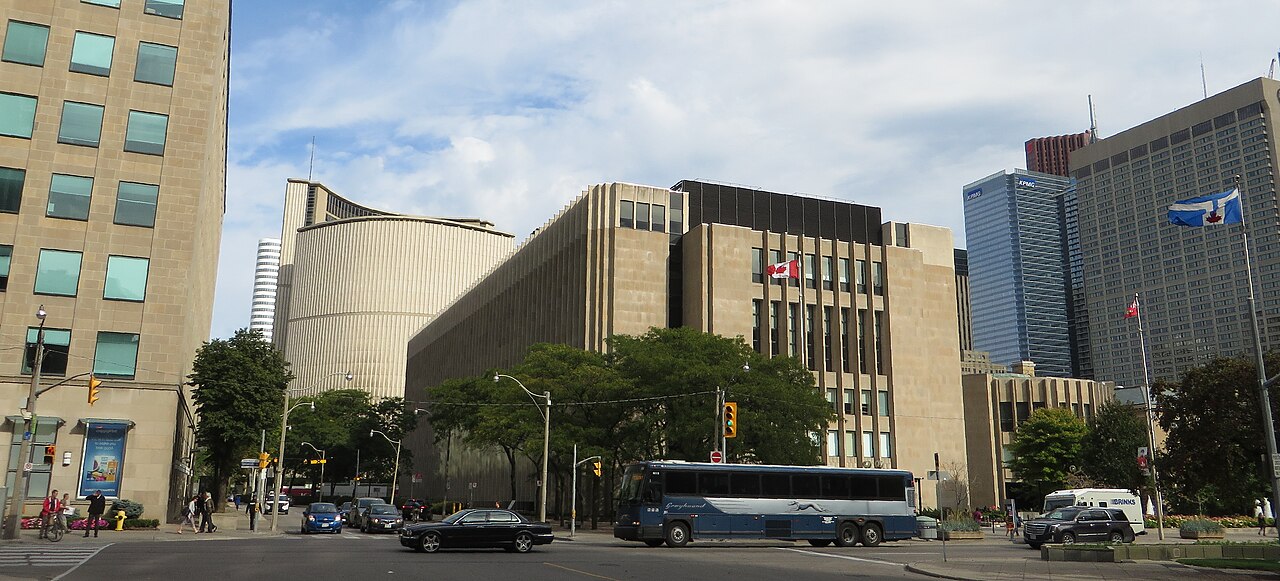
- Hero and in-body photo: "Ontario Superior Court of Justice and Toronto City Hall, Toronto, Ontario" by Ken Lund, licensed CC BY-SA 2.0, via Wikimedia Commons. Pulled 2026-10-21 and reviewed visually before use.