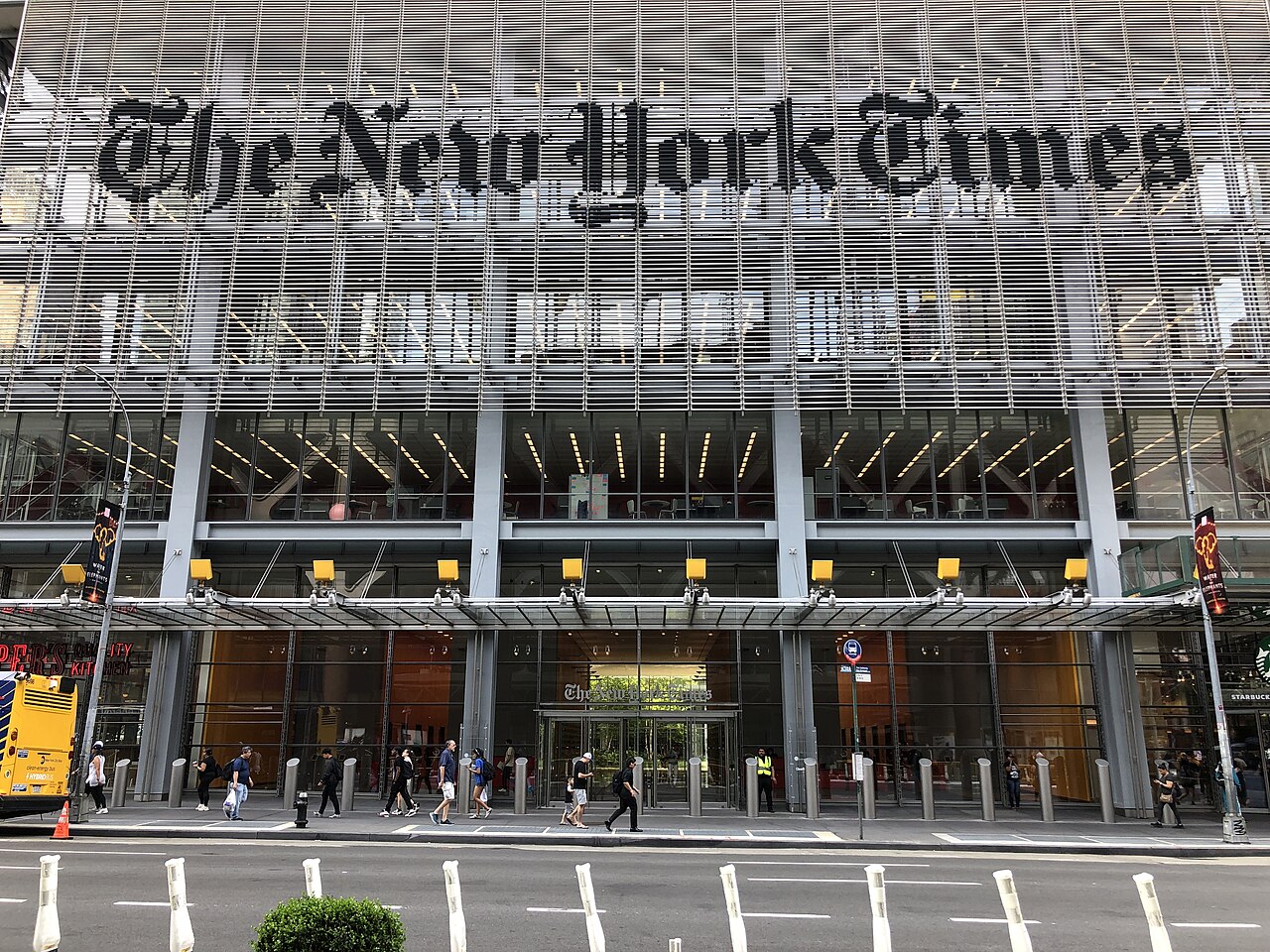
On September 1, 2026, the U.S. Department of Justice filed a statement of interest in federal court in Manhattan, siding with OpenAI's fair-use defense in the copyright litigation brought by The New York Times. Filed and reported on September 2, it is the first known instance of the federal government formally weighing in on the wave of AI-training copyright lawsuits filed against AI labs since 2023. That fact alone makes it worth understanding precisely, because "the government backs OpenAI" and "the government wins the case for OpenAI" are two very different claims, and the filing itself is closer to the first.
 OpenAI
 Microsoft
What the DOJ actually filed
A statement of interest is a formal, non-party submission a federal agency can make in a private lawsuit when it believes the outcome touches a broader government interest. It is not a lawsuit, a ruling, or a binding legal determination. The court is free to agree with it, partially agree with it, or ignore it entirely. Its weight is persuasive, not authoritative, the way an amicus brief carries weight without deciding a case.
The filing was submitted in the U.S. District Court for the Southern District of New York, where Judge Sidney Stein is overseeing a consolidated set of copyright cases against OpenAI and Microsoft brought by The New York Times alongside other publishers, including the Daily News, The Intercept and Ziff Davis. According to reporting on the filing, the DOJ argued that training large language models on copyrighted material generally qualifies as fair use, that the practice is "extraordinarily" transformative, and that the government has "a strong interest in this court rejecting any argument that training LLMs on copyrighted texts violates copyright law." The brief also raised a national security argument: that an adverse ruling could slow U.S. AI development relative to foreign competitors that are not constrained by U.S. copyright law.
Why "transformative" and "market harm" pull in opposite directions
Fair use in U.S. copyright law is not a single test. Courts weigh four statutory factors under 17 U.S.C. Section 107, and no one factor is automatically decisive. The dispute between OpenAI and the Times is, in large part, a dispute about how those four factors apply to a genuinely new kind of use that Congress never anticipated when it wrote the statute.
The four fair-use factors, applied to LLM training
Courts weigh all four factors under 17 U.S.C. Section 107. No single factor is decisive on its own.
Training extracts statistical patterns across billions of documents to build a general-purpose model; the model does not store or reproduce the Times’ articles.
The output is a commercial product that competes directly with the plaintiff’s own business of publishing journalism.
News reporting is largely factual, and facts themselves are not copyrightable, only the specific expression of them.
Times journalism reflects substantial editorial judgment, investigation and original expression, not raw data.
Each article is one of billions of training documents; no single work drives the model’s behavior.
The complaint alleges millions of Times articles were copied in full, not excerpted, to build the training corpus.
DOJ argues the public and scientific benefits of AI training “far outweigh any competitive harm,” and that the model is not a market substitute for reading the Times.
The Times argues a chatbot that answers questions using its reporting, without payment, undermines subscription and licensing revenue that funds journalism.
A lean shown here reflects the strongest public arguments on each side, not a legal conclusion. Judge Stein has not ruled on any factor.
Two of the four factors matter most here, and they cut in opposite directions. The first factor, the purpose and character of the use, favors OpenAI if courts accept that training a general-purpose model on billions of documents is meaningfully different from republishing any one of them, the core of the "transformative use" argument the DOJ's filing leans on. The fourth factor, effect on the market for the original work, favors the Times if a chatbot that can answer questions using the substance of its reporting substitutes for the reporting itself, undermining the subscription and licensing revenue that funds it. A court does not have to pick a side wholesale; it can find a use highly transformative and still rule against fair use if the market harm is severe enough, or vice versa. That is what makes this genuinely unresolved rather than a case where one side is obviously right.
A statement of interest is persuasive, not binding. The court has not decided the case, and this filing does not decide it for them.
Metir AI analysis
The Times has responded that letting AI companies use its journalism without permission or compensation threatens the sustainability of the reporting that a healthy information ecosystem, and by extension AI systems trained on accurate information, actually depends on. That argument sits inside the fourth factor and the second (the nature of the copyrighted work), since original reporting reflects substantial investment and editorial judgment rather than raw, uncopyrightable facts.

The stakes reach well beyond this one case
The Times suit was filed in December 2023 and later consolidated with related claims from other news organizations before the same judge. It is one of dozens of AI-training copyright suits now working through federal courts, brought by authors, visual artists, music publishers and news organizations against nearly every major AI lab. A ruling on fair use in this case, especially one informed by a DOJ filing on the record, would not bind those other cases directly, since each proceeds on its own facts and in its own court. But a well-reasoned opinion from a federal judge on how the four fair-use factors apply to LLM training would be closely read and cited across the docket, making this case more consequential than its single set of parties suggests.
The New York Times v. OpenAI, so far
From the original 2023 complaint to the first federal government intervention in an AI copyright case.
- Dec 2023NYT files suit
The New York Times sues OpenAI and Microsoft in the Southern District of New York, alleging millions of articles were used without permission to train ChatGPT.
- 2024Case consolidated
Related suits from other publishers, including the Daily News, The Intercept and Ziff Davis, are consolidated before U.S. District Judge Sidney Stein.
- Nov 2024Microsoft claims narrowed
A judge dismisses some claims against Microsoft while allowing core claims against OpenAI to proceed.
- Sep 1-2, 2026DOJ statement of interest
The Justice Department files a statement of interest backing OpenAI’s fair-use defense, the first federal intervention in an AI-training copyright suit.
- PendingNo ruling yet
Judge Stein has not ruled on fair use. The DOJ filing is persuasive input, not a decision.
Two different futures for how models get built
The underlying question is really about which of two systems governs how AI companies acquire training data going forward. A fair-use outcome would let labs continue training on publicly available text broadly, with publishers unable to demand payment simply because their content was included in a training corpus. A licensing-market outcome, by contrast, would push labs toward negotiated deals, similar to the content-licensing agreements several AI companies have already signed with individual publishers, turning training data into a priced input rather than a free one. Neither outcome is guaranteed, and the DOJ's filing does not settle which path the law will ultimately take; it is one argument in an unresolved case.
For teams building products on top of these models, the outcome shapes the data layer every model is built on, not just OpenAI's. That uncertainty is one more reason teams increasingly avoid betting a product on a single lab's legal exposure, and instead stay model-agnostic so a ruling that reshapes one company's training practices does not reshape their whole stack. Platforms like Metir AI are built around that portability, giving teams access to models from OpenAI, Anthropic, Google and others side by side rather than tying a product to one vendor's legal outcome.
The takeaway
The DOJ's statement of interest is a real, notable development: the first time the federal government has formally backed an AI lab's fair-use defense in litigation over training data, and evidence that the current administration sees AI competitiveness as a policy interest worth weighing in on. It is not a ruling, and it does not resolve the case. Judge Stein has not decided whether OpenAI's use of the Times' journalism is fair use, and the Times has made clear it intends to keep pressing its claim that the practice amounts to an uncompensated taking of its work. The honest read is that both sides' arguments remain live, the four fair-use factors still point in different directions depending on which one a court weighs most heavily, and the eventual ruling, whenever it comes, will matter well beyond this single lawsuit.
Sources:
- Trump administration backs OpenAI in New York Times copyright lawsuit | Quartz
- Trump administration backs OpenAI in New York Times copyright case over training of chatbots | Local10
- Trump Admin Tells Court: Let OpenAI Rip Off The Intercept's Articles | The Intercept
Image credits
Header image: The New York Times Building at 620 Eighth Avenue in Manhattan, the newspaper's headquarters, photographed by Famartin via Wikimedia Commons, licensed under CC BY-SA 4.0. In-body photograph: the Thurgood Marshall United States Courthouse in Manhattan, home to the Southern District of New York, via Wikimedia Commons, licensed under CC BY-SA 3.0. Neither photo depicts the DOJ filing or any specific court hearing; both show the real buildings involved in this case.