United Airlines announced on November 11, 2026 that it is restricting third-party AI agents from booking its flights and managing reservations on behalf of customers, according to reporting by TechCrunch and Bloomberg. The restriction applies on United's own digital platforms and, indirectly, through travel agencies and aggregators. It is one of the clearest cases so far of a large consumer brand drawing a line around what a customer's AI assistant may do with the customer's account.
What the policy says
Per TechCrunch's report, United said the restriction covers access directly on its digital platforms and indirectly through travel agencies and aggregators, and that it prohibits use by "unauthorized, third-party personal AI agents or assistants." United described the work as including "updates to our booking, ticketing and distribution policies."
The airline gave three reasons:
| Reason | What United said |
|---|---|
| Credential exposure | "Sharing account credentials with personal, third-party, AI assistants can expose sensitive information." |
| Unintended activity | Actions by these tools "may result in unintended purchases, account changes, or use of MileagePlus miles." |
| Federal rules | Federal aviation requirements, such as a human completing check-in and acknowledging that their bags contain no banned substances, cannot be met by an AI agent acting alone. |
A Benzinga report carried on Yahoo Finance adds that fares will remain available through Kayak, Hopper and Google Flights, so price search by comparison sites continues while booking through unauthorized agents does not. TechCrunch's report does not say how United will define an "authorized" agent, or what remains permitted for United's own tools or sanctioned partners, so the boundary between permitted and blocked tools is not yet public.
Sharing account credentials with personal, third-party, AI assistants can expose sensitive information.
United Airlines, as quoted by TechCrunch, November 12, 2026
Three different problems in one policy
The statement bundles distinct issues that are worth separating, because each one has a different fix.
1. Authentication. An agent that logs in as the customer typically holds the customer's password or a session. From the airline's side, that traffic is hard to tell apart from account takeover. This is a security problem that identity technology can address, for example with scoped tokens that grant an agent limited access without sharing a password. Our earlier post on password managers for agents covers one approach to that layer.
2. Authorization and intent. Even with legitimate access, an agent can misread a request. United's reference to unintended purchases and MileagePlus miles is about this: a wrong fare or an unwanted change is a customer service cost to the airline as well as a cost to the traveler.
3. Regulatory duties. The check-in acknowledgment is different in kind. It is a legal attestation that a person must make, and the airline cites it as something an agent cannot do for them. No technical standard for agents changes who the law says must attest.
Because the three are separable, the policy can be read as a position on the first two that rests on the third.
The competing readings
Reporting around the announcement offers two framings, and the evidence in the public record does not settle between them.
- Security and compliance. This is United's stated reasoning, and it fits the timing: Bank of America had urged customers the week before not to share banking passwords with AI assistants, which TechCrunch cites as context.
- Control of the customer relationship. Aviation analyst Henry Harteveldt told CBS News, as paraphrased in the Benzinga report, that the airline wants to avoid another powerful intermediary, alongside Google, metasearch platforms and online travel agencies. That is an interpretation of motive, not a statement from United.
Both can be true at once, since a rule can serve a security purpose and a commercial one. United's wording also targets "unauthorized" third-party agents, which leaves room for agents that have an agreement with the airline. The same logic appears in other agent-commerce disputes we have covered, such as the standoff between Amazon and Meta's Muse agent.
Where the standards work fits
The industry has been building ways for businesses to tell agents what they may do. We covered one of these in our post on the agent-to-business protocol from Meta and Sierra, and the wider interoperability layer in MCP, A2A and related standards. OpenAI's Businesses in ChatGPT beta takes the opposite direction, letting verified merchants deploy their own agents.
United's announcement does not reference any of these standards, so it would be an overreach to say it rejects them. What the announcement does show is the gap those standards aim to fill: until a business can verify who an agent is, whom it acts for and what it is allowed to do, the simplest policy available is to block unverified agents while leaving search to comparison sites.
What to watch next
- The definition of "authorized." Whether United publishes criteria or partners with specific assistants will determine whether this is a ban or a gate.
- Other travel brands. TechCrunch frames United as the latest large US company to block customer agents but names no other airline in this report. Whether peers follow, differ or sign agent agreements is an open question.
- Enforcement. The reports describe no mechanism for how United will detect agent traffic, and detection errors could affect ordinary customers using assistive tools.
- Customer-side workarounds. Agents that operate through the customer's own browser session rather than a server-side integration sit in a gray area that the announcement does not address.
For individuals, the practical lesson is narrower: giving any assistant a password gives it everything that password can do. Tools that ask for approval before an action, and that keep credentials out of the model's view, reduce that exposure, which is part of how assistants such as Metir are designed to work. United's policy is a reminder that the account holder, not the assistant, carries the risk when something goes wrong.
Sources:
- TechCrunch: United Airlines blocks AI agents from booking flights, citing cybersecurity risks (Nov 12, 2026)
- Bloomberg: United Airlines Blocks AI Agents From Booking Flights Ahead of Holiday Travel (Nov 11, 2026)
- Benzinga via Yahoo Finance (Nov 13, 2026): United Airlines Blocks AI Agents From Booking Flights as Analyst Says Carrier Wants to Avoid Another Google-Like Intermediary
Image credits
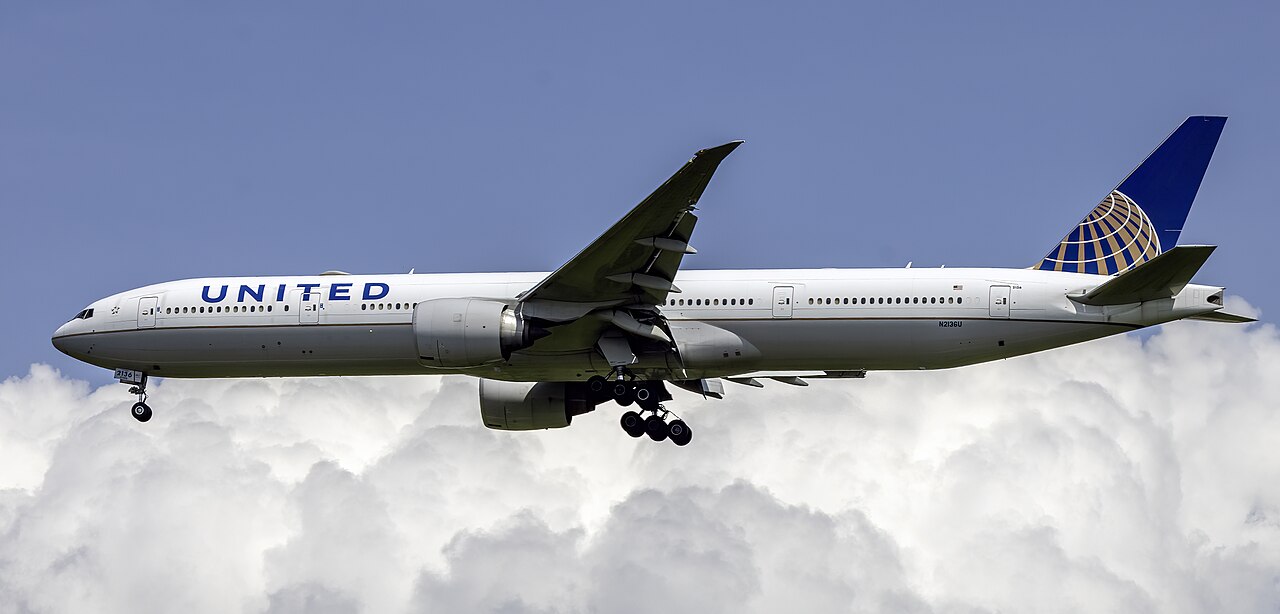
- Hero and in-body photo: United Boeing 777-300ER N2136U, Wikimedia Commons, "United Boeing 777-300ER N2136U IAD VA2.jpg". Author: Acroterion. Licence: CC BY-SA 4.0 (https://creativecommons.org/licenses/by-sa/4.0/).