RobCo, the Munich robotics company, has crossed a $1 billion valuation, roughly doubling the price it carried nine months earlier. Silicon Republic reported that the Wall Street Journal was first to report the milestone on October 5, 2026. The RobCo valuation did not come from a classic funding round. It came from a secondary sale in which employees sold more than $40 million of shares to new and existing investors, a structure worth understanding because it says something different from a primary raise. This piece covers what RobCo builds, how the deal worked, and how to read it against a record year for physical AI funding.
What RobCo builds
RobCo was founded in 2020 out of the Technical University of Munich. Its co-founders are Roman Hölzl (CEO), Paul Maroldt and Constantin Dresel, according to Silicon Republic and Tech Funding News. The company sells what it calls an Autonomous Manufacturing Platform: modular robot hardware paired with physical AI software, offered as robotics-as-a-service. The Robot Report lists machine tending, palletizing, dispensing and welding as target tasks, and names BMW, DynaEnergetics, Fabricated Extrusion Company, T-Systems and Rosenberger among its customers.
The pitch is about programming effort. Traditional industrial arms are reliable but need specialist integrators to program each task. According to the coverage, RobCo's robots can pick up task-specific skills through demonstration and self-learning rather than manual programming, which targets small and mid-sized manufacturers that cannot afford long integration projects. The company has also announced a new autonomous robot called Alfie, with commercial launch reported for March 2027.
How the secondary sale worked
The reported facts are consistent across outlets. Cherry Ventures and European Tech Collective, a group of European technology founders, joined as new investors, while existing backers including Sequoia, Lightspeed, Lingotto and Leitmotif took part, per Silicon Republic and Seeking Alpha's summary of the WSJ report. Tech Funding News adds Greenfield, Kindred and Promus Ventures to the existing-investor list. Hölzl framed it as a reward for staff: "This is an important moment for Robco, and I cannot think of a better way to mark it than by giving some of the people who built this company the opportunity to realise part of the value they created."
In a secondary, existing holders sell stakes they already own. The company's balance sheet does not receive the cash.
The distinction matters. Crypto Briefing explains that in a typical primary round a startup issues new shares and cash lands on its balance sheet, while in a secondary existing holders sell stakes they already own. A secondary does not fund R&D or hiring directly. What it does is set a price, because outside investors agreed to buy at a valuation of $1 billion or more.
Two cautions apply. First, the company's own January announcement did not state a valuation; the roughly $500 million figure for the $100 million Series C comes from press and database reports, so the "doubling" rests on a reported baseline. Second, secondary prices often reflect a smaller block of shares and negotiated terms, so they are not always equivalent to the price of a large new round.
The January round for context
In January 2026, RobCo announced a $100 million Series C led by Lightspeed Venture Partners and Lingotto Innovation, with Sequoia Capital, Greenfield Partners, Kindred Capital, Leitmotif and The Friedkin Group participating. The Robot Report quoted the CEO: "With $100 million of additional funding, we will become the dominant AI robotics company for manufacturing in the U.S. and Europe." RobCo expanded into the United States in 2025, with a lab in San Francisco and operations in Austin. Primary capital for growth arrived in January, and the October secondary gave staff liquidity at a higher price.
Physical AI funding: which number?
RobCo's step-up arrives in a heavy funding year, and the headline total depends on who counts. Crypto Briefing reports that robotics and physical AI startups raised $33.4 billion in the first half of 2026 according to PitchBook, a six-month total it says already exceeds all of 2025. Crunchbase News reports a higher $47.4 billion across 521 deals in the same half, versus $12 billion across 470 deals in the second half of 2025. Crunchbase counts robotics, autonomous vehicles, aerospace, drones, industrial automation and sensors, and its total is led by Waymo's $16 billion round.
Physical AI venture funding: same half-year, two trackers
US$ billions. PitchBook and Crunchbase define the category differently, so the bars are not directly additive.
The gap between $33.4 billion and $47.4 billion is a reminder that "physical AI" has no fixed boundary. A narrower robotics-focused count and a broader one that includes self-driving cars and defense tech tell different stories about how much capital is flowing to factory-floor automation specifically. Readers comparing figures across reports should check the definition before the number.
Where RobCo sits in the market
The demand backdrop is real if less dramatic. Tech Funding News cites 603,000 industrial robots installed worldwide in 2025, up 11%, with an operational stock of 5.079 million, and a projection of 655,000 installations in 2026. Those are conventional robots, which means the market RobCo targets is large but still dominated by machines that need specialist programming.
RobCo's route differs from the better-funded brain-layer companies. We covered one of them in our look at FieldAI's reported $10 billion valuation, which sells software that runs on other makers' machines. RobCo instead sells an integrated package of modular hardware and software, so it carries hardware cost and delivery risk in exchange for owning the customer relationship. It is also a European example in a funding wave often described through US names such as Skild AI or Figure.
What to watch
- Primary financing. A secondary sets a price but adds no cash. Whether RobCo raises a new priced round at or above $1 billion will be the cleaner signal.
- Revenue disclosure. None of the coverage reviewed gave RobCo's revenue, so the valuation cannot be compared to sales.
- Alfie's launch. The reported March 2027 commercial release is the first big test of the learning-based approach beyond current deployments.
- Deployment depth. "More than 1,000 robots deployed" counts units, not contract value or how autonomous each deployment is.
The takeaway
RobCo reaching a $1 billion valuation through an employee secondary sale shows that investors will pay unicorn prices for European industrial robotics with real deployments, and that companies can reward staff without raising new capital. It is also a narrower signal than a headline primary round. Read alongside two funding trackers that disagree by $14 billion for the same half-year, the deal is best treated as one data point in a fast-moving, loosely defined category.
Sources:
- Germany's Robco hits unicorn status after secondary share sale | Silicon Republic
- Europe's new robotics unicorn: Germany's RobCo hits $1B valuation | Tech Funding News
- German robotics startup RobCo hits $1B valuation: WSJ | Seeking Alpha
- RobCo passes $1 billion valuation as investors pile into physical AI | Crypto Briefing
- RobCo raises Series C funding to scale industrial automation | The Robot Report
- VCs Pour Billions Into Physical AI | Crunchbase News
Image credits
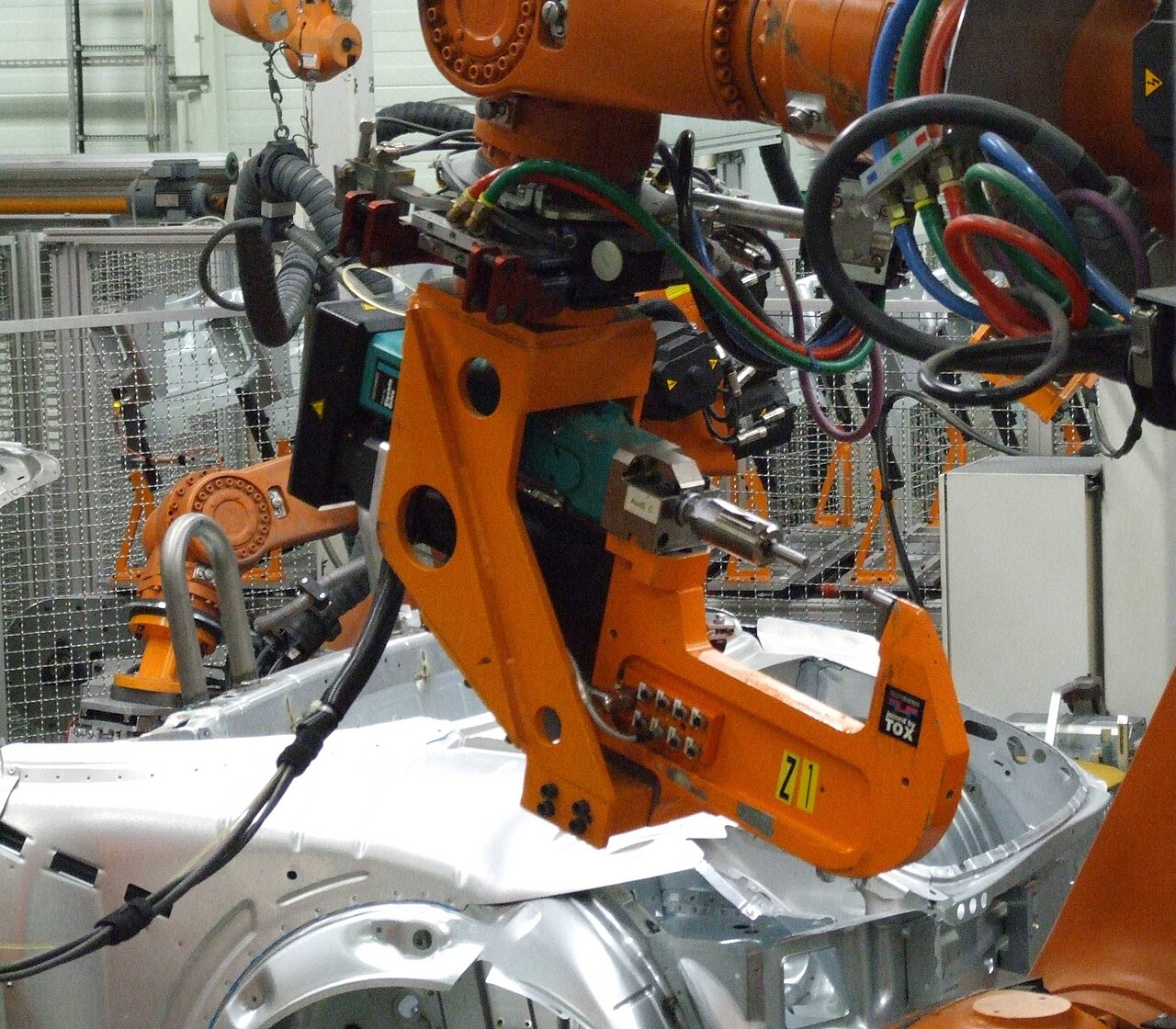
- Industrial robots clinching an automotive body (hero), generic illustration: Nestor Jarque, Wikimedia Commons, CC BY 3.0.
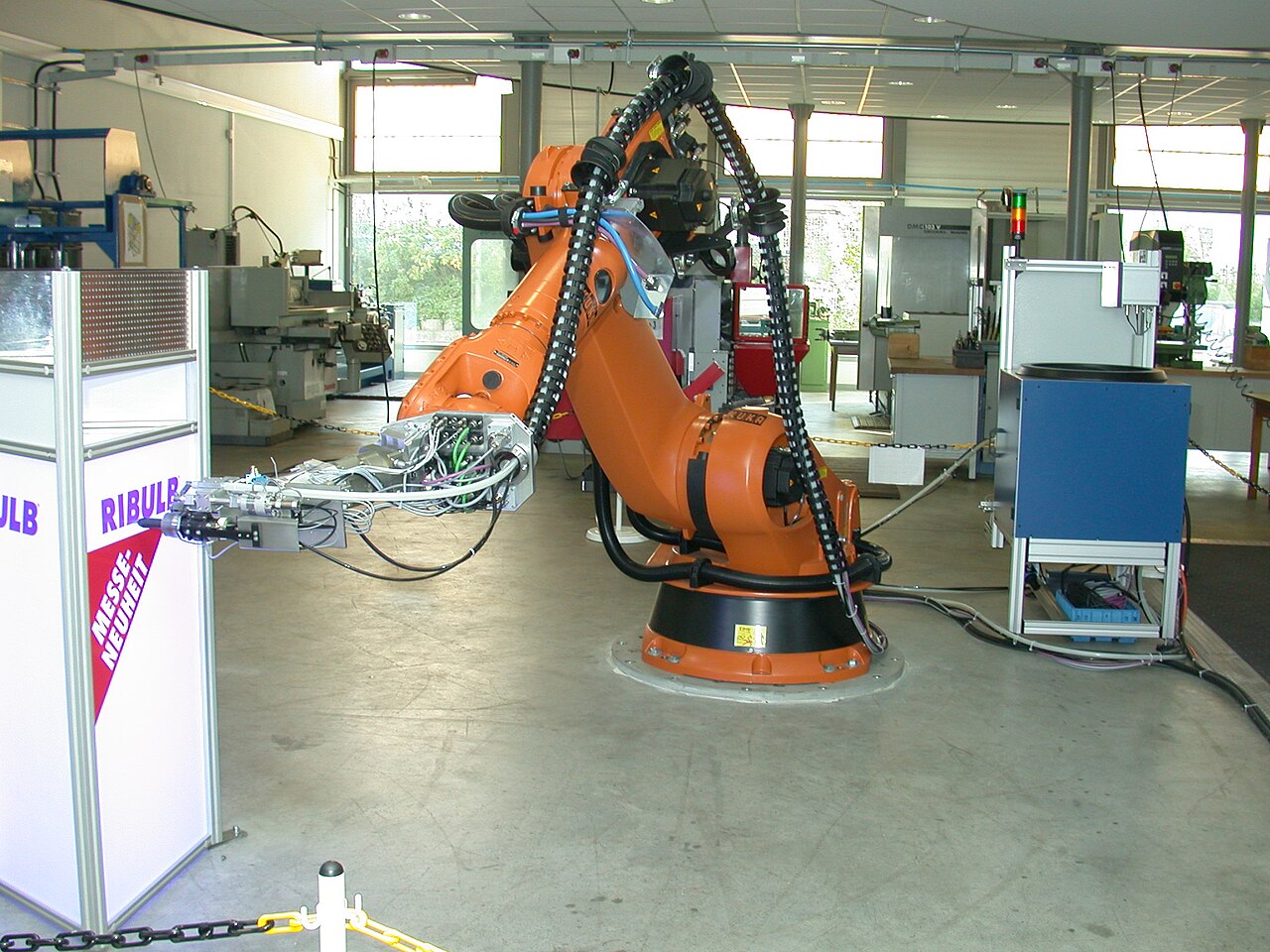
- Industrial robot arm with riveting tool in a workshop cell, generic illustration: Michael KR, Wikimedia Commons, CC BY-SA 4.0.