FieldAI, the startup building what it calls a universal "brain" for robots, has signed a term sheet to raise $700 million at a $10 billion valuation, Business Insider reported on October 2, 2026. If the round closes on those terms, the FieldAI valuation would be five times the $2 billion it reached in August 2025. The company does not make robots. It sells software that runs on other people's machines, and according to the report its revenue and signed customer contracts together now exceed $135 million across more than 30 customers. This piece explains what FieldAI's "Field Foundation Models" are, how its strategy differs from humanoid-first rivals, and what a $10 billion price tag implies.
What FieldAI is raising, and what has been confirmed
The details come from Business Insider, which said FieldAI has signed a term sheet but that the financing has not formally closed. Coverage summarizing the report, including The Next Web and the Orange County Business Journal, describes FieldAI's software as a "universal general-purpose brain" that runs humanoids, robot dogs, drones and industrial rovers for construction, data center and defense customers. The same reporting says the combined revenue and contract figure rose by at least $35 million since June. The Orange County Business Journal noted it had asked FieldAI for confirmation at the time of publication, so the figures should be read as reported rather than announced.
The previous round is better documented. In August 2025, FieldAI said it had raised $405 million across two consecutive rounds, the most recent a $314 million round co-led by Bezos Expeditions, Prysm and Temasek. Other backers named at the time included Khosla Ventures, Intel Capital, Canaan Partners, BHP Ventures, Emerson Collective, Gates Frontier, Samsung and NVIDIA's venture arm, NVentures. That raise put the company at a $2 billion valuation.
 NVIDIA
What a "Field Foundation Model" actually is
Most of the recent excitement in AI comes from large language and vision models trained on internet-scale text and images. FieldAI's pitch is that robots in the real world need something built differently. On its website, the company describes Field Foundation Models (FFMs) as "a new class of risk-aware robotics AI" centered on what it calls a Belief World Model, a predictive engine intended to let machines "reason under uncertainty." Its product, EDGE, is marketed as a "general-purpose robot brain" with "one brain across robots, tasks, and environments."
The design choice that stands out is how FieldAI treats risk. At the time of the 2025 raise, CEO Ali Agha said: "Rather than attempting to shoehorn large language and vision models into robotics... we have designed intrinsically risk-aware architectures from the ground up," according to The Robot Report. In an interview with TechCrunch, Agha, who previously worked at NASA and MIT, described the core idea as building physics into the models so a robot can judge its own confidence rather than blindly following instructions. The company says its models let robots operate in dynamic, unstructured places without prior maps or GPS.
Why does this matter? A chatbot that is wrong produces a bad paragraph. A robot that is wrong on a construction site or an energy facility can damage equipment or hurt someone. A model that estimates its own uncertainty can, in principle, slow down, pick a safer route, or stop and ask, which is the behaviour industrial buyers need before they let a machine work unsupervised.
Software on existing robots versus humanoids first
The physical-AI field broadly splits into two strategies. One group builds its own hardware, most visibly humanoids. Figure said in September 2025 that its Series C brought committed capital above $1 billion at a $39 billion post-money valuation, with funds going toward general-purpose humanoids. The other group sells the brain and lets others supply the body. FieldAI sits firmly in the second camp, alongside Skild AI, which builds foundation models meant to be retrofitted to many different robots, and Physical Intelligence, which develops general-purpose models for tasks such as folding laundry.
The humanoid makers are betting on a new body. FieldAI is betting that the bodies already exist and only the brain is missing.
On the software-first strategy
Within the software camp, FieldAI's emphasis is distinctive. Its deployments have been in construction, energy, manufacturing, urban delivery and inspection, and Construction Dive reported that the software had been deployed across hundreds of industrial sites in the U.S., Japan and Europe, including jobsites where it captures data to build building information models. Rather than waiting for a capable humanoid at a viable price, FieldAI's approach sells into machines customers can buy today, such as quadrupeds and wheeled rovers, in settings where the job is mostly to move safely, look and record.
The tradeoff is clear. A software-only company avoids the capital burden of manufacturing, but it depends on hardware partners and must prove that one brain really does transfer across very different bodies. Humanoid makers control the full stack, but they carry the cost and timeline risk of building a new machine category.
The physical AI funding wave in context
FieldAI's round lands in a record year. Robotics startups had raised $18.8 billion globally in 2026 by Crunchbase's count at mid-year, already more than the $15 billion raised in all of 2025 and the $14.1 billion of the 2021 peak. Large rounds this year include Skild AI's $1.4 billion Series C led by SoftBank at a $14 billion valuation, up from $4.5 billion in mid-2025, and Physical Intelligence's reported talks to raise about $1 billion at more than $11 billion, roughly double its $5.6 billion valuation four months earlier. We covered another piece of the same wave in our look at Atoms' $1.7 billion physical AI raise.
Robot-brain startups: previous vs latest valuation
US$ billions. Latest figures for FieldAI and Physical Intelligence are reported terms, not announced closings.
Seen side by side, the pattern is a sharp repricing of the brain layer. FieldAI's reported 5x step-up is the largest multiple of the three, though it starts from the lowest base, and its new price would still sit slightly below Physical Intelligence and Skild AI.
Reading the valuation-to-revenue multiple
A simple calculation helps frame the price. Dividing $10 billion by the reported $135 million gives roughly 74 times. But that denominator is generous: it mixes recognized revenue with signed contract value, which may be multi-year and not yet delivered. On recognized annual revenue alone, the multiple would be higher, by an amount the public reporting does not let anyone calculate.
That makes the comparison to typical software multiples imprecise, but the direction is clear. Investors are not pricing FieldAI on current sales. They are pricing the option that a single robot brain becomes a standard layer across many fleets and industries, much as operating systems became a standard layer across PCs. The same logic shows up in AI software more broadly: value accrues to whoever owns the layer that works across many underlying systems. It is the same reason model-agnostic tools such as Metir route across several AI providers rather than binding to one.

Open questions
Several things remain unknown and worth watching:
- Closing terms. A signed term sheet is not a closed round. The lead investor and final valuation had not been publicly confirmed at the time of the report.
- Revenue quality. How much of the $135 million is recognized revenue, how much is recurring, and how much is backlog spread over several years?
- Transfer across bodies. The "one brain, many robots" claim is the core of the thesis. Independent evidence of performance across very different platforms will matter more than investor enthusiasm.
- Competition from hardware makers. If humanoid and quadruped makers build strong in-house brains, the market for a third-party brain could narrow.
- Defense exposure. Reported defense customers can bring large contracts, but also concentration and policy risk.
The takeaway
FieldAI's reported round shows investors treating the robot brain as a distinct and valuable layer, separate from the robots themselves. Its bet is practical: put risk-aware AI onto machines that already exist, in industries that already need inspection and autonomy, and earn revenue while the humanoid market matures. For more on how frontier models are being wired into physical machines, see our piece on HomeBody and embodied AI. Whether a $10 billion price is justified will depend less on this round than on what FieldAI's contracts turn into over the next few years.
Sources:
- Robotics Company FieldAI Set to Raise $700M at $10B Valuation: BI | Orange County Business Journal
- Robot software startup FieldAI is set to raise $700M at a $10B valuation | The Next Web
- FieldAI raises $405M to build universal robot brains | TechCrunch
- FieldAI raises $405M to scale "physics first" foundation models for robots | The Robot Report
- Robotic software startup FieldAI lands $405M in fresh funding | Construction Dive
- FieldAI company website
- Robotics software maker Skild AI hits $14B valuation | TechCrunch
- Physical Intelligence is reportedly in talks to raise $1 billion, again | TechCrunch via Yahoo Finance
- Figure AI passes $1B with Series C funding toward humanoid robot development | The Robot Report
- Robotics startups on fire as venture funding surges to record numbers in 2026 | Crunchbase News
Image credits
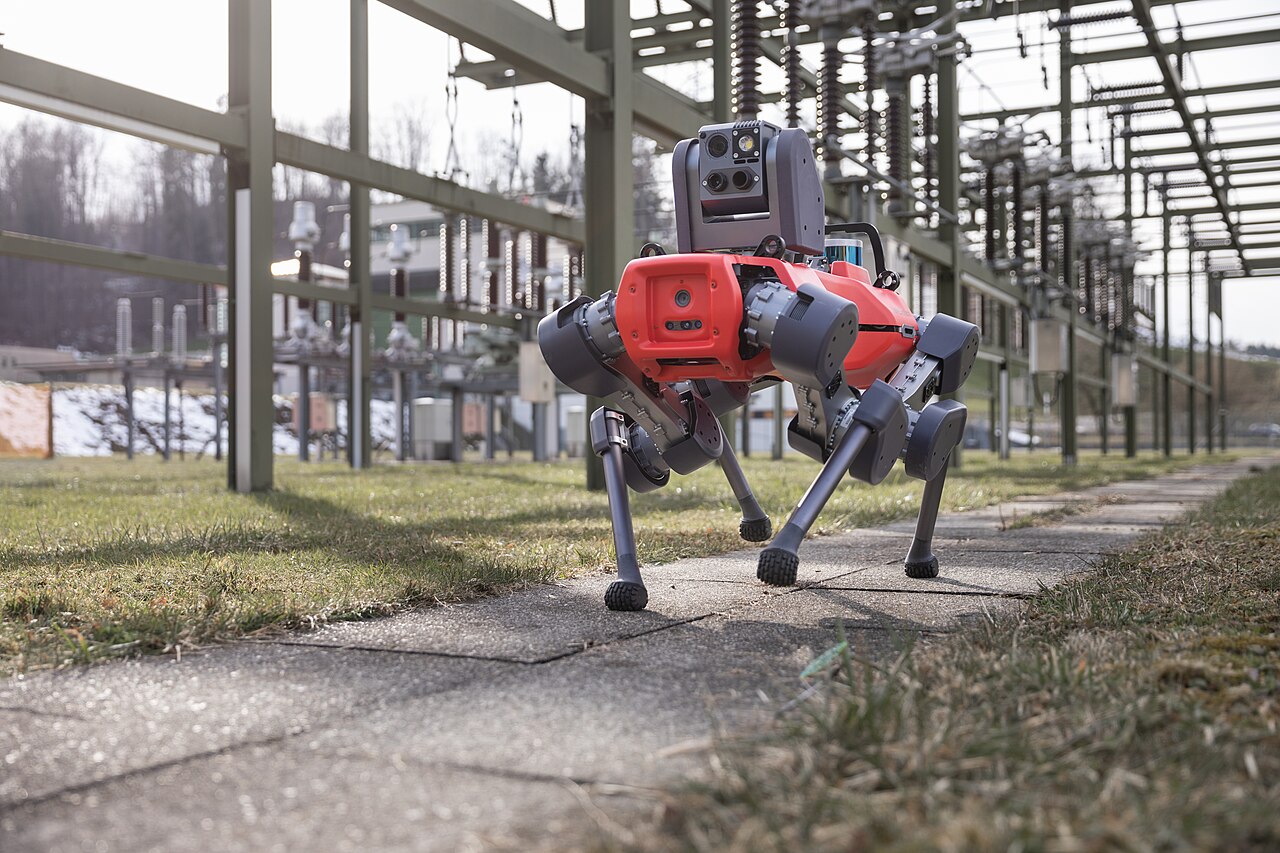
- ANYbotics ANYmal D robot inspecting an electrical substation (hero): Cvoellmy, Wikimedia Commons, CC BY-SA 4.0.
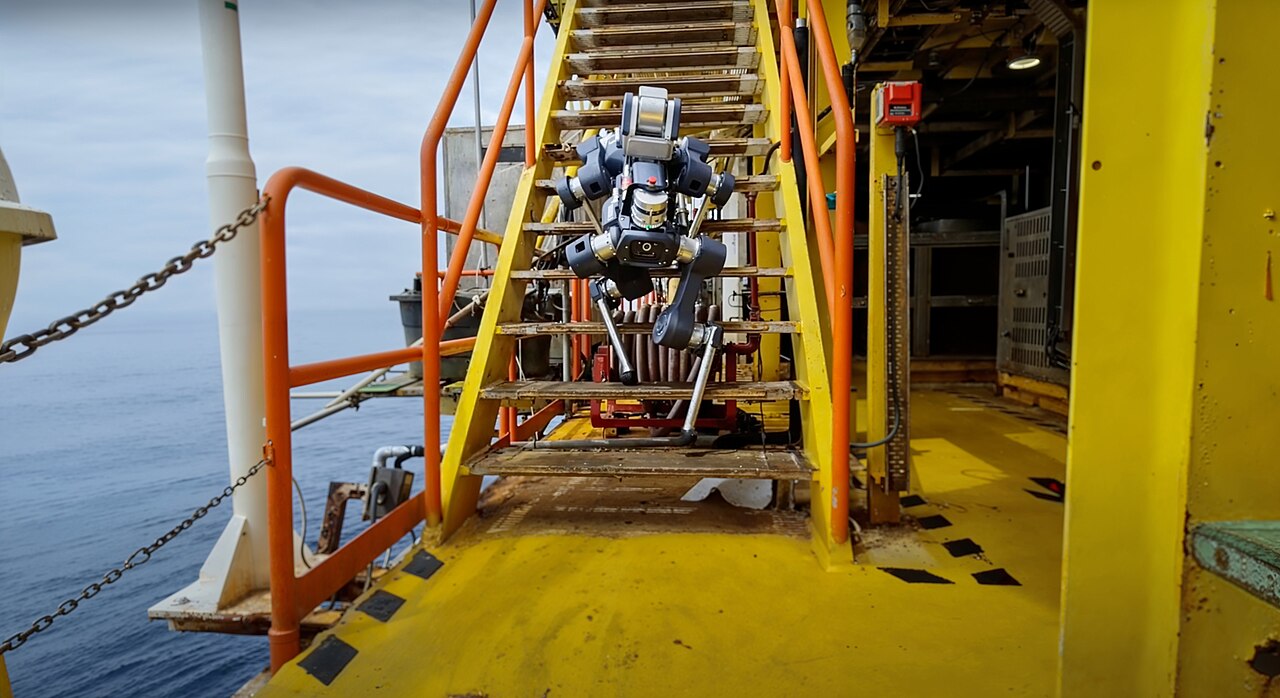
- ANYmal X robot on an offshore platform staircase: Cvoellmy, Wikimedia Commons, CC BY-SA 4.0.
- Boston Dynamics Spot during exercise Agile Liberty 21-2, August 2021: Senior Airman John Ennis, U.S. Air Force, Wikimedia Commons, public domain.