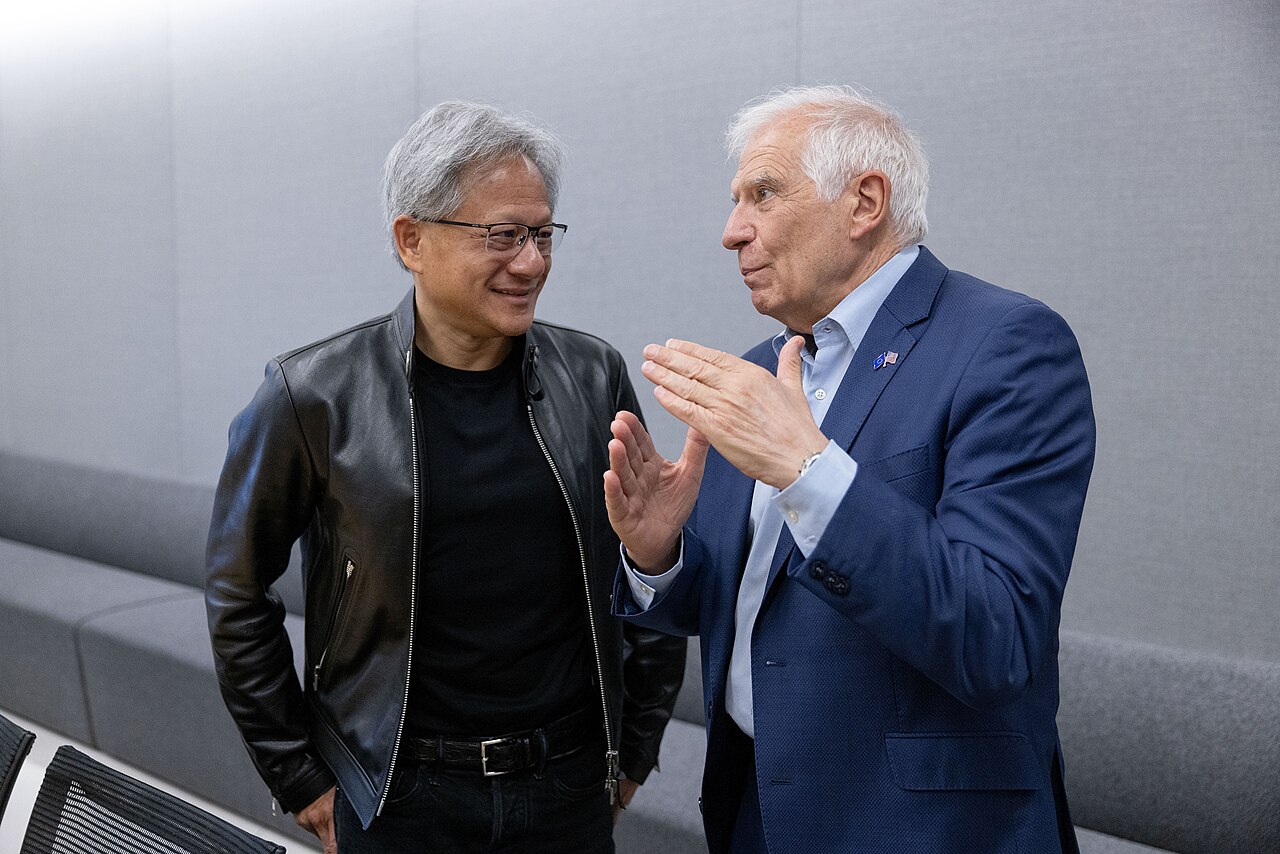
On July 24, 2026, Nvidia CEO Jensen Huang posted a policy letter on X titled "Open Weights and American AI Leadership," and within a day dozens of companies, from chipmakers to cloud platforms to two-person startups, had put their name on it. The letter argues that Washington should not respond to rising competition from Chinese open-weight AI models by broadly restricting open-weight models at home. It is a genuine coalition document, and it is also a moment where the open-versus-closed debate in AI policy became visible all at once, with predictable and some less predictable names on each side.
 NVIDIA
 Microsoft
 Meta
Meta OpenAI
What the letter actually says
Nvidia's letter opens by comparing this moment to the rise of open-source software in the 1980s, arguing that American AI leadership "will be judged not by one frontier AI model, but by whether the United States builds a strong, open ecosystem that diffuses into every sector." Open weight models, defined in the letter as "AI models that anyone can download, inspect, modify, and run on their own infrastructure," are framed as central to that ecosystem: they let organizations "match the right model to the right job at the right cost," and they prevent AI capability from concentrating inside a handful of closed providers.
The letter's most pointed argument is a security one, and it is worth quoting directly because it inverts the usual assumption that closed systems are inherently safer.
Relying solely on closed models is not inherently safe: they can be breached, misused, or fail in ways that outsiders cannot detect.
'Open Weights and American AI Leadership,' July 24, 2026
The letter goes on to argue that concentrating advanced AI behind a small number of closed models creates "a small number of single points of failure," while open weights let "a broad community of researchers and developers examine their behavior, identify vulnerabilities, develop safeguards, and improve them over time." It closes with a specific policy ask: that regulators avoid conflating distillation, described as "a widely used technique for model improvement, evaluation, and validation," with unlawful misappropriation of a closed model's outputs, and instead address IP theft through "targeted legal and commercial frameworks rather than sweeping restrictions."
A coalition that grew by the hour
The letter launched with roughly 25 signatories on July 24, including Nvidia, Microsoft, Meta, IBM, Dell Technologies, Palantir, Hugging Face, Mistral, Mozilla, The Linux Foundation, Perplexity, Replit, ServiceNow, CrowdStrike, Box, Andreessen Horowitz, Y Combinator, Arcee AI, Black Forest Labs and Reflection, according to reporting from Tom's Hardware and others who reviewed the launch document. Within about 24 hours that list had grown past 35, adding OpenAI, Cisco, Cohere, GitHub, Fireworks AI, Nous Research, Palo Alto Networks, Prime Intellect and DoorDash, per FourWeekMBA's tracking of the rollout. Forbes reported the count approaching 50 by the following day.
The signatory list grew fast, and kept growing
Reported signatory counts for the "Open Weights and American AI Leadership" letter across its first roughly 48 hours. Because Nvidia hosts it as a living, rolling document, later snapshots (including one read for this piece) list more than 70 names.
Counts vary by outlet and by the moment the rolling document was checked; treat these as reported snapshots, not a single official total.
Nvidia hosts the letter as a rolling document rather than a static press release, and it shows: the version of the PDF pulled for this piece, still dated July 24, 2026 at the top, lists 77 organizations, spanning chipmakers (AMD), cloud and infrastructure names (Cloudflare, Nebius, SpaceX), developer-tooling companies (LangChain, Modal, Vercel, Ollama) and AI labs and startups across the open and closed spectrum. That count will likely be different again by the time this is read, which is itself part of the story: this was engineered as a fast-moving show of industry consensus, not a one-time signing event.
Who signed, and the notable gaps
Reporting on Google's status conflicted. Tom's Hardware's initial coverage listed Google among the companies absent from the July 24 launch, alongside OpenAI and Anthropic. Other outlets reported that Google CEO Sundar Pichai publicly endorsed the letter on X the following day, and separate coverage described Google appearing on an expanded roster later in the week. The 77-name document pulled for this piece does include Google. Given that spread, the honest summary is that Google was not among the original signatories and joined at some point in the days that followed, with outlets disagreeing on exactly when.
 Google
Anthropic and Amazon were the most consistently cited holdouts. Neither appeared on any version of the signatory list reviewed for this piece, including the 77-name document. Elon Musk publicly endorsed Huang's post on X, calling it something he fully supported, but xAI itself is not listed as a formal signatory either. Anthropic's specific reasoning for staying off the letter, and the pointed internal criticism it drew from some of its own employees, is its own story: Anthropic's position.
 Anthropic
Why the letter landed on July 24
The timing was not incidental. On July 22, 2026, TechCrunch reported that Michael Kratsios, the White House's science and technology policy chief, had accused China's Moonshot AI of distilling Anthropic's "Fable" model to help build its Kimi K3 model, which launched in mid-July. Treasury Secretary Scott Bessent said the administration would examine Chinese open-weight models for evidence of "industrial-scale distillation" amounting to intellectual property theft, warning that "sanctions and Entity List designations will be on the table." Some AI researchers quoted in that coverage questioned the timeline, noting Fable had only been publicly available since July 1, roughly 15 days before Kimi K3 shipped.
 Moonshot
That accusation, and the sanctions threat attached to it, is the backdrop the letter was written against. Nvidia's signatories are not defending Moonshot; the letter is explicitly framed as being about American AI leadership. Their concern, as the letter states directly, is that a policy response built to punish one accused Chinese lab could sweep in ordinary American startups that use distillation as a routine, legal technique to build and evaluate their own models.
Who signed, who didn't, and why it isn't a clean open-vs-closed line
A qualitative snapshot, not an exhaustive roster. Several signatories sell closed software elsewhere in their business; several Chinese labs below are not signatories at all, but are the reason the letter exists.
Signatory rosters shifted by the day on a live document; see this post's Sources for the specific reports behind each entry.
Why a chipmaker leads this fight
It is worth being explicit about incentives on both sides of this letter, because they explain a lot about who signed and who didn't. Nvidia's business grows when more organizations train and run more models, on more infrastructure, regardless of whether those models are open or closed. A world with thousands of open-weight models running on self-hosted GPU clusters is, if anything, a better outcome for Nvidia than a world where a handful of closed APIs from a small number of providers concentrate demand. A frontier lab selling a closed model through its own API has a different calculation: openness means competitors, including cheaper or specialized open alternatives, can erode the pricing power of that one flagship model.
That does not make either position dishonest, but it is a useful lens on the letter's signatory list. Cloud platforms, chip and infrastructure vendors, and companies that sell tools around models (Hugging Face, Replit, GitHub, LangChain) have comparatively little to lose and plenty to gain from an open ecosystem staying legal and unrestricted. It is also worth noting the letter's own tension: several signatories, including Nvidia itself with CUDA, keep their own most valuable software closed and proprietary, even while arguing for openness at the model-weights layer. That is not necessarily a contradiction, weights and tooling are different layers of the stack, but it is a distinction the letter does not dwell on.
The security argument, both ways
The letter's core safety claim, that openness can be more secure than obscurity because it lets more people find and fix flaws, mirrors a genuinely long-running argument in software security, sometimes called "given enough eyeballs, all bugs are shallow." It is not an unreasonable position, and the letter is right that closed systems have also been breached, misused or found to fail in undetectable ways.
The competing view, held informally by some of the letter's most notable absentees, is that once a frontier model's weights are released, they cannot be recalled, retrained away from harmful behavior, or updated the way a hosted API can be patched overnight. That is also true, and it is the reason China's own open-weight releases, from DeepSeek's earlier models to Moonshot's Kimi line, are treated by US policymakers as both a competitive threat and a governance problem at the same time: the same openness that lets American startups build on Meta's or Mistral's weights lets any actor, anywhere, build on a released Chinese model too, and vice versa. Neither side of that argument has been settled by this letter, and this piece is not going to settle it either. Both readings of the security tradeoff remain genuinely open.
The takeaway
Nvidia's letter did what a well-organized policy campaign is supposed to do: it took a somewhat technical, internal industry disagreement over model distillation and open-weight restrictions and put it in front of Washington with dozens of recognizable logos attached, growing by the day. It also drew a fairly clean, if imperfect, line through the industry: companies whose business benefits from an open, plural model layer signed quickly; the two frontier labs most identified with tightly controlled, closed frontier models did not. Whichever way this specific fight resolves, in whatever the American AI leadership question, the practical case for most teams building on AI right now is not to bet exclusively on either camp. Open-weight and closed models both keep improving on their own timelines, and the safer position at the application layer is being able to use whichever one fits a given job, rather than being locked into one provider's stance in this debate. That model-agnostic approach, giving teams access to leading models across providers in one workspace, is the logic Metir AI applies day to day, independent of how the open-versus-closed policy question ultimately shakes out.
Sources:
- Open Weights and American AI Leadership, July 24, 2026
- Nvidia and 24 other companies sign open-weights letter as Washington weighs Chinese AI model ban | Tom's Hardware
- Nvidia Open Weights Letter Doubled To 50 Without Amazon And Anthropic | Forbes
- OpenAI Signs the Open-Weights Letter It Skipped at Launch, and the Coalition Grew to 35 in a Day | FourWeekMBA
- OpenAI and Google join growing coalition for open-weight AI as Elon Musk endorses Jensen Huang's call for American AI leadership | Tech Startups
- 25 American Companies Sign Joint Letter Opposing Restrictions on Open-Weight Models; OpenAI Among Non-Participants | Winzheng
- Nvidia-hosted open-weights letter doubles to 50 signatories as Washington weighs China restrictions | MLQ News
- Nvidia, Microsoft, Meta warn against 'premature restrictions' of open-weight models | CNBC
- Treasury threatens sanctions after White House claims Moonshot distilled Anthropic's Fable | TechCrunch
- Open Weights letter: 25 signers, and what it changes | PacketNebula
- Open Weights and American AI Leadership Letter: NVIDIA, Google, Microsoft, Updated | ExplainX
Image credits
Header image: Jensen Huang, founder and CEO of Nvidia, in conversation with Josep Borrell Fontelles, then the European Union's High Representative for Foreign Affairs and Security Policy, photographed in 2024. Via Wikimedia Commons, licensed under CC BY 4.0. This photograph predates the July 2026 letter and is used solely as a portrait of Huang, not as documentation of the letter's release. In-body photograph: the United States Capitol building, Washington, D.C., via Wikimedia Commons, public domain.