
Nscale, a London-based AI cloud infrastructure firm founded in 2024, is in talks to raise about $3.5 billion in pre-IPO financing ahead of a planned New York listing, according to reporting in early September 2026. The round is anchored by roughly $2 billion from Nvidia and up to $1.5 billion in convertible notes led by Daniel Loeb's Third Point, with Goldman Sachs advising. The number that makes the raise legible is the one behind it: a contracted revenue backlog that has ballooned to around $103 billion, nearly doubling from about $51 billion a month earlier.
 NVIDIA
 Anthropic
 Microsoft
 OpenAI
That kind of growth invites both enthusiasm and skepticism, and both are warranted. Nscale is a clear example of the "neocloud," a category of specialized AI cloud providers that rent out clusters of Nvidia GPUs to companies whose businesses depend on massive compute. Understanding why this raise is happening, and why it carries real risk, means looking at how that model is financed rather than just the headline figures.
What the money is actually for
The structure of the round is the tell. Roughly $2 billion of it is a direct investment from Nvidia, and up to $1.5 billion is convertible notes led by Third Point, priced at a double-digit discount to the eventual IPO price with conversion adjustments capped at a $30 billion valuation. For context, Nscale's most recent private valuation was $14.6 billion, set at a $2 billion Series C round in March 2026. If the IPO proceeds, it could raise roughly $3 billion more on top of the private financing.
How the pre-IPO round is put together
Two tranches of roughly $3.5 billion, raised privately, ahead of a New York listing that could add about $3 billion more.
Nvidia investing in a cloud that buys Nvidia chips is the circular pattern investors are watching across the neocloud sector.
Neoclouds are capital-intensive in a specific, punishing way. Building AI data centers means buying enormous quantities of GPUs upfront, securing power and physical sites, and signing multi-year customer contracts, all before most of the revenue arrives. That mismatch, huge capital outlays now against revenue spread over years, is why a firm like Nscale raises debt and equity in large tranches and moves quickly toward public markets: it needs continuous access to capital to keep building ahead of demand. The pre-IPO round is bridge financing for a construction schedule, not a war chest for a mature, cash-generating business.
The backlog is real, and it is not cash
The catalyst for the backlog's jump is concrete: a six-year, roughly $45 billion agreement with Anthropic for capacity at Nscale's West Virginia campus, a deal we examined in more detail here. Nscale has also reportedly secured contracts with Microsoft and OpenAI. Stacked together, those commitments produced the leap from about $51 billion to about $103 billion in roughly a month.
A backlog that nearly doubled in a month
Nscale's reported contracted revenue backlog, before and after its $45B Anthropic agreement, with CoreWeave's backlog shown for scale. In billions of US dollars.
A backlog is contracted future revenue, not cash in hand. It depends on customers paying as promised over multi-year terms.
A backlog of this size is a genuine asset and a genuine caveat at once. It is contracted future revenue, which is exactly what a bank wants to see before underwriting an IPO, and it is why the raise can be framed against a $30 billion valuation cap rather than the $14.6 billion of six months ago. But a backlog is a promise, not a bank balance. It converts to revenue only if the customers pay as agreed over the full term, if the capacity gets built on schedule, and if none of those customers renegotiate or walk. The AI infrastructure market has already seen a letter of intent for a major site evaporate: Microsoft held one for the same West Virginia campus before stepping away, and Anthropic took its place. Backlogs can shrink as fast as they grew.
A backlog is contracted future revenue, not cash in hand. It converts only if every customer pays as promised, for years.
On reading neocloud financials
The circularity worth watching
The most scrutinized feature of this raise is Nvidia's role in it. Nvidia is investing about $2 billion in a company whose entire business is buying and deploying Nvidia GPUs. That is not unique to Nscale; it is a pattern repeating across the neocloud sector, where the dominant chip supplier also helps finance the customers that buy its chips. The arrangement can be read two ways, and honesty requires holding both.
The benign reading is that Nvidia is smoothing the supply chain for its own hardware, ensuring there is enough well-capitalized cloud capacity to absorb the chips it produces, which is rational for any supplier facing demand it cannot serve directly. The cautionary reading is that vendor financing can flatter demand: when the supplier funds the buyer, some portion of "demand" for the product is demand the supplier itself underwrote. Neither reading is proven by the deal alone. What the pattern does is make the sector's growth harder to assess from the outside, because the same company sits on multiple sides of the transaction.
The CoreWeave comparison, and its limits
Nscale is following a path CoreWeave laid down. CoreWeave went public on Nasdaq in March 2025, raising about $1.5 billion, and its stock has risen sharply since, on the back of a backlog of its own in the tens of billions. That precedent is part of why Nscale's bankers can move confidently toward a listing: public markets have already shown appetite for the neocloud story.
The comparison also imports CoreWeave's warning signs. Both companies carry heavy backlogs against heavy liabilities, both depend on a concentrated set of very large customers, and both are exposed to the same core question: what happens to a business built entirely on renting one vendor's chips if AI compute demand slows, if the chips depreciate faster than expected, or if a marquee customer restructures a contract. CoreWeave's post-IPO trading has been volatile precisely because investors keep re-pricing those risks. Nscale would inherit the same debate.
The model-agnostic angle
For companies buying compute rather than selling it, the neocloud boom has a quieter implication. The infrastructure layer is consolidating around a handful of very large providers and one dominant chipmaker, which is efficient but concentrates dependence. The same lesson that applies at the model layer applies here: the fewer suppliers a workload can run on, the more exposed it is to any one of them changing terms, pricing, or availability. Teams that keep their AI workloads portable, able to run across models and across providers rather than welded to a single stack, retain leverage that a locked-in buyer gives up. Platforms like Metir that stay model-agnostic are one expression of that principle at the software layer, and the neocloud consolidation is the same argument playing out one level down, in silicon and power.
The honest read on Nscale's raise is that it is a credible, well-backed bet on continued AI compute demand, resting on real contracts and a proven public-market template, and carrying real, unresolved risks around customer concentration, vendor circularity, and the gap between a backlog and a bank balance. It is neither the sure thing the headline backlog implies nor the bubble its skeptics assert. It is a high-conviction infrastructure bet whose payoff depends on demand staying where the contracts assume it will.
Sources:
- AI compute provider Nscale is looking for $3.5B in pre-IPO financing | TechCrunch
- AI cloud firm Nscale seeking $3.5B in pre-IPO financing from Nvidia and Third Point | The Next Web
- Nscale Aims for $3.5B Pre-IPO Financing, Eyes $30B Valuation | KuCoin
- Nscale seeks about $3.5 billion pre-IPO funding, source says | KSL
- As CoreWeave Files for IPO, Will NVIDIA Tighten Its Grip on the AI Cloud? | Data Center Frontier
Image credits
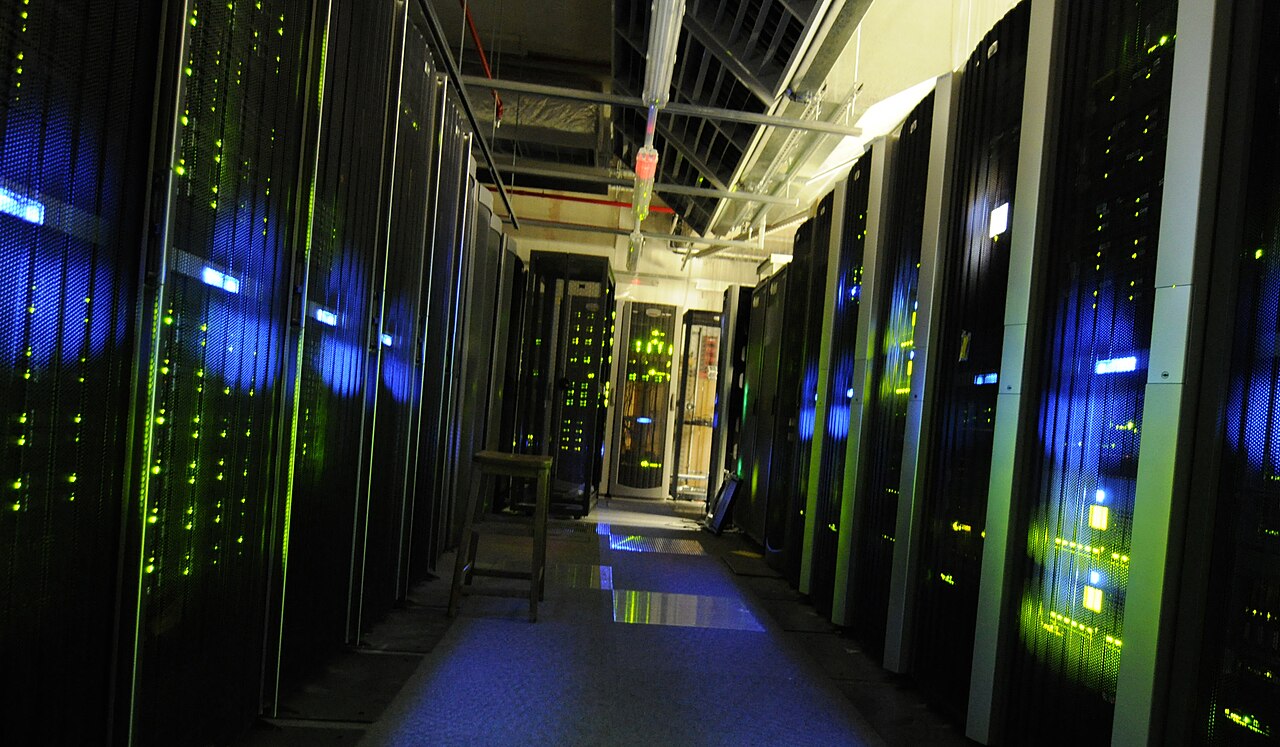
Hero image: the New York Stock Exchange on Wall Street, photographed by Arild Vagen, via Wikimedia Commons, licensed under CC BY-SA 4.0. In-body photograph: a data center server hall by The National Archives (UK), via Wikimedia Commons, licensed under CC BY 3.0. The data center photograph is a generic illustration and does not depict Nscale's own facilities.