On November 5, 2026, the evaluation group METR published an assessment of whether AI is accelerating AI research at Anthropic. Its headline: as of October 2026, Anthropic is likely improving capabilities on well-specified tasks at "around twice the rate" it did from March 2024 to October 2025, according to METR's report. METR also says it would not be surprised if the true multiple were 1.3x or 3x.
 Anthropic
The report is notable less for the number than for how it was produced and how uncertain METR says it is. This post walks through the method, the spread of estimates, and what the access limits mean for how much weight a reader can place on the result.
What METR did
METR staff ran a high-access evaluation at Anthropic from August 12 to October 29, 2026, with the report submitted November 3 and dated November 5. The assessment asked three questions: whether Anthropic's capability growth accelerated, how much of any acceleration is attributable to AI, and whether bottlenecks could limit acceleration.
The primary method uses AECI, Anthropic's version of the Epoch Capabilities Index. METR reports that the trend slope rose from about 15 points per year to about 29 points per year, with a breakpoint on October 7, 2025, giving an acceleration of 1.9x with a 95% confidence interval of 1.5 to 2.8x. That 1.9x includes unreleased internal models; the Haiku 5.5 system card reported 1.7x.
The spread across analysis choices
METR also tested how much the answer depends on analytical choices. Across those, the range is 1.1x to 2.9x. The differences come from the link function used to map underlying capability onto benchmark scores: probit gave 1.8x, cauchit 2.8x, complementary log-log 1.1x, log-log 2.9x and a learned Stukel function 2.6x. Using all frontier developers rather than only Anthropic models gave 1.4x.
METR acceleration estimates by specification (multiple of the pre-October 2025 rate)
Headline figure and alternative analysis choices from METR's assessment.
Bars share one axis (0 to 3x). The 1.0x line would mean no acceleration. Spread across link functions is 1.1x to 2.9x.
The chart shows why the report speaks of "around twice" rather than a precise value. A reader who looks only at the middle of the distribution sees acceleration of roughly 1.7x to 2x; one who looks at the extremes sees anything from near-flat to nearly triple. The all-developer figure of 1.4x is a different comparison: it covers every frontier developer rather than only Anthropic models, and it comes out lower than the Anthropic-only figure.
The honest summary is a central estimate near 2x inside an interval that runs from barely accelerating to nearly tripling.
Analysis of METR's robustness checks
Other evidence METR weighed
| Evidence | What METR reports | How METR characterises it |
|---|---|---|
| Training compute | Confident the acceleration was not due to accelerating compute scaling | Supporting details redacted |
| Self-reported uplift | About 12x for the most capable internal model in October 2026, from informal Slack polls | "Very loose evidence" |
| Staff interviews | 2 yes, 3 leans yes, 4 borderline or unclear, 0 leans no, 2 no | Impression centred around 2x |
| Bottlenecks | No convincing bottlenecks in algorithms, training compute, experiment compute or data over the next 12 months | Confidence limited; understanding changed several times |
| Autonomy | Not yet highly significant, fully autonomous contributions to the most important training steps | Researchers described "signs of life" |
The self-reported 12x figure and the roughly 2x capability estimate measure different things. Uplift in a person's own tasks is not the same as faster progress in the capabilities of the next model, since the latter depends on bottlenecks such as compute and data that help with individual tasks does not remove. METR's treatment of the interview and poll data as weak evidence reflects that gap.
Caveats METR states
METR lists reasons the true figure could be higher, including hyperbolic growth, nearness to automation, or AECI understating real-world impact. It also lists reasons it could be lower: non-AI factors explaining most of the gains, gains limited to well-specified tasks, or an unusually low historical baseline. Measurement itself is a concern, because one internal model scores above 50% on all 15 benchmarks used, which raises the risk of saturation, and benchmark token budgets may be too low to elicit maximum performance. Most of the analysis relied on Claude, and METR reports no detected systematic bias while saying greater access would strengthen adversarial robustness. METR also disclosed that one staff member had a declined job offer from Anthropic and former equity in a competitor, and that their work was checked by an unconflicted team member.
The access limits
Anthropic had unilateral redaction rights and, per METR, redacted a majority of the evidence METR found most informative for its conclusions. Anthropic described the redactions as aimed at removing confidential information that could accelerate other AI developers. METR did not get query access to unreleased models, and a planned verification of compute allocation, including the split between capabilities and safety work, was cancelled midway. METR says the public report does not achieve transparency about its evidence, so readers must rely heavily on its judgment. On its own checklist, METR marked "No" for query access to the system, sufficient methodological detail for independent review, rights to disclose results upfront, absence of provider authority to redact concerning findings, and a responsible disclosure policy.
How to read this
- Third-party access is a spectrum. A high-access, on-site review is stronger than company self-reporting, but the redactions limit what outsiders can verify. Both facts belong in any summary.
- One benchmark, one window. The estimate rests on a single index and about 11 weeks of on-site work, with stated sensitivity to modelling choices.
- Acceleration is not the same as takeoff. A doubling of a rate of improvement describes a trend; METR's own analysis finds no convincing bottleneck within 12 months but says its confidence is limited.
This connects to the wider debate in earlier coverage, including the September working paper on AI R&D automation and oversight. For organisations choosing tools, the practical implication is that model capabilities may change faster than procurement cycles. A workspace such as Metir that lets teams switch models without rebuilding their work is one way to absorb that pace.
Sources:
- Assessment of AI R&D acceleration at Anthropic - METR
- Anthropic's AI test scores are rising at nearly twice their old pace, METR estimates - TechEnclave
Image credits
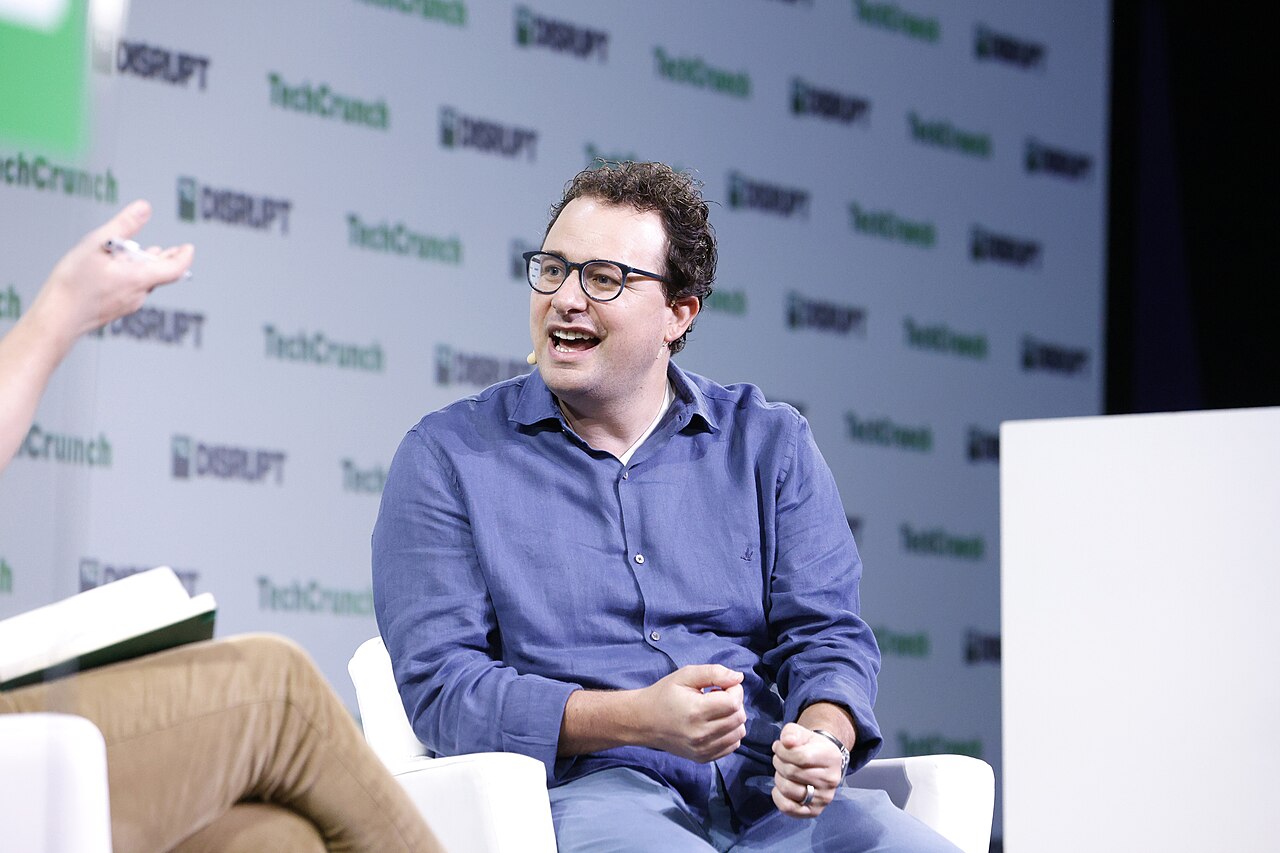
Header and in-body image: Dario Amodei at TechCrunch Disrupt 2023, by TechCrunch, via Wikimedia Commons, licensed CC BY 2.0.