In two consecutive days, the two largest cloud providers with in-house AI chips released tools aimed at the same target. Amazon announced TorchNeuron on Monday, October 19, 2026, and Google announced on Tuesday, October 20 that TorchTPU, its version of PyTorch, is available as an open source project. Both promise that existing PyTorch applications can move to custom silicon, Trainium at AWS and TPUs at Google Cloud, without being rewritten.
The hardware has existed for years. The new part is the software bridge, which is where much of the practical cost of switching accelerators has historically sat.
What each company announced
According to TechCrunch's report, the two announcements break down as follows:
| Amazon TorchNeuron | Google TorchTPU | |
|---|---|---|
| Date | October 19, 2026 | October 20, 2026 |
| Target hardware | Trainium chips and AWS | Tensor Processing Units and Google Cloud |
| Promise | Move AI apps without rewriting | Move PyTorch apps with a simple configuration change |
| Ecosystem work | Submitting code to main PyTorch that separates many features from Nvidia chips, so PyTorch works with any hardware by default | Worked with Meta, Hugging Face, Inferact (vLLM) and RadixArk (SGLang) |
| Extras | Not detailed in the report | A TPU agent suite to help developers migrate and fix errors, plus a LiteRT update for PyTorch on phones, laptops and embedded devices |
 Google
 AWS
 NVIDIA
 Meta
Why PyTorch is the leverage point
PyTorch is the open source toolkit most AI developers use to build, train and run models. TechCrunch notes that by some accounts about 85% of AI apps use it. Meta created it in 2016 when the company was called Facebook and handed it to the Linux Foundation in 2022. The same report notes that many PyTorch features were originally built to work specifically with Nvidia GPUs, which were the standard for AI research at the time.
That history explains the strategy. A chip can be fast on paper, but if the framework most teams already use assumes a competitor's hardware, adopting the chip means porting code, debugging unfamiliar behaviour and re-validating results. Lowering that cost works on the demand side, rather than by competing on peak specifications.
What a promise to avoid a rewrite does and does not cover
The public reporting does not include benchmarks, so the following is analysis of what a framework-level bridge can address rather than a measurement of results.
| Layer | What TorchTPU and TorchNeuron address | What remains a practical question |
|---|---|---|
| Application code | Running existing PyTorch code on the new chip with minimal edits | Whether every operator and library an app uses is supported |
| Serving engines | Google worked with vLLM and SGLang makers for TorchTPU | Performance parity of serving stacks across chips is not documented in the coverage |
| Performance tuning | A migration agent and upstream PyTorch changes reduce manual work | Peak throughput usually depends on chip-specific optimisation after the port |
| Hardware access | Easier to try a second platform | Capacity, pricing and quota still decide whether switching is possible |
The practical reading is that these tools lower the first barrier, getting a model to run, while leaving the second, getting it to run well and at scale, to be proven app by app. TechCrunch makes the same point: the tools do not mean developers will quickly abandon Nvidia hardware.
Running on a second chip is a compatibility question. Running well on it is an engineering question. The announcements address the first.
Why now: the wider silicon picture
Both moves land in a period of heavy custom silicon activity. Our coverage of AI labs and custom silicon tracks the labs building their own chips, and Tenstorrent's $1.5 billion Series E shows a RISC-V challenger raising capital on the same premise. Each of these efforts faces the same gap: hardware that exists but a software ecosystem that was shaped around one vendor.
Cloud providers have an additional incentive. A customer whose code runs on several accelerators has more negotiating leverage on price and supply, and a cloud with its own chip captures more of the margin when the workload lands there. That is an observation about incentives, not a claim about either company's internal plans.
What this means for teams building on AI
For application builders, the shift points toward a stack where hardware choice becomes a deployment decision rather than a design decision. The more layers stay interchangeable, from framework to serving engine to model provider, the lower the cost of moving when prices or capacity change. The same principle motivates model-agnostic tools such as Metir at the application layer: keeping workflows portable across providers is cheaper to maintain than rebuilding them later.
What to watch next
- Independent benchmarks. Throughput and cost per token for common open-weight models on TPUs and Trainium versus Nvidia GPUs, run through these new paths.
- Operator coverage. How many PyTorch operators and popular libraries work without custom changes.
- Upstream acceptance. Whether Amazon's proposed changes to main PyTorch are merged, since they would benefit every non-Nvidia backend.
- Adoption signals. Named customers moving production inference, not only trial workloads.
Sources:
- Google has joined Amazon in attacking Nvidia's stronghold with AI app developers (TechCrunch)
- Tenstorrent Raises US$1.5 Billion in Funding (Rio Times)
Image credits
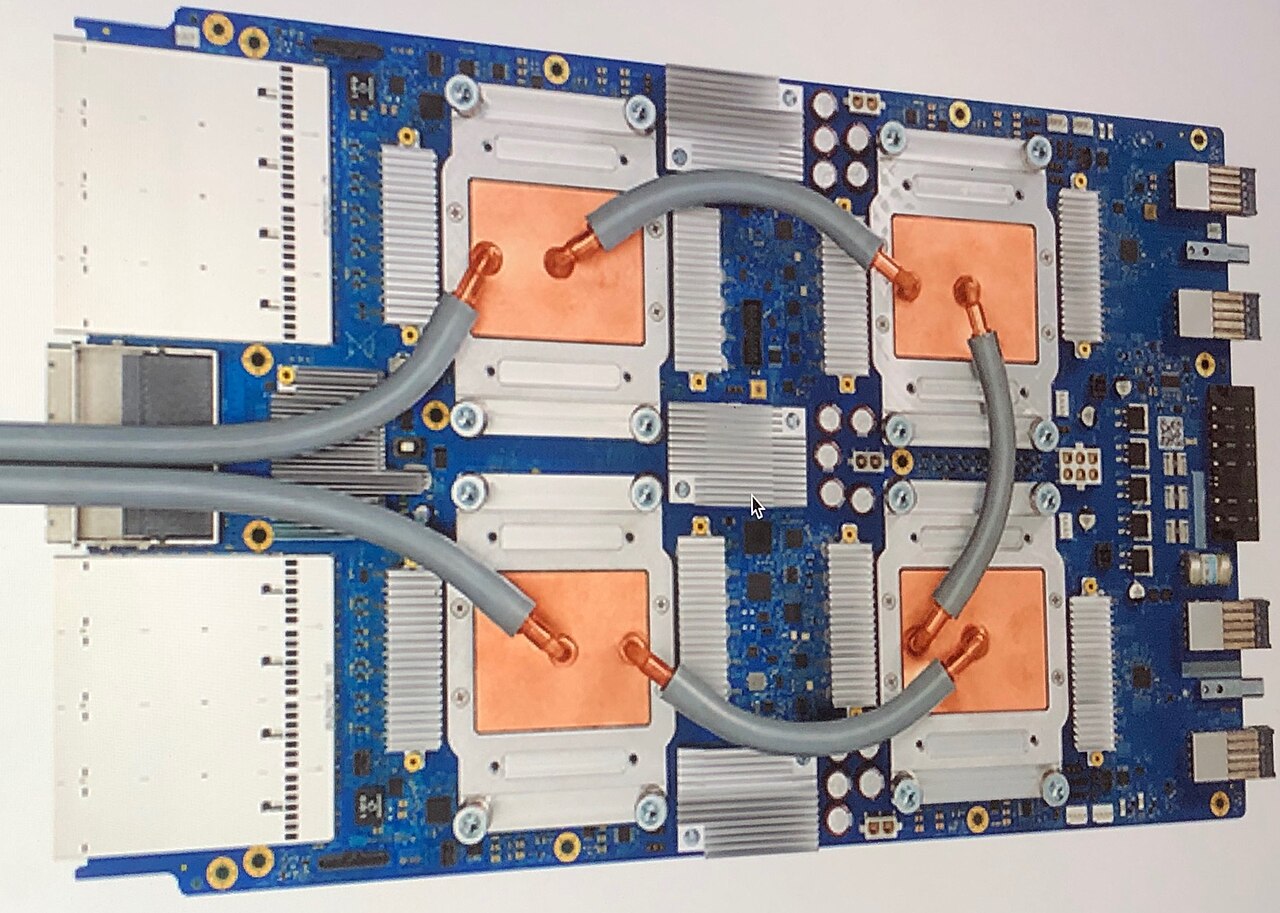
- Hero and in-body photo: "Tensor Processing Unit 3.0.jpg" by Zinskauf, licensed CC BY-SA 4.0, via Wikimedia Commons. Pulled 2026-10-23 and reviewed visually before use.