The US Energy Department is lending up to $4.4 billion to restart three shuttered nuclear plants, according to Associated Press reporting on October 16, 2026. Together the plants would return 2.25 gigawatts (2,250 megawatts) to the grid, which AP says is enough for roughly 2 million homes and businesses. Two of the three have agreements with big technology companies that want large volumes of carbon-free power for data centers. The story is a useful test of how AI electricity demand is changing decisions about assets that were written off only a few years ago.
The three plants
| Plant | Owner | Reported offtaker | Reported timing |
|---|---|---|---|
| Palisades (Michigan) | Holtec International | Power purchase agreement, buyer not named in the AP report | In service by March 2027 under its agreements |
| Crane Clean Energy Center, formerly Three Mile Island Unit 1 (Pennsylvania) | Constellation Energy | Microsoft, 20-year agreement | Constellation hopes for 2027 |
| Duane Arnold (Iowa) | NextEra Energy | Google, collaborating with NextEra | Early 2029 |
 Microsoft
 Google
Loan figures AP reports: $1.5 billion for Palisades, approved in 2024 and continued by the current administration, and $1 billion for Crane, where Constellation plans to spend $1.6 billion on the restart. No loan amount was given for Duane Arnold.
Where the up-to-$4.4 billion ceiling goes
Reported Energy Department loan amounts by plant, US dollars, billions.
Source: Associated Press, October 16, 2026. The grey bar is the arithmetic remainder of the reported ceiling, not a reported loan.
Why the economics changed
Per AP, Exelon shut Crane's functioning reactor in 2019 citing losses and refused state subsidies, Entergy exited nuclear in 2022 and Palisades had operated since 1971, and Duane Arnold, which began operating in 1975, shut down early in August 2020 after a derecho damaged it. AP also notes a 1979 accident destroyed the other reactor at the Three Mile Island site, which is separate from the Crane unit being restarted. Replacing Duane Arnold with cheaper sources was projected to save Iowa customers $300 million.
What changed is a buyer willing to sign a long contract at a premium. A 20-year agreement like the one between Constellation and Microsoft turns a plant with uncertain revenue into one with a predictable stream, which is what lenders need. That is analysis rather than reported detail, but the structure appears in the facts: two of the three restarts are tied to technology companies, and NextEra CEO John Ketchum called it "a perfect example of data centers paying their own way."
This is a perfect example of data centers paying their own way.
John Ketchum, NextEra CEO, as quoted by AP
For earlier coverage of one of these projects, see our post on the Duane Arnold restart and Google.
Scale: how much does 2.25 GW matter to AI?
The restored capacity is meaningful but small against projected AI campuses, many of which are planned at a gigawatt each. As a rough comparison, 2.25 GW is the equivalent of about two gigawatt-scale data center campuses running flat out. That is an illustration of order of magnitude, not a forecast of how the power will be used, and the plants will serve their grids and contract holders under terms that are not public in detail.
The value of restarts is speed and certainty rather than volume. Reusing an existing site with grid connection, cooling and a trained licensing history can be quicker than a new build, though the first of its kind carries its own risk, discussed below.
Risks and criticism
- Technical novelty. AP reports Palisades is expected to be the first commercial reactor worldwide to resume generating power after beginning decommissioning. Holtec began loading fuel in August, then paused after a fuel assembly tilted from its upright position.
- Safety questions. Edwin Lyman of the Union of Concerned Scientists told AP the plants could be restored if owners set the right level of safety and spend what is needed, but said "that's not happening at this point." He also noted most US plants were built between 1970 and 1990 for that era's natural disasters, and extreme weather is becoming more frequent.
- Public money. Jack Spencer of the Heritage Foundation argues the projects are low-risk with strong demand and do not need federal support. Jennifer Gordon of the Atlantic Council called federal financing a good way to secure needed electricity.
- Policy view. The World Nuclear Association said restarts should be celebrated, but that preventing premature closures would be better.
What to watch
- Whether Palisades resumes fuel loading and meets its March 2027 service commitment.
- The regulatory steps owners still need, since AP says they must ask regulators to restore operating licenses and gives no status.
- Whether the loan terms for Duane Arnold are disclosed.
- Whether other retired reactors attract similar offtake agreements.
Power supply is a binding constraint on how fast AI capacity grows, and it shapes what inference costs end users. Teams that route work across providers with a multi-model tool such as Metir AI can respond to price changes as those costs filter through, though restarts of this size will take years to show up in any price.
Sources:
- US reviving shuttered nuclear plants to meet growing demand, power data centers | Associated Press via ABC News
- US is reviving shuttered nuclear plants to meet growing electricity demand and to power data centres | BNN Bloomberg
- US Supports Revival of Three Nuclear Plants to Power AI Data Centres | The CSR Journal
Image credits
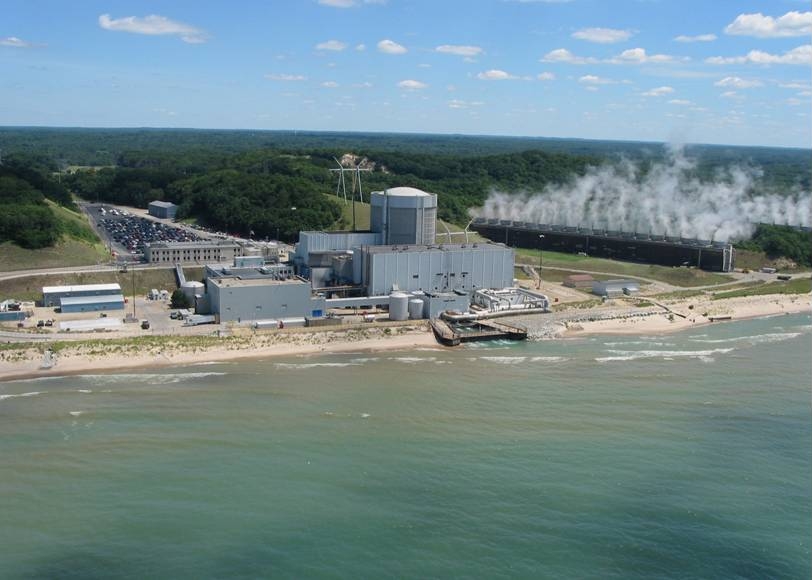
Header and in-body image: Palisades Nuclear Plant, a US Nuclear Regulatory Commission image (author and date unknown), via Wikimedia Commons, public domain as a work of a US federal government employee.