
CoreWeave reported second-quarter 2026 results on August 11, and the two biggest numbers point in opposite directions. Revenue more than doubled year over year to $2.58 billion, and the company's revenue backlog reached roughly $104 billion. At the same time, its GAAP net loss widened to $626 million. Understanding how both can be true at once is the key to understanding the entire neocloud category that CoreWeave leads.
 NVIDIA
 Microsoft
 Meta
MetaCoreWeave rents out GPU computing capacity, mostly Nvidia hardware, to companies training and running large AI models. It is the largest of the "neoclouds," a group of specialized providers that raised debt and equity to buy chips at scale and lease them to AI labs and hyperscalers. The Q2 report is a clean illustration of why that model produces spectacular growth and heavy losses in the same breath.
The growth is real and enormous
Start with the top line. Q2 2026 revenue of $2,575 million was up 112 percent from $1,212 million a year earlier. Adjusted EBITDA, a measure of operating cash generation before interest, taxes, depreciation and amortization, came in at $1,510 million, a 59 percent margin, roughly double the $753 million of a year ago. On an operating-cash basis, this is a highly profitable business scaling fast.
The backlog is the more striking figure. CoreWeave reported about $104 billion in revenue backlog as of June 30, 2026, up from roughly $30 billion a year earlier, and said that figure excludes more than $25 billion in further customer commitments signed early in the third quarter. Backlog is contracted future revenue, much of it on multi-year take-or-pay terms, and at $104 billion it dwarfs the company's current annual revenue run rate.
Revenue doubled. Backlog more than tripled.
CoreWeave's reported revenue and total revenue backlog, year over year. The gap between the two panels is the whole neocloud thesis: revenue today is small next to contracted revenue promised for years ahead.
Backlog excludes more than $25B in additional customer commitments CoreWeave says it signed early in Q3 2026.
Much of that backlog traces to a small number of very large contracts. CoreWeave has disclosed a roughly $21 billion capacity agreement with Meta running through 2032, alongside business with Microsoft, OpenAI and Anthropic. That concentration is a double-edged fact: it underwrites years of revenue, and it also means the company's fortunes are tied to the continued spending of a handful of counterparties.
The loss is also real, and it is structural
Now the other number. Despite $1.5 billion in adjusted EBITDA, CoreWeave posted a net loss of $626 million, wider than the $290 million loss a year earlier. The gap between strong EBITDA and a deep net loss is not an accounting quirk. It is the entire economic shape of the business.
Cash-profitable at the top, still losing money at the bottom
Q2 2026 adjusted EBITDA against GAAP net income, in millions of dollars. The distance between them is mostly interest on debt and depreciation on GPUs, the defining line items of a leveraged infrastructure buildout.
Adjusted EBITDA excludes exactly the costs that make the net loss: interest and depreciation. Which number matters depends on whether the contracted backlog gets delivered on schedule.
Two line items sit in that gap. The first is depreciation: GPUs are expensive, wear out and become obsolete, so the cost of the hardware is spread across the years it is expected to earn revenue. The second, and the one that draws the most scrutiny, is interest. CoreWeave financed much of its chip buildout with debt, and servicing that debt is a large, recurring cost that adjusted EBITDA deliberately excludes but net income cannot.
Adjusted EBITDA excludes exactly the costs that create the net loss. Which number you believe depends on whether the backlog gets delivered on schedule.
Metir AI analysis
This is why adjusted EBITDA and net income tell such different stories, and why sophisticated readers watch both. EBITDA answers "is the core service profitable to operate?" and the answer is clearly yes. Net income answers "after paying for the capital that built it, is the company making money?" and the answer is not yet. The bridge between the two is a bet that the $104 billion backlog converts into delivered, paid-for revenue faster than the debt and depreciation weigh the company down.
The number that ties it together: power
The constraint that decides whether the backlog becomes revenue is not chips or capital. It is power. AI data centers consume enormous amounts of electricity, and a contract is only worth its backlog value if CoreWeave can energize the capacity to fulfill it. CoreWeave reported about 1.5 gigawatts of active power, expanded by roughly 500 megawatts in the quarter, against approximately 3.7 gigawatts of total contracted power, and it raised its year-end active-power target to more than 1.85 gigawatts.
That gap between active and contracted power is the physical version of the gap between revenue and backlog. The company has signed for far more capacity than it has yet brought online, and the pace at which it can close that gap, through construction, grid connections and energization, is the real governor on how quickly the backlog turns into cash. CEO Michael Intrator framed the quarter as an inflection point where, in his words, scale translated into expanding operating leverage.
What it signals about the AI infrastructure cycle
CoreWeave is a useful barometer for the broader AI buildout precisely because it is a pure play. It has little else going on to muddy the signal. A $104 billion backlog says that the largest AI spenders are still committing to multi-year compute at scale, which is a genuine vote of confidence in sustained demand. The widening net loss and the debt behind it say that this demand is being met with heavily leveraged capital, which raises the stakes if that demand ever softens.
Those two readings are not contradictory. They are the same fact seen from two ends: the neocloud model front-loads enormous capital and debt to capture contracted future revenue, and it works as long as the revenue arrives on schedule and the counterparties keep paying. The risk is concentrated in exactly those assumptions, which is why the credit market has paid close attention to CoreWeave's debt, a dynamic explored in our earlier analysis of CoreWeave's debt and the credit-market warning signs.
The takeaway
The honest summary of CoreWeave's Q2 is that both the bulls and the skeptics found support in the same report. Revenue doubled, EBITDA margins are strong, and the backlog reached a scale that few infrastructure companies ever see. The net loss also widened, driven by the interest and depreciation that a debt-financed buildout necessarily carries. Whether this quarter is remembered as an inflection point or as the peak of a leveraged cycle depends on a single question that the earnings release cannot answer: how much of that $104 billion backlog gets delivered, on time, and paid in full.
For companies building on top of AI rather than financing the infrastructure underneath it, the relevant lesson is subtler. The compute layer is consolidating around a few heavily capitalized providers, which makes the flexibility to run workloads across different models and providers more valuable, not less. Platforms like Metir AI that stay model-agnostic give teams a way to benefit from cheaper, faster compute wherever it emerges, without being locked to the economics of any single provider.
Build on AI without betting on one provider
The AI infrastructure layer is consolidating fast. Metir AI keeps your team model-agnostic, with unified access to leading models from OpenAI, Google, Anthropic and xAI in one workspace, so you can route each task to whichever option is best and cheapest. Try Metir AI free.
Sources:
- CoreWeave Reports Strong Second Quarter 2026 Results | CoreWeave Investor Relations
- CoreWeave (CRWV) Q2 earnings report 2026 | CNBC
- CoreWeave Q2 2026 slides: revenue doubles, backlog surges 246% | Investing.com
- CoreWeave expects $12.4B-$13.2B of 2026 revenue while raising year-end active power target to more than 1.85 GW | Seeking Alpha
- CoreWeave Q2 2026 earnings: revenue beats, losses widen | Quartz
Image credits
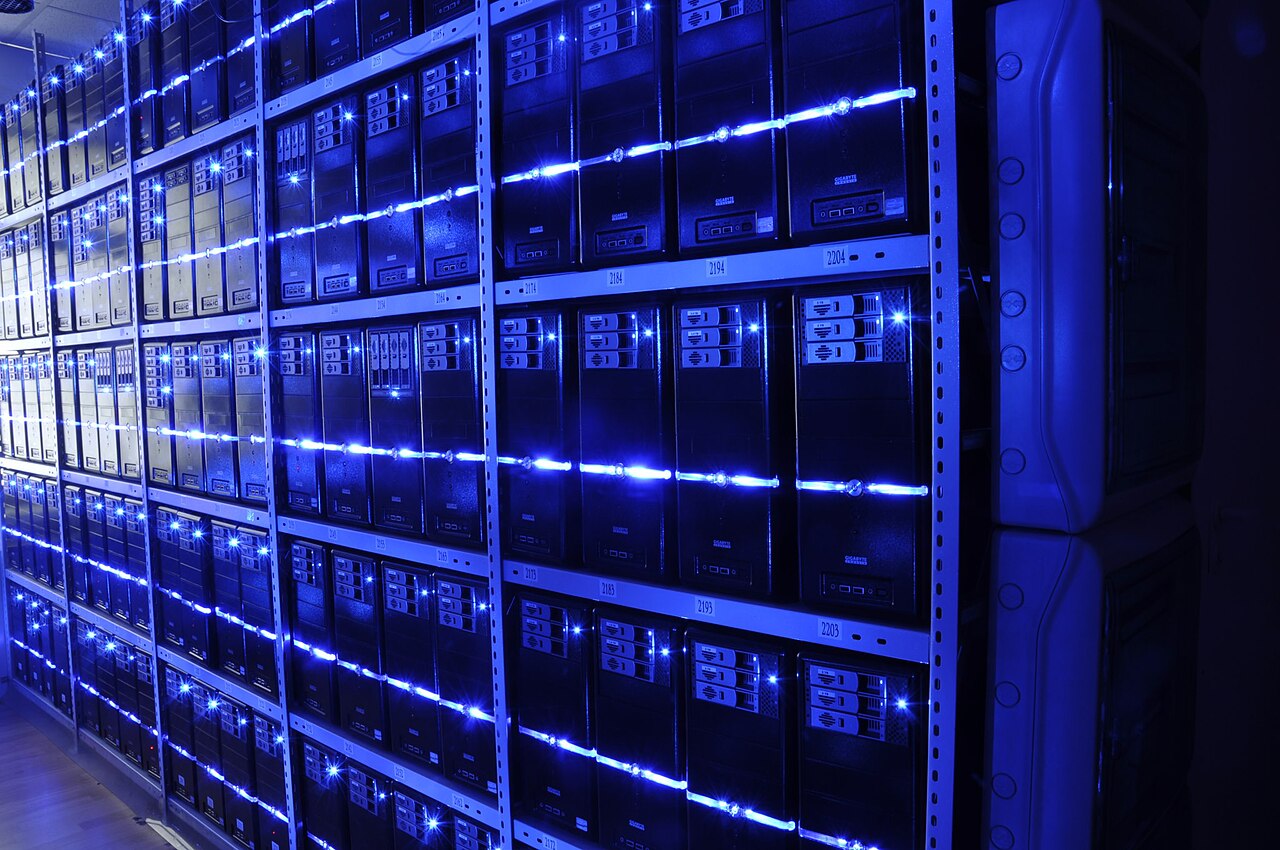
Header image: the Nasdaq MarketSite in Times Square, New York, where CoreWeave (ticker CRWV) is listed, via Wikimedia Commons, licensed under CC BY 2.0. In-body photograph of a data center server hall by BalticServers.com via Wikimedia Commons, licensed under CC BY-SA 3.0. The data center image is illustrative and does not depict a CoreWeave facility.