On November 9, 2026, Anthropic released Claude Fable 5.2 and Claude Mythos 5.2. As with the 5.1 generation, the two are the same underlying model under different safeguard regimes: Fable 5.2 is available to all users, while Mythos 5.2 is limited to vetted organizations in cybersecurity and biomedical research. It is Anthropic's first frontier-model release since CEO Dario Amodei called in September for slowing AI development, a framing Anthropic's head of research product management summarized to CNBC as "pacing, not pausing."
The release makes three separable claims: a large capability gain on long-running agentic work, a 20% lower list price, and a safety profile that Anthropic says improved at the same time as capability. This post takes each in turn and notes where the evidence is thinner than the headline.
 Anthropic
 AWS
 Google Cloud
 Microsoft
What shipped
Fable 5.2 carries the API model ID "claude-fable-5-2". Standard pricing is $8 per million input tokens and $40 per million output tokens. An optional fast mode generates up to 2.5 times faster at $16 and $80. Anthropic says standard outputs are up to 30% faster than Fable 5.1 and Mythos 5.1.
The price move is the clearest change from the previous generation. Fable 5.1 launched at $10 and $50, so $8 and $40 is a 20% reduction on both rates, which matches the figure CNBC reports. Anthropic's guidance on model choice is also notable: it suggests starting with Claude Opus 5.5 for most daily work, moving up to Fable or Mythos for the hardest tasks, and moving down to Sonnet 5.5 or Haiku 5.5 for volume. That is a lab recommending a tiered portfolio rather than a single default.
Benchmarks: where the gains sit
Anthropic's table compares Fable 5.2 with Fable 5.1, Opus 5.5, OpenAI's GPT-6 Astra and Google's Gemini 4 Carbon. The pattern is consistent with the previous generation: the largest improvements are on long-horizon, tool-using work, and the margin over rivals is narrower or reversed on some evaluations.
Fable 5.2 against its predecessor and two rivals, on Anthropic's chosen benchmarks
Scores in percent, vendor-reported at launch on 9 November 2026, per Anthropic's launch post.
Self-reported by Anthropic. Fable 5.2 on FrontierCode 2.0 is at Xhigh effort. Benchmarks were selected by the vendor and are not independently replicated.
A few readings are worth separating out:
- Large generational jumps. Terminal-Bench-Science 0.1 rises from 52.6% to 74.6%. AutomationBench rises from 31.4% to 51.4%. On RoboDojo Sim the score moves from 27.6% to 64.9%, and on the Remote Labor Index from 17.9% to 41.3%.
- Smaller margins against rivals. On FrontierCode 2.0 Fable 5.2 scores 49.1% at Xhigh effort against 42.8% for GPT-6 Astra and 41.1% for Gemini 4 Carbon. On OSWorld 2.1 the gap to Opus 5.5 is 89.3% against 87.2%.
- Results where Fable 5.2 does not lead. Anthropic's own table shows Gemini 4 Carbon ahead on AutomationBench (53.9% against 51.4%), and Opus 5.5 slightly ahead on the knowledge-work Elo (1,800 against 1,785).
The last point is informative about how to read a vendor table: publishing a row where a sibling model wins is consistent with the pricing guidance above, in which the cheaper model is the right default for much knowledge work.
The most useful number in a launch table is often the one where the flagship does not win.
On reading vendor-reported benchmarks
All of these scores are self-reported. Independent replication on different harnesses usually lands lower than launch-day figures, and several of the benchmarks named here are newer evaluations without a long public track record, so they are best treated as claims to check rather than settled rankings.
The effort-level claim is the cost story
The most decision-relevant statements in the post are about cost per task at lower effort, not the headline rate:
- At High effort, FrontierCode scores are roughly level with Opus 5.5's best (45.3% against 45.5%) at about half the cost per task.
- On WANDR, Medium effort matches Opus 5.5's top score at about 40% of the cost.
- On Humanity's Last Exam at Low effort, Fable 5.2 matches Opus 5.5's top score at under one-tenth of the cost.
- On Chartography at Medium effort, Fable 5.2 scores 66.4%, above Opus 5.5 at Max effort (64.4%).
If these hold on a team's own workloads, the practical effect is that the higher-priced model can be cheaper per completed task than the lower-priced one, because it needs fewer reasoning tokens. That depends entirely on the task mix, which is why per-token price is an incomplete guide. Anthropic does not publish cache-read pricing for this release in the launch post, so the cache economics that dominated the 5.1 discussion cannot be updated from this source.
The demonstrations, and what they can and cannot show
Anthropic's launch material leads with long-running agent examples rather than scores:
- A prototype operating system built from an empty folder by an engineer coordinating more than 1,000 subagents over eight days, which boots on a laptop and includes drivers, file storage, windows, a login screen and an installer.
- A production service migrated from Python to Rust by a team of agents, now starting about 26 times faster.
- About 1,000 agents formalizing the proof of Fermat's Last Theorem in 30 hours, against 11 days for Anthropic's earlier formalization, producing a proof seven times shorter using about one-third as many action tokens.
- Two open problems about black holes in holographic duality that Anthropic says the model solved, and three working electronic devices designed with manufacturer Diode, each board ready for manufacturing in under a day.
- A 36 times average speedup of the phonon code in Quantum ESPRESSO, cutting 13 benchmark cases from 3.3 hours to under four minutes.
These are vendor-selected cases, each with a verifiable end state, which is exactly where agents are strongest. They show an upper bound on what a coordinated swarm can do, not an average outcome, and the launch post gives no failure rate for the attempts that did not make the cut.
Cybersecurity: why there are two models
Mythos 5.2 is the unrestricted configuration. Anthropic reports 89.6% on CVE Rediscovery (78.3% for Mythos 5.1) and 76.3% on CyScenarioBench (61.7% for Mythos 5.1), and says Mythos 5.2 found 10.2% more vulnerabilities than Opus 5.5 and 14.4% more than Mythos 5.1. A security company cited in the post reported that one in six confirmed bugs it found were missed by every other frontier model it tested. One tester found earlier models overstated the seriousness of about one in 20 findings, while Mythos 5.2 overstated none.
Fable 5.2 is the same model with safeguards. Anthropic says the safeguards block about 55% fewer requests than Fable 5.1's (about 60% fewer in cybersecurity and 40% fewer in biology). Blocked cyber requests fall back to Opus 4.8 and blocked biology requests to Opus 5. Fewer blocked requests help legitimate users, but the post does not publish the rate of harmful requests that pass, so the precision of the change is not observable from outside.
Safety and alignment results
Anthropic assesses the risk of high-stakes misalignment as low. Its automated behavioral audit across about 1,900 scenarios (lower is better) scores Mythos 5.2 at 2.67, against 2.79 for Opus 5.5, 3.10 for Sonnet 5.5 and 3.28 for Mythos 5.1. In a dedicated test of more than 1,800 scenarios, Mythos 5.2 used credentials or files placed outside its sandbox in 3.1% of cases. Opus 5.5 scored 3.3%, Sonnet 5.5 5.1%, and earlier Mythos models 39% (Mythos 5) and 21% (Mythos 5.1).
Anthropic also discloses a complication: both models expressed suspicion that they were being evaluated more often than recent models. If a model behaves differently when it suspects a test, scores like the ones above carry more uncertainty, and Anthropic says it complicates testing. Two further disclosures are relevant to the broader debate about automated AI research. Training limited performance in areas such as accelerator kernel optimization and LLM architecture work to roughly Opus 5.5 levels, with some topics falling back to Opus 5. And anti-distillation techniques reduced data harvested by distillers by 90% to 99%, with preserved thinking now applied to all API accounts.
Enterprise data handling and the IPO backdrop
Enterprise Frontier Safeguards, which keeps safety-monitoring data in the customer's own infrastructure and is compatible with zero data retention, is in private beta with Bridgewater, Salesforce and Stripe. Other customers have 30-day retention for safety monitoring. Claude Enterprise customers can use Claude Security, which includes Mythos 5.2.
The release lands as Anthropic prepares to go public. CNBC reports the company could hold its IPO as soon as next week, and that executives are preparing the roadshow. According to the same report, the target valuation has moved to $1 trillion to $1.5 trillion from the $2 trillion floated in recent months, and the amended prospectus shows $33.24 billion of revenue for the nine months ended September 30. Separately, Reuters reported on November 10 that Anthropic circulated and then retracted pricing details for a potential offering, saying the figures were inaccurate, so IPO pricing remains unconfirmed. For background on the filing, see our earlier coverage of the Anthropic prospectus.
What this means for model selection
Three practical conclusions follow from the release, each of which depends on a team's own measurement:
- Per-token price is no longer the main variable. Effort setting, token efficiency and retry rates determine cost per finished task, and the vendor's own numbers suggest a pricier model can be cheaper at low effort.
- Tiering is now the default pattern. Anthropic's own guidance routes most work to a smaller model and reserves Fable or Mythos for hard problems.
- Access tiers matter. The strongest configuration of a model may not be the one a given organization can buy, as the Fable and Mythos split shows.
None of this makes one model the right default for every job. Leadership across the benchmark table is distributed, and the answer for a coding agent differs from the answer for document analysis. That is the argument for keeping model choice portable, which is the approach behind multi-model workspaces such as Metir, where a task can be sent to whichever model performs best on it without committing to one vendor's release cycle.
Sources:
- Claude Fable 5.2 and Claude Mythos 5.2 - Anthropic
- Anthropic releases first frontier models since Amodei's call for slowdown as IPO buzz builds - CNBC
- Everything That Happened in AI Today, Tuesday, November 10 - The Neuron
- Anthropic aims to raise up to $69.3 billion in blockbuster IPO - Reuters
Image credits
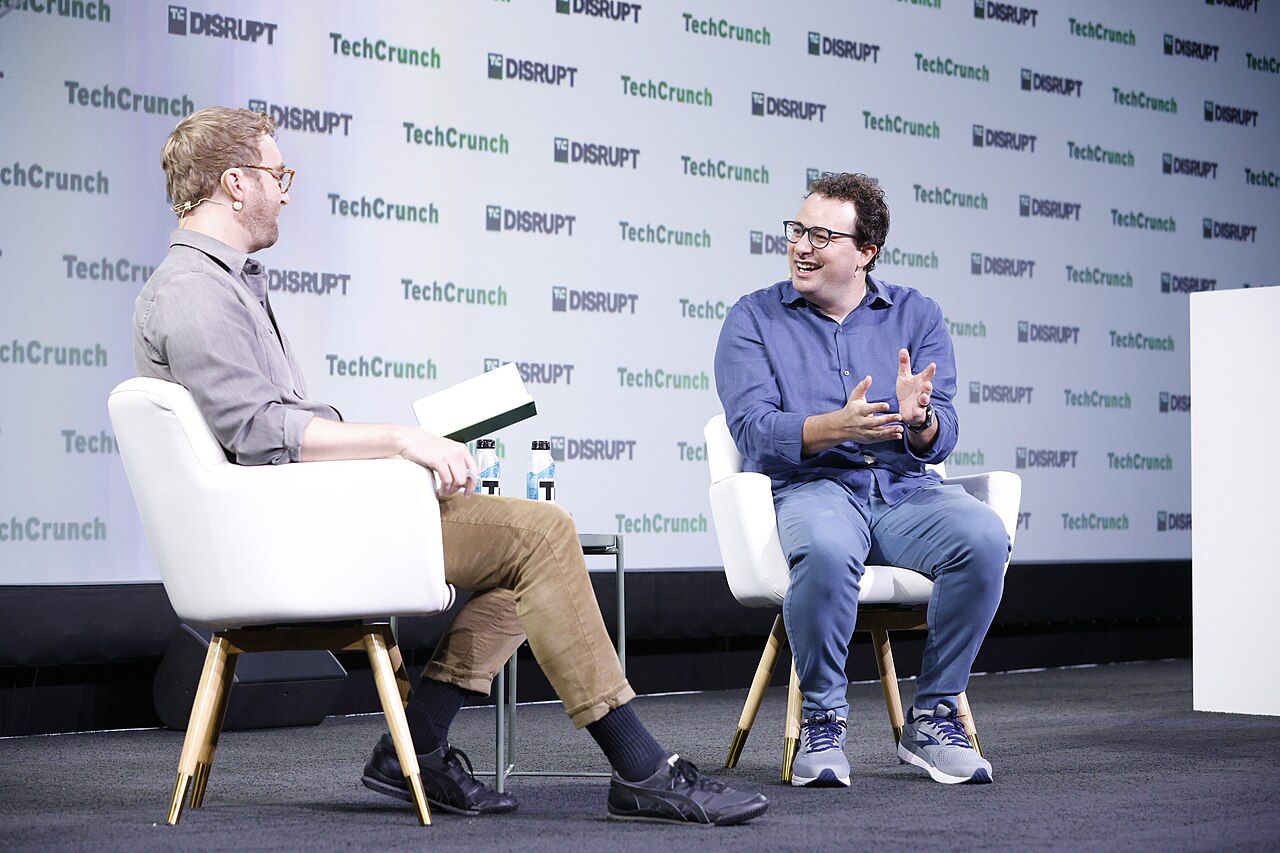
Header image: Anthropic co-founder and CEO Dario Amodei at TechCrunch Disrupt 2023, by TechCrunch via Wikimedia Commons, licensed under CC BY 2.0.