On October 5, 2026, OpenAI said it will begin testing ChatGPT visual ads later this month in the United States, with ads appearing while a user generates an image. It is the first time the company has tied advertising to a creative, image-producing moment rather than to a text answer. This piece looks at what OpenAI actually announced, how the format differs from the text ads already running, what the measurement partnerships suggest about the business behind it, and the questions that remain open. It builds on our earlier coverage of the ChatGPT ads business crossing a $1 billion run rate.
 OpenAI
What OpenAI announced about ChatGPT visual ads
According to BleepingComputer, the test will start later this month in the US with an initial group of advertisers, during image generation. OpenAI describes the format as using images to show "product inspiration, how a product is used, or experiences associated with a service." The company's stated guardrails are that ads will be "clearly labeled, and remain separate from the image being created," and that ads do not influence ChatGPT's answers. Unite.ai reports the announcement also put the platform's reach at 1.2 billion weekly users.
Two points are worth separating. First, this is a test, not a general launch: an initial group of advertisers, one country, one surface. Second, the surface is narrow. The ad is tied to the moment a person is waiting on an image, not to every conversation. Reports describe the unit as a sponsored card with product photos and a "Learn more" button placed next to the result (per AI Weekly and other trade coverage), though OpenAI's own wording only commits to labeled and separate. We could not retrieve OpenAI's own post directly, so details below come from reporting that quotes it.
How this differs from text ads
ChatGPT has carried text-based sponsored placements for months, with a disclosure line stating that ads do not influence the answers a user receives. The example below, a sponsored placement for The Times, shows that existing text format.
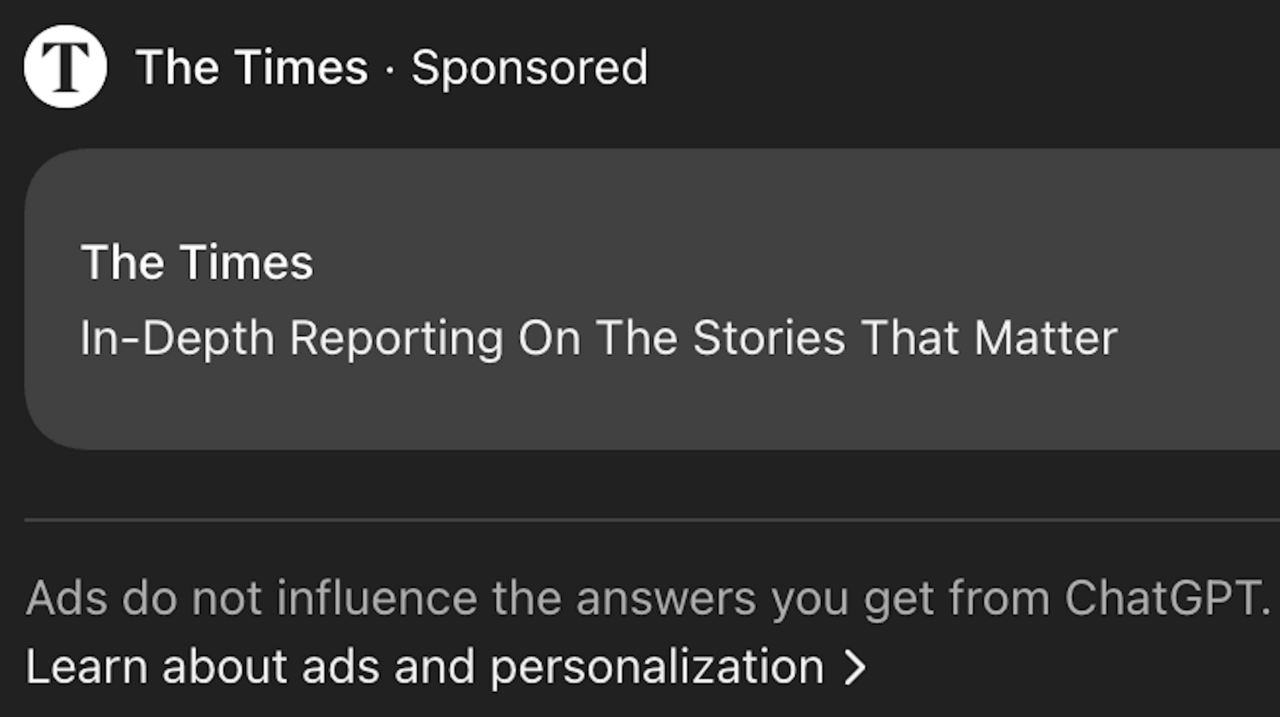
The new format differs in three ways that matter for analysis:
- Medium. A visual ad competes for attention with an image the user asked for, so layout and separation carry more weight than they do for a line of text.
- Moment. Image generation involves a wait. Placing an ad in that window uses time the user is already spending, rather than interrupting a finished answer.
- Intent signal. A prompt for an image of a kitchen, a trip or an outfit can reveal interest in categories advertisers pay for. OpenAI has not published how, or whether, prompt content informs ad selection in this format, so that remains an open question rather than a finding.
Ads will be clearly labeled, and remain separate from the image being created.
OpenAI, as quoted by BleepingComputer
The measurement stack behind ChatGPT Ads
The announcement was not only about a format. Per Unite.ai, OpenAI also expanded the partner ecosystem advertisers use to measure results. Data integration partners are Hightouch, Tealium and LiveRamp. Attribution partners include AppsFlyer, Triple Whale, Adjust, DV Rockerbox, Northbeam, Branch, Singular, Kochava, Airbridge and Tenjin. Further partners cover advanced measurement, incrementality testing and early-stage brand metrics.
Where the ChatGPT Ads measurement stack is built out
Named measurement partners by category, as listed in OpenAI's October 5, 2026 announcement. Measured is counted in two categories. Source: Unite.ai.
The weighting toward attribution is informative. Performance advertisers generally need to connect an ad to a purchase before they commit larger budgets, so a long attribution list suggests OpenAI is courting that buyer first, in the same way search and social platforms did. The partner counts in the chart are our tally of names in the reported lists, not an OpenAI statistic, and Measured appears in two categories.
Unite.ai also lists early advertiser results, each attributed to a measurement partner: WeightWatchers at 15.3% lower cost per acquisition than paid search (per DV Rockerbox), 67% of incremental purchases from new customers for the wellness brand Dose (per WorkMagic), and 93% of ChatGPT visitors being new for Portland Leather (per Triple Whale). These are single-advertiser figures reported through vendors, on text-era placements, and they should not be read as typical outcomes for the visual format.
Brand suitability and privacy safeguards
OpenAI said it is piloting brand suitability evaluations with DoubleVerify and Integral Ad Science. As reported by BleepingComputer, the two firms will assess how OpenAI applies its brand safety standards in a controlled environment, and OpenAI stated they "will not get access to private user conversations." The safeguards are described as designed to keep ads out of emotionally vulnerable, sensitive or otherwise unsuitable conversations.
This is a verification model that advertising has used for years on web and video inventory: a third party checks the platform's claims instead of the platform grading itself. What is different here is the input. In a chat product, the content being assessed is private by default, which is why the pilots are set in a controlled test environment rather than on live conversations.
The regulatory backdrop in Europe
The Next Web reports that ChatGPT ads have been running in 31 European countries since late August, and that the European Commission designated ChatGPT a very large online search engine on August 31, based on 159.1 million monthly EU users. Per the same report, that status brings Digital Services Act obligations, including a public advertisement repository due by January that lists advertiser names, run dates, targeting parameters and reach. The visual test is US-only for now, so how an image-based format would be disclosed under those rules is not yet known.
What remains unclear
- Who sees the ads. Coverage differs on which subscription tiers are ad-free, and we are not stating a tier list that sources do not agree on.
- Targeting inputs. Whether the text of an image prompt influences ad selection has not been detailed.
- Scale and pricing. No figures for the test's size, pricing model or revenue contribution were disclosed.
- Measured effect. There are no results yet for the visual format, only vendor-reported results for earlier placements.
What to watch
- The first public examples. Seeing how the card is separated from the generated image will show how the labeling commitment works in practice.
- User response. Whether people tolerate ads during generation, and whether ad-free tiers become a stronger upgrade reason, will be visible in the next few quarters.
- Expansion beyond the US. Any extension into the 31 European markets will bring the repository and disclosure rules into play.
- Competitor moves. Other assistants with image generators face the same monetization question. Our earlier analysis of how OpenAI blocks competitor ads shows the policy questions that grow as the ad surface widens.
For people who use several assistants, a practical consequence is that ad policies now differ by product and tier. A model-agnostic workspace such as Metir AI is one way to keep access to image and chat models without tying a workflow to any single provider's monetization choices.
The takeaway
The confirmed facts are narrow: OpenAI will test labeled visual ads during ChatGPT image generation in the US later this month with an initial group of advertisers, says ads stay separate from the generated image and do not influence answers, cites 1.2 billion weekly users, and has widened its measurement and brand-suitability partnerships. Everything about scale, targeting and performance of the visual format is still to be shown. The test is best read as the next step in a text-to-visual progression in OpenAI's ad business, with its results the thing to track.
Sources:
- OpenAI will show visual ads in ChatGPT while you generate images | BleepingComputer
- OpenAI Introduces Visual ChatGPT Ad Format and Expanded Measurement | Unite.ai
- OpenAI is putting ads inside ChatGPT's image generation | The Next Web
- OpenAI to test visual ads during ChatGPT image generation | AI Weekly
Image credits
Header and in-body image: screenshot of a sponsored text ad for The Times in ChatGPT, via Wikimedia Commons, listed as public domain. It shows the existing text ad format, not the new visual format. Reviewed before use.