
OpenAI said in late August 2026 that its ChatGPT advertising business had crossed a $1 billion annualized run rate, less than a year after it started placing ads inside the assistant. It is a striking number for a product that spent its first three years defined by a clean, ad-free chat box. It is also a number that is easy to misread. A run rate is an extrapolation, a recent period annualized, not a billion dollars already banked. The more useful question is not whether the figure is precise but what a fast-growing ad business inside a frontier assistant tells us about where consumer AI is heading, and about the incentives that come with it.
 OpenAI
 Google
 Meta
MetaWhat the $1 Billion Actually Represents
Read carefully, the milestone describes momentum, not a settled annual total. OpenAI began selling ads in ChatGPT in late 2025, started testing formats in February 2026, introduced an ads manager in March, and integrated with the mobile measurement firm AppsFlyer in August. A $1 billion annualized run rate reached by late summer means the most recent monthly pace, multiplied out, lands near a billion. That is genuinely fast for a business less than a year old, and it is also the kind of figure that can move sharply in either direction as testing widens or pulls back.
From ad-free to a $1B run rate in under a year
Publicly reported milestones in the build-out of ChatGPT advertising. A date-ordered sequence, not an inferred causal chain.
The scale underneath the number is what makes it plausible. OpenAI has described roughly a billion weekly active users for ChatGPT, and its chief marketing officer, Colin Fleming, has said about a fifth of them show commercial intent, meaning their questions touch products, purchases, or services. An audience that large with that share of buying-adjacent queries is, in advertising terms, a substantial inventory. The company has been rolling out its Ads Manager across India, Europe, the Middle East, and North Africa, and its recent India launch reportedly brought in 50 brands alongside the agency holding companies WPP and Omnicom. Measurement partners including Adobe, Criteo, and LiveRamp fill in the attribution plumbing advertisers expect.
The Economics That Motivate It
To understand why OpenAI is building an ad business at all, look at the shape of its finances. The company generated close to $10 billion in revenue in 2025, and reporting has put its operating losses in the range of $21 billion, driven by the enormous cost of training and serving models. That gap is the context for every monetization decision the company makes. Subscriptions and enterprise contracts are the core of the business, but advertising offers something they do not: a way to earn revenue from the very large share of users who will never pay a subscription while still using the product heavily.
The gap advertising is meant to help close
Reported 2025 revenue against reported 2025 operating losses, in billions of dollars, with the new ad run rate shown for scale. The loss figure is a reported estimate.
A free product with a billion users and heavy per-query costs is the classic case for an advertising model that scales with usage.
Advertising, in other words, is the classic answer to a free consumer product with a billion users and a heavy cost to serve each one. It is the model that funded search and social media, and it scales with usage rather than with willingness to pay a monthly fee. OpenAI has reportedly set a goal of surpassing $2.3 billion in ad revenue in 2026 and a long-range target of $100 billion by 2030. Those numbers put the current $1 billion run rate in perspective. Against the 2030 ambition, today's business is an early prototype, and reaching the target would require building an advertising operation approaching the scale of the incumbents, which analysts note is a multi-year climb given the burn rate and the competitive field.
Advertising scales with usage, not with willingness to pay. That is exactly why it is attractive for a free product serving a billion people at a real cost per query.
Analysis of OpenAI's monetization
The Incentive Question
The analytically important part is not the revenue. It is what advertising does to the incentives of an assistant. A subscription or usage-based tool is paid to be useful to the person using it. An ad-supported tool is paid by two parties at once: the user, who wants the best answer, and the advertiser, who wants attention or a conversion. Those interests usually overlap, but not always, and the entire history of search and social advertising is a running negotiation over where the line sits between a helpful result and a paid placement dressed as one.
This is sharper for a conversational assistant than for a search page. A list of ten blue links keeps ads visually separate from results. A single synthesized answer does not have that seam. When the interface is one paragraph of natural language, the boundary between a recommendation the model reached on the merits and one influenced by a commercial relationship is harder for a user to see. OpenAI has an obvious interest in keeping that boundary clean, because trust is the whole asset, but the tension is structural rather than a matter of good intentions. It is worth watching how disclosure, labeling, and the separation of paid content from organic answers evolve as the ad business grows.
Notably, not every lab is taking the same path. Anthropic has said it will not introduce advertising, positioning its business around enterprise and usage-based revenue instead. That divergence is itself informative. It means the industry is running a live experiment on whether frontier assistants are best funded like media, paid for by advertisers, or like software, paid for by users, and the two models pull the product in different directions.
What It Means for People Building on AI
For anyone choosing tools rather than building the labs, the lesson is to notice how a product is funded, because the funding shapes the incentives. A tool paid for by its users is optimizing for their outcomes. A tool paid for by advertisers is balancing two masters. Neither is inherently wrong, and ad-supported products have brought enormously useful things to billions of people for free. But the incentive is real, and it is worth being deliberate about which model sits behind the assistant doing your work.
That is part of the case for keeping the tooling layer neutral and under your own control. A platform like Metir AI that is paid on usage and routes across models from OpenAI, Anthropic, Google, and others has no advertiser in the loop shaping which answer surfaces, and it can move between models as their quality and terms change. The point is not that advertising is bad. It is that when an assistant starts earning money from attention as well as from usefulness, the person relying on it should know that, and should have the option of a tool whose only customer is them.
What to Watch Next
Three things will tell the story from here. Watch whether the run rate keeps climbing toward the stated 2026 goal or plateaus as the novelty of a new ad format wears off, since early run rates are volatile. Watch how OpenAI labels and separates paid content inside a conversational answer, because that is where user trust is won or lost. And watch whether the ad-funded and subscription-funded camps stay split, or whether Anthropic's no-ads stance becomes a durable point of product differentiation. A $1 billion run rate is a real milestone. The more consequential number is whether ad-supported AI can grow without eroding the trust that made the assistant worth advertising on in the first place.
Sources:
- ChatGPT Surpasses $1 Billion in Annualized Ads Revenue | Adweek
- OpenAI ChatGPT ads hit $1 billion annualized revenue run rate | Quartz via Yahoo Finance
- OpenAI Says Ad Business Reaches $1 Billion Run Rate | PYMNTS
- FAQ on ChatGPT Advertising: Formats, costs, and early strategies | eMarketer
- OpenAI is accelerating its ad business plans | INMA
Image credits
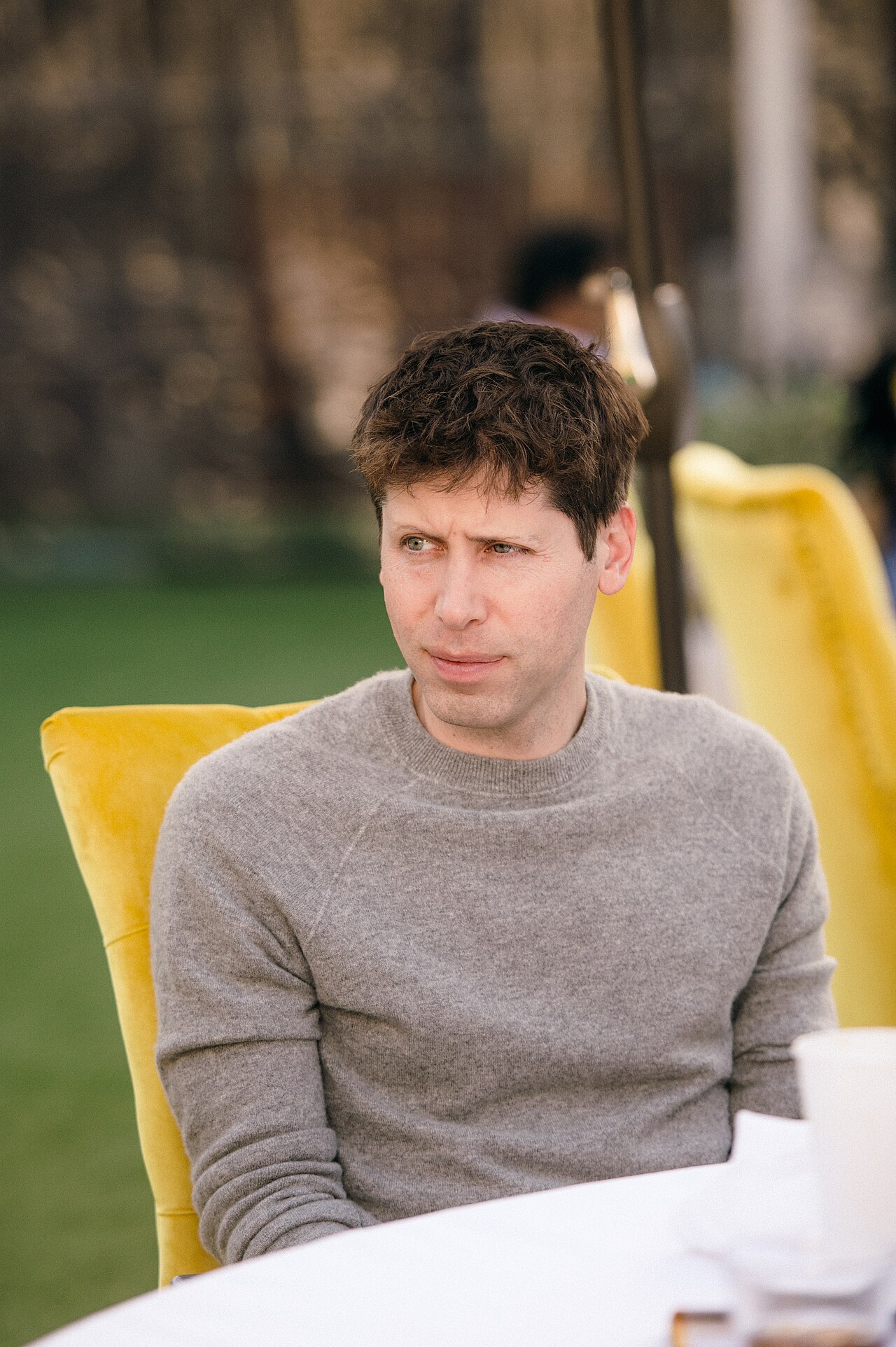
Header image: a smartphone running the ChatGPT app in front of a laptop, by Sanket Mishra via Wikimedia Commons, licensed under CC BY 2.0. In-body photograph of OpenAI CEO Sam Altman via Wikimedia Commons, licensed under CC BY 2.0.