
Chainalysis, the blockchain analytics firm, reported on October 14, 2026 that x402, a protocol that lets software pay for web services, has processed more than 138 million transactions on Coinbase's Base chain. The figure appears in the firm's North America chapter of its 2026 Geography of Cryptocurrency series, and Fortune covered it the same day. Most payments are tiny, and the time between funding a wallet and first spending from it has collapsed. This article explains what x402 is, works through the arithmetic those figures allow, and sets out what the numbers cannot tell us.
What x402 is
According to Coinbase's developer documentation, x402 is an open standard for adding per-request payments to HTTP, so that APIs and services can charge without checkout pages, subscriptions or separate billing integrations. The name refers to HTTP status code 402, "Payment Required". The documented flow has several steps:
- The client requests a resource.
- The server replies that payment is required, stating the price, the payee and the accepted payment options.
- The client signs a payment and resends the request with proof of payment attached.
- The server asks a facilitator service to verify the payment, does the work, then asks the facilitator to settle.
- The server returns the resource and confirms the payment.
The docs say x402 works across EVM networks and Solana and supports USDC as well as other tokens. Fortune reports that Coinbase introduced the protocol in May 2025, that Cloudflare partnered on its development, and that an x402 foundation launched under the Linux Foundation in July with 40 members including Visa, Mastercard, Stripe and Google. For how this fits with other agent standards, see our overview of MCP, A2A and agent interoperability standards.
The headline numbers and a window conflict
Fortune and Decrypt both report that cumulative x402 transactions on Base rose from about 1,500 in mid-2025 to more than 138 million by Q3 2026. Chainalysis's own page words the window differently: it says x402 had processed over 138 million transactions on Base by the end of its 2026 reporting period, which it defines as July 2025 to June 2026, while its micropayment analysis covers 16 months ending September 2026. Both describe the same 138 million figure but the end date differs by source, so the safest reading is "more than 138 million in roughly the first year to fifteen months." Chainalysis's page does not itself state the 1,500 starting figure, so that number rests on the press coverage.
Fortune also notes that its headline refers to Base while the figure covers x402 transactions, not all activity on the chain.
Micropayment arithmetic: what under 10 cents implies
Chainalysis says over 87% of payments fall between one hundredth of a cent and 10 cents, with one to ten cents the most common bracket. Chainalysis does not report a total dollar value for x402 spending, so any value estimate here is a bound, not a measurement.
Chainalysis reports 138 million payments but no dollar total. Arithmetic on the size distribution can only give a ceiling for part of the activity.
Reading the report's size distribution
- Ceiling for the small payments: 87% of 138 million is about 120 million payments. At most 10 cents each, that group moved no more than about 12 million dollars (120 million times 0.10). If the 87% was measured on a sample, as one secondary report describes, applying it to the full count is an assumption.
- The rest is unconstrained: the remaining 13%, roughly 18 million payments, has no stated size range in the sources reviewed, so the total value cannot be bounded from the figures above.
- Fees versus price: Fortune says card processing fees can exceed the cost of very small purchases. Cryptopolitan, summarizing analysis by Keyrock of 176 million x402 payments, reports that 76% cost less than a card processing fee of about 30 cents. A fixed 30-cent fee on a 10-cent payment is three times the payment itself, which is why per-call pricing in the cents range is hard on card rails. The 30-cent figure is that analysis's approximation, not a universal card fee.
The practical meaning is that x402 activity is high-frequency and low-value per call. Counting transactions therefore measures usage frequency far more than economic weight.
Reading the onboarding metric
The most striking figure is time to first spend. Chainalysis's page says wallets were a median of 73 days old at their first x402 payment in late 2025, while by Q3 2026 the median gap was 18 minutes. Fortune words it as the median time from first deposit to first payment. The two phrasings are close but not identical, so the exact definition is worth confirming in the full report.
The arithmetic: 73 days is 105,120 minutes, and 105,120 divided by 18 is roughly 5,840. The median gap is about 5,800 times shorter. Chainalysis also reports that wallets making a first payment within an hour of funding rose from 4% to 67%, and Fortune adds that about 90% of qualifying active wallets received another deposit within 30 days, up from roughly 71% a year earlier. Chainalysis's page gives the underlying cohort figures as 70.6% (Q3 2025) to 89.3% (Q2 2026), counting only wallets that sent on two or more separate days.
x402 wallet behavior on Base, earlier versus later cohorts
Share of wallets, in percent. Both metrics rose between the earlier and the later cohort.
Source: Chainalysis, 2026 Geography of Cryptocurrency, North America chapter. First-payment-within-an-hour compares Q3 2025 with Q3 2026. Top-up within 30 days compares the Q3 2025 funding cohort with the Q2 2026 cohort and counts only wallets that sent on two or more separate days.
A plausible interpretation, which Chainalysis itself offers, is that wallets are increasingly funded for a specific job rather than held speculatively. An alternative is a change in who the wallets belong to: early wallets may have been curious testers or speculators, and later ones scripted or purpose-built deployments. Median figures also hide the tail. A median of 18 minutes says half of wallets spend faster, not how long the slowest take.
Growth-curve caveats
Several sourced facts argue against reading 138 million as a simple measure of agent demand.
- A memecoin drove early volume. Chainalysis's June 2026 analysis said the PING memecoin, a pay-to-mint experiment costing 1 USDC per mint through x402, drove much of the Q4 2025 surge, with transactions rising over 10,000% in one week. Weekly retention for PING-driven wallets hit 87% in one week in October 2025, then fell to 5%.
- Growth moderated. That same analysis said growth plateaued in Q1 2026 and that it was unclear whether usage reflected sustainable adoption or a different cohort of users.
- Agent identification is hard. Fortune notes that rival firm TRM found much apparent agent activity may be scripts or self-dealing. TRM's September 2026 report covered about 198.9 million settlements worth roughly 52.7 million dollars across Base, Solana and Polygon since May 2025, and after removing self-payments, bulk flows from one or two payers and sellers with fewer than ten buyers, about 25.62 million dollars remained, of which 0.6% to 7.5% appeared agentic. TRM says scheduled scripts leave on-chain records like real agents, and that its test may understate single-purpose agents.
- Counts differ by method. Chainalysis (138 million on Base), Keyrock (176 million) and TRM (198.9 million across three chains) use different chains, periods and filters, so they should not be compared as if they measured the same thing.
None of this shows the Chainalysis count is wrong. It shows that a transaction count, on its own, cannot separate autonomous agents from scheduled scripts, testers or incentive-driven activity.
How this compares with card rails and agentic checkout
The sources describe two different jobs. Card-based agentic checkout, as in Stripe's agentic commerce suite or the shopping flows covered in Amazon's standoff over Meta's agent, targets purchases a person has asked an agent to make, with merchants, receipts and dispute rights. x402 as measured by Chainalysis targets machine-to-machine calls: live data, model queries and code security scans, paid from a wallet a developer has funded, without per-purchase approval. Chainalysis quotes Circle as describing card rails for consumer-prompted agent payments and stablecoin rails for machine-to-machine settlement.
On the evidence in these sources, the two are not yet head-to-head. Chainalysis's categories include information services, gaming, token issuance, gambling, agent tooling and model inference, which it calls one of the largest, not retail shopping. Chainalysis also reports that 88.1% of geolocatable model-inference payments came from US-linked wallets and 0.1% from China-linked ones, and offers open-weight model costs as a hypothesis rather than a finding. Net spending by merchants, refunds and chargebacks are not covered in the sources reviewed.
What remains unknown
- Total value. No dollar total for x402 on Base appears in the sources reviewed.
- Agent share. Chainalysis's count does not show how many autonomous agents were involved, or whether sellers earn sustainable income.
- Definitions. The press accounts do not define "qualifying active wallets", and the time-to-first-spend definition varies by outlet.
- Forecasts. Chainalysis's head of research, Eric Jardine, told Fortune he would hazard that the trend is likely to be exponential. That is a projection, not a finding.
The takeaway
The Chainalysis data shows a protocol moving from a handful of transactions to more than 138 million, dominated by payments of 10 cents or less, with wallets that spend within minutes and top up repeatedly. The same sources show why the count needs care: no dollar total, a memecoin-driven early surge, a plateau in early 2026, and a rival analysis attributing a small share of screened volume to agents. The sharper question for the next report is how much value, and how many distinct buyers, sit behind those transactions.
Sources:
- AI agents shopping spree: 138 million payments on Base, Chainalysis | Fortune
- 2026 North America Crypto Adoption | Chainalysis
- Inside x402: 100M Agentic Payments on Base | Chainalysis
- AI Agents Made 138 Million Crypto Payments in a Year. Most Were Tiny | Decrypt
- Base logs 138 million x402 payments as AI agent revenue draws scrutiny | Cryptopolitan
- Who's actually paying: measuring AI agent payments onchain | TRM Labs
- How x402 works | Coinbase Developer Platform docs
- Agentic payment activity tops 100M transactions on Base | Cointelegraph
Image credits
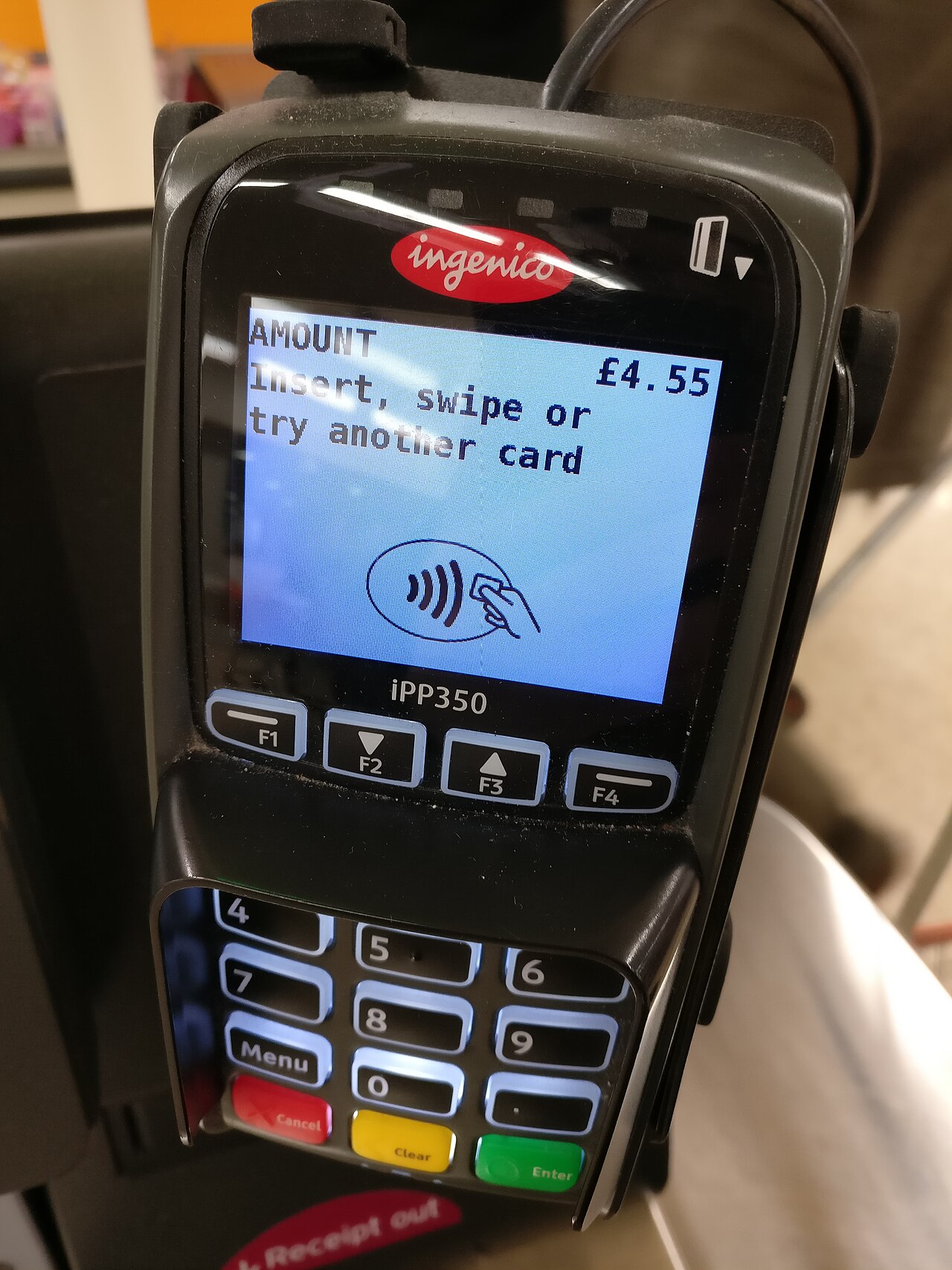
Header image: a contactless cashless payment reader, by RuinDig (Yuki Uchida), via Wikimedia Commons, licensed CC BY 4.0. In-body photograph of an Ingenico iPP350 card terminal, by User:Daylon124, via Wikimedia Commons, released under CC0. Both are illustrative of conventional card-payment hardware; neither shows x402, Coinbase or Base.