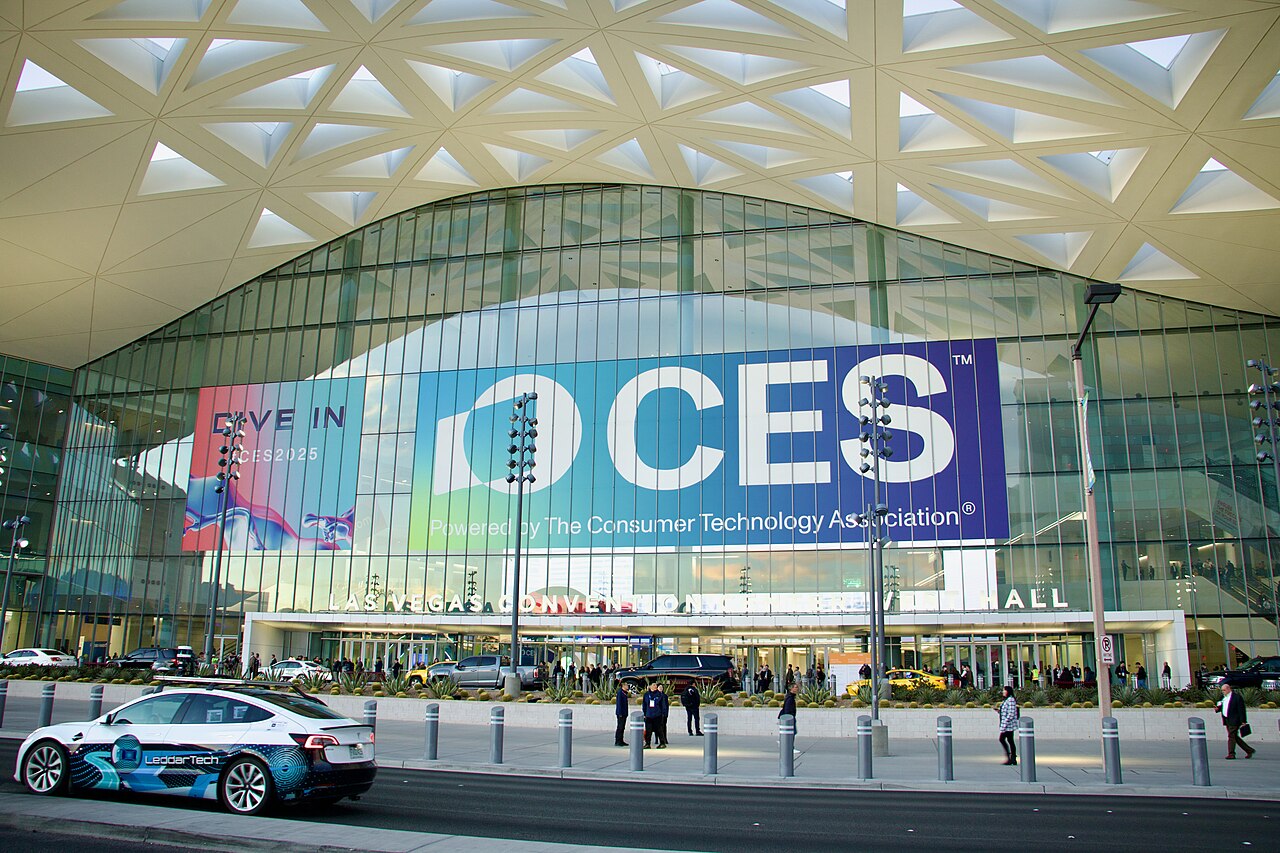
CES 2026 just wrapped up in Las Vegas, and if there's one takeaway from this year's showcase, it's this: AI is no longer confined to your screen. The annual tech extravaganza revealed a fundamental shift from "AI that talks" to "AI that does"—physical AI systems that can climb stairs, fold laundry, and even become your holographic desk companion.
With over 145,000 attendees across 12 venues, CES 2026 demonstrated that the AI revolution is moving from chatbots to the real world. Here's what caught our eye from the show floor.
Physical AI Takes Center Stage
This year's dominant theme was "physical AI"—Nvidia's term for AI models trained in virtual environments using synthetic data, then deployed as physical machines once they've mastered their purpose. After years of agentic AI hype, 2026 is all about AI that interacts with the physical world.
The shift is significant. While AI agents like Manus execute digital tasks autonomously, physical AI brings intelligence to robots, vehicles, and appliances. The convergence of these two trends—autonomous decision-making and real-world interaction—defined CES 2026.
The Coolest Tech from CES 2026
1. LG CLOiD: The Robot Butler That Actually Works
LG's CLOiD home robot was easily the most ambitious demonstration at CES 2026. This AI-powered household assistant didn't just roll around looking cute—it showed off genuine utility.
During a 15-minute demo, CLOiD demonstrated taking a shirt from a basket to place in a dryer, putting a croissant into an oven, fetching drinks from the fridge, folding and sorting laundry, and retrieving lost keys. It represents LG's vision of a "Zero Labor Home" where intelligent machines handle everyday chores through robotics and connected home integration.
The reality check? LG made no commitment to actually sell CLOiD to consumers. But as a showcase of where home robotics is heading, it was the show's standout—proving that laundry-folding robots are moving from science fiction to plausible reality.
2. Dreame Cyber X: The Robot Vacuum That Climbs Stairs
Robot vacuums have been around for years, but they've had one persistent limitation: stairs. The Dreame Cyber X concept robot vacuum solves this with a four-legged base that lets it climb stairs autonomously.
This isn't just clever engineering—it's a genuine game-changer for multi-level homes. Instead of buying separate robot vacuums for each floor or manually carrying one up and down, the Cyber X handles the entire house. It represents the kind of practical AI innovation that actually improves daily life rather than just adding flashy features.
3. Razer's Project AVA: Your AI Holographic Desk Companion
If you've ever wanted an anime character sitting on your desk, Razer has you covered. Project AVA is a 5.5-inch animated holographic companion that evolved from an esports AI coach into something far more... personal.
Users can choose from different characters—from anime girl Kira to the muscular Zane—featuring lifelike movements, eye-tracking, expressive faces, and lip-syncing for realistic interactions. AVA responds to voice commands, tracks your gaze, and adapts its personality based on your interactions.
Is it useful? Debatable. Is it a creative application of AI that people will absolutely buy? Absolutely. Project AVA demonstrates how AI companionship is becoming a legitimate product category—quirky as that may seem.
4. An'An AI Panda: Emotional Support That Learns You
From Mind with Heart Robotics, the An'An AI Panda takes AI companionship in a more wholesome direction. This AI pet features high-tech sensors throughout its body that react naturally to touch, while its emotional AI remembers your voice, interactions, and preferences to become more personalized over time.
The target market? Elderly adults and those seeking emotional support. An'An provides around-the-clock companionship to combat loneliness, helps seniors with memory by keeping them engaged, reminds them about daily tasks, and keeps caregivers informed about their well-being.
As populations age and loneliness becomes recognized as a public health crisis, AI companions designed for emotional support represent a genuinely thoughtful application of the technology.
5. Lenovo Legion Pro Rollable: Gaming Laptop with a Growing Screen
Gaming laptops usually compete on GPU power and cooling. Lenovo took a different approach: what if the screen could grow?
The Lenovo Legion Pro Rollable features a display that expands from 16 inches to 21.5 inches, then to 23.8 inches at maximum extension—all via a quick keyboard shortcut. The screen expands horizontally, giving you the equivalent of a desktop monitor in a portable form factor.
It's the kind of creative hardware innovation that makes you wonder why no one thought of it sooner. For gamers, content creators, and anyone who needs more screen real estate on the go, this is a legitimate productivity boost wrapped in impressive engineering.
6. Lego Smart Play: Building Blocks Meet AI
Lego's first-ever CES press conference unveiled Smart Play—a system that packs technology into a Smart Brick the size of a single Lego stud. These tiny chips allow Smart Bricks to sense what's around them, opening up new interactive features.
While details on specific experiences were limited, the potential is enormous. Imagine Lego sets that respond to how they're built, provide guided building instructions through AR, or enable multiplayer interactive games. Lego is bringing ambient intelligence to physical play, potentially revolutionizing how kids (and adults) engage with the iconic building blocks.
7. Samsung Freestyle+ Projector: AI-Powered Anywhere Cinema
Samsung's Freestyle+ projector demonstrates how AI is elevating even simple gadgets. This compact projector uses AI to adapt image quality based on distance and wall material, automatically adjusting brightness and sharpness for optimal viewing regardless of where you point it.
Add in a new 360-degree speaker and higher 430-lumen brightness, and you have a genuinely smart entertainment device. It's a perfect example of AI adding real value without gimmicks—the projector just works better because it understands its environment.
8. Subtle Voicebuds: AI Transcription in Chaos
Most earbuds use noise cancellation to block out the world. Subtle's Voicebuds take a different approach: an AI model trained to transcribe voices accurately even in extremely noisy environments or when you're speaking below a whisper.
Demonstrators successfully transcribed sentences amid the chaos of the CES show floor—one of the noisiest environments imaginable. For journalists, content creators, or anyone who needs reliable voice transcription in real-world conditions, this represents a significant leap forward.
Nvidia, AMD, and Intel: The AI Chip Wars Continue
While consumer gadgets grabbed headlines, the real power moves happened in processors and chips—the foundation that makes all this AI possible.
Nvidia's Rubin Platform
Nvidia CEO Jensen Huang announced the Vera Rubin platform with six new chips, including the Vera CPU, Rubin GPU, and four networking and storage chips. The claimed improvements are staggering: 10x throughput versus the Grace Blackwell platform and 10x reduction in token costs.
Huang also unveiled Alpamayo, a self-driving car AI model designed to help vehicles understand unique driving situations—like a child chasing a ball into the street. And in a demonstration of physical AI's industrial potential, Caterpillar and Nvidia showcased the "Cat AI Assistant" for excavator vehicles, bringing autonomous intelligence to heavy machinery.
AMD and Intel Push AI PCs
AMD CEO Lisa Su announced the Ryzen AI 400 Series processors, continuing AMD's expansion into AI-powered personal computers. Intel countered with Intel Core Ultra Series 3 processors—the first AI PC platform built on Intel's 18A process technology—promising stronger performance, improved battery life, and advanced graphics.
The message is clear: every PC will soon be an "AI PC," with neural processing units becoming as standard as graphics cards.
The Creative AI Trend: From Chatbots to Companions
Perhaps the most fascinating trend at CES 2026 wasn't any single product—it's how creatively companies are integrating AI into unexpected places.
Consider the GoveeLife Smart Ice Maker, which uses AI NoiseGuard technology to detect when it's about to freeze up and make noise, automatically defrosting before things get loud. Or hair clippers being marketed as "mistake-proof" through AI guidance. Even a musical lollipop that sings to you as you consume it made an appearance.
These aren't necessarily world-changing innovations. But they demonstrate that AI is moving from a specialized technology to an ambient feature—something that makes everyday objects smarter, more responsive, and more personalized without requiring you to learn complex interfaces.
It's the difference between "using AI" and "benefiting from AI." The best implementations at CES 2026 were those that simply worked better because of intelligence baked in, not those that required you to interact with an AI assistant.
What CES 2026 Tells Us About the Future of AI
Stepping back from individual products, several larger trends emerged from CES 2026:
1. Physical AI is the Next Frontier
The shift from digital agents to physical robots, smart appliances, and autonomous vehicles represents AI's next chapter. As Nvidia's emphasis on physical AI suggests, the companies that figure out how to deploy AI in the real world—not just on screens—will lead the next wave of innovation.
2. Companionship is a Legitimate AI Category
From Razer's holographic companions to emotional support pandas, CES 2026 validated that people want AI relationships, not just AI tools. Whether that's exciting or concerning probably depends on your perspective, but the market demand is undeniable.
3. AI Enables Creative Hardware Innovation
Rollable displays, stair-climbing vacuums, and self-adjusting projectors all demonstrate how AI unlocks hardware innovations that would be impractical without intelligent software. The best products at CES 2026 weren't just "AI-powered"—they were genuinely new experiences made possible by AI.
4. The Infrastructure Race Matters
While consumer gadgets grab attention, the real competition is in chips, platforms, and infrastructure. Nvidia, AMD, and Intel are betting hundreds of billions that whoever controls the processing power controls the AI future.
5. Practical Beats Spectacular
The consensus among tech journalists at CES 2026 was clear: teams were more excited by tangible products that enrich lives than by iterative improvements to large language models. After years of AI hype, people want AI that does something useful—not just talks about doing things.
How This Connects to Metir AI's Vision
At Metir AI, we're watching CES 2026's trends closely because they align perfectly with our vision of ambient AI—intelligence that extends your capabilities without constant interaction.
The shift toward physical AI and practical applications validates what we've been building: a platform that gives you access to multiple AI models for different tasks, whether that's coding, research, creative work, or automation.
Just as CES 2026 showcased devices that intelligently adapt to their environment and your needs, Metir AI enables you to swap between OpenAI, Anthropic, Google, Meta, and other models mid-conversation—using the right AI for each specific task rather than being locked into one vendor's approach.
The future isn't about having one AI that does everything. It's about having access to specialized AI capabilities that work together seamlessly—the software equivalent of CES 2026's best hardware innovations.
The Road Ahead
CES 2026 made one thing abundantly clear: AI is moving from proof-of-concept to practical product. The robots that fold laundry might not be in your home this year, but the trajectory is obvious. The vacuum that climbs stairs will soon be standard. The projector that auto-adjusts is already shipping.
We're transitioning from the "AI can do that?" phase to the "of course it does that" phase. And that's where things get really interesting.
The most creative AI applications at CES 2026 weren't necessarily the most powerful—they were the ones that thoughtfully integrated intelligence into products that improve daily life. As AI capabilities continue advancing, expect more companies to follow that playbook: not AI for AI's sake, but AI that makes products genuinely better.
If CES 2026 is any indication, 2026 will be the year AI stops being something you use and becomes something that's just there—making your home smarter, your work easier, and your tech more responsive to your actual needs.
And honestly? That's way more exciting than another chatbot.
Stay informed about the latest AI innovations with Metir AI. Access multiple AI models including OpenAI's GPT-4, Anthropic's Claude, Google's Gemini, and more—all in one platform. Learn more about Metir AI and experience the future of ambient AI.
Sources:
- AI, chips, and robots dominated CES 2026. It's just the beginning.
- CES 2026: Everything revealed, from Nvidia's debuts to AMD's new chips to Razer's AI oddities
- Engadget's best of CES 2026: All the new tech that caught our eye in Las Vegas
- Best of CES 2026 Awards: The top 27 new gadgets
- LG Electronics Presents LG CLOiD Home Robot To Demonstrate "Zero Labor Home" at CES 2026
- The robots we saw at CES 2026: The lovable, the creepy and the utterly confusing
- The most bizarre tech announced so far at CES 2026
Image credits
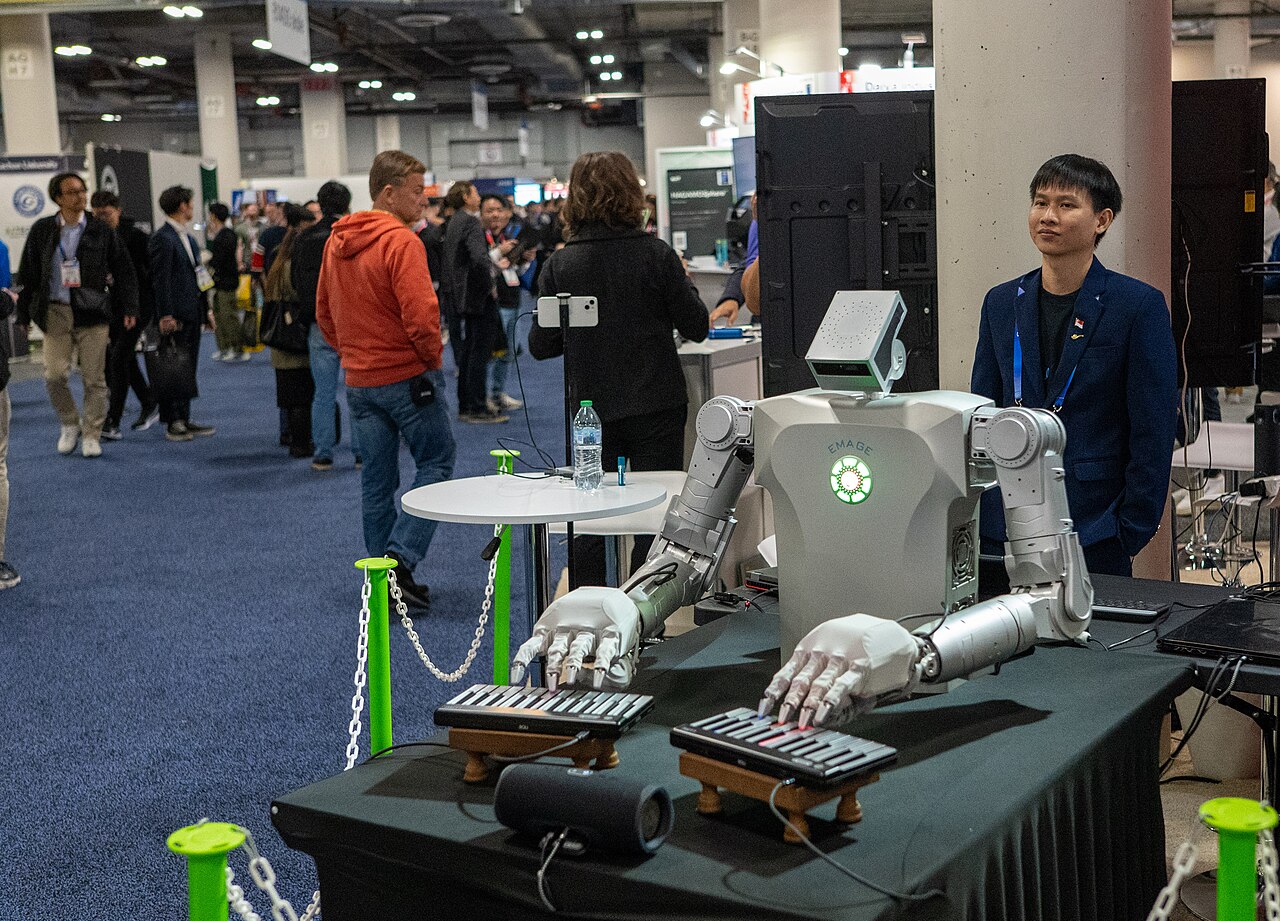
Header image: the Las Vegas Convention Center West Hall during CES 2025, by Xuthoria via Wikimedia Commons, licensed under CC BY-SA 4.0. In-body photograph of a humanoid robot on the CES 2025 show floor by Arthur Petron via Wikimedia Commons, licensed under CC BY-SA 4.0. Both photographs are from CES 2025, the year before the show covered in this post.