California's 2026 bill-signing period ended with a burst of AI legislation. On September 30, 2026, Governor Gavin Newsom's office announced a batch of AI-related signings, and the new California AI laws reach well beyond the frontier-model rules that dominated earlier coverage. Two of them are aimed at everyday professional life: SB 574, the first statute to set rules for how lawyers and arbitrators use generative AI, and SB 947, which bars employers from disciplining or firing workers on the strength of an automated system alone. This explainer sets out what each does, who it affects, when it applies, and how the package sits next to the federal effort to rein in state AI rules.
How many AI bills did Newsom actually sign?
The count depends on who is counting. The governor's September 30 release lists 13 bills, one of which is a gene synthesis bill (AB 1864) about biosecurity rather than AI as such. The Next Web headlined its coverage as 13 AI bills, and the Transparency Coalition's tracker uses a somewhat different list. Earlier in September Newsom had already signed SB 813 and AB 1405, the AI auditor laws we covered in California's AI auditor laws, explained. Counting both weeks, the AI-related total runs higher than any single tally, which is why this post names bills individually and leaves out any measure we could not match to the governor's list.
The September 30 list, with authors, includes: AB 1331 (Elhawary) and AB 1883 (Bryan) on workplace surveillance; AB 1979 (Bonta) and SB 503 (Weber Pierson) on AI in health care; AB 2392 (Fong) on generative AI in public higher education; AB 2713 (Wicks) and SB 1000 (Becker) on the California AI Transparency Act; SB 574 (Umberg) on attorneys and arbitrators; SB 947 (McNerney) and SB 951 (Gomez Reyes) on employment; SB 1111 (Ashby) on digital replicas; and SB 1159 (Cabaldon) on AI transparency and governance.
Signed California AI bills by category and operative date
Selected bills from the governor's September 30, 2026 list. Dates are shown only where a source we opened states one.
No delegating the practice of law to AI, citation checks, court disclosure, arbitrator limits
Extra Cal/WARN notice when AI causes a mass layoff
No AI inference of emotional state or neural data collection at work
No discipline or firing relying solely on an automated system
Limits workplace surveillance tools in bathrooms
AI in health care services
AI Transparency Act changes, digital replicas, AI transparency and governance
Public colleges: generative AI procurement standards and training
SB 574: the first statute on lawyers and generative AI
For lawyers, SB 574 turns a patchwork of court standing orders and bar guidance into statute. According to a Holland & Knight analysis, the law adds a duty at Business and Professions Code section 6068.1 that an attorney "shall not delegate the practice of law" to generative AI. It also bars entering confidential, nonpublic or personally identifying information into a generative AI system unless access is restricted to the attorney and authorized people bound by confidentiality. Lawyers must take reasonable steps to verify AI output, including case and statutory citations, and correct hallucinated material.
Court filings get their own rule. Under an amendment to Code of Civil Procedure section 128.7, a filing in any California court may not contain a citation the responsible attorney has not personally verified, whether or not AI supplied it. Reporting on the law also describes a requirement that at least one attorney sign each court filing in their own name unless the party is self-represented, and a duty to disclose generative AI use in documents filed with a court. Violations of the citation rule fall under the existing sanctions framework, and a firm can be jointly responsible for its lawyers' violations.
An attorney shall not delegate the practice of law to generative AI.
SB 574, as quoted by Holland & Knight
Arbitrators and alternative dispute resolution providers are covered too. Arbitrators may not delegate any part of their decision-making to an AI tool, and the law creates a complaint process for ADR providers. The governor's release frames the lawyer provisions the same way: attorneys stay responsible for their work and cannot hand core tasks such as drafting briefs or exercising legal judgment to AI.
Open questions for the legal profession
The Holland & Knight alert flags two ambiguities. The statute does not define "delegate" or "the practice of law," so the line between using AI for a first draft and delegating legal work is left to interpretation. It is also unclear whether the court disclosure duty applies only to AI-assisted filings or to any AI use. The alert further notes a drafting issue: a protection for represented parties in section 128.7 may now map onto the citation rule rather than onto frivolous contentions, which could need a legislative fix or judicial construction. Bloomberg Law's coverage describes the law as one that codifies and expands existing court rules, which suggests firms with AI policies built around standing orders will find much of it familiar, with statewide reach.
SB 947: what employers must change
SB 947, nicknamed the "No Robo Bosses Act," bars employers from relying solely on an automated decision system to discipline or fire a worker. Where such a system is the primary basis for a decision, a human must corroborate it using other evidence, such as manager evaluations, personnel files or peer reviews, and simply approving the system's output does not count, according to The Next Web. Employers must give written notice that an automated system was used, and workers can request a description of the data it relied on. Inside Privacy reports a $500 civil penalty enforceable by civil action or the Labor Commissioner, and The Next Web adds that the attorney general and local prosecutors can enforce it. The law becomes operative on July 1, 2027.
This is a second attempt. HR Dive reports Newsom vetoed an earlier version of SB 947 in October 2025, criticizing its "unfocused notification requirements." The signed text is the version summarized above.
The rest of the employment package
SB 947 did not travel alone. Labor leaders named four worker bills as a set:
- SB 951 amends the California WARN Act so employers must say when a mass layoff, relocation or termination is caused wholly or substantially by AI or other automated technology, and the state's Employment Development Department must publish summaries. Inside Privacy reports penalties of up to $500 per day and an operative date of January 1, 2027.
- AB 1883 bars using workplace surveillance tools to infer emotional state or collect neural data, with limited safety and federal-law exceptions, effective January 1, 2027 per Inside Privacy.
- AB 1331 limits workplace surveillance in bathrooms. The sources we opened did not give an operative date.
Employers using hiring or performance tools should also note a separate track: HR Dive reports California Privacy Protection Agency regulations, effective January 1, 2027, that would require pre-use notices, opt-outs and risk assessments when AI informs hiring and compensation decisions.
What it means for consumers
Most of the consumer-facing changes are in the transparency and health bills. AB 2713 and SB 1000 revise the California AI Transparency Act, which we covered when it went live in California AI Transparency Act (SB 942) is now live. The governor's release says the package prohibits deleting a digital watermark, and the Transparency Coalition describes AB 2713 as requiring disclosures about whether provenance data or digital signatures are embedded in content. In health care, the release says doctors and licensed providers keep their professional judgment when AI or clinical decision tools are used, while SB 503 and AB 1979 cover AI in health care services. SB 1111 updates civil and criminal law on digital replicas. We could not confirm operative dates for these from the sources we opened.
One notable non-signing: Newsom vetoed SB 1130, a smart-glasses bill that would have penalized secret recording and required recording lights on wearables from 2028. His veto letter said the definition of a wearable recording device was too broad and could sweep in some smartwatches, according to The Next Web.
How it fits the federal preemption fight
These laws land while Washington is trying to slow state AI rulemaking. A December 11, 2025 executive order told the Justice Department to set up an AI Litigation Task Force to challenge state AI laws that, among other things, "unconstitutionally regulate interstate commerce," directed Commerce to list "onerous" state laws, and tied some federal funding to compliance, according to the California State Association of Counties. The same summary notes the order does not change any enacted state law by itself, and that proposed legislative recommendations would not preempt state laws on child safety, data center infrastructure or state government procurement and use of AI.
Where the new California laws fall against that line is an analytical question, not a settled one. Rules on a state's own lawyers and arbitrators, and on employers' internal personnel decisions, regulate professional conduct and workplace practice inside California, which is a different posture from rules on how AI models are built and distributed nationally. The commerce-clause theory the task force is expected to use is more naturally aimed at the latter, and the earlier frontier-model measures such as SB 53 are the ones commentators have named as exposed. We did not find a confirmed federal filing against any of the September 2026 California bills. Newsom's own framing is political rather than legal: his office says he "continues to call on the federal government to establish robust national regulations," and McNerney said California acted "since Washington, D.C., is unable or unwilling to do so." A federal statute with an express preemption clause, rather than an executive order, would be the route that could actually displace these laws.
What to watch before the effective dates
- January 1, 2027: SB 574, SB 951 and AB 1883 begin to apply, along with the privacy agency's hiring-tool regulations.
- July 1, 2027: SB 947 becomes operative, giving employers about nine months to map where automated tools influence discipline or dismissal.
- Court and bar guidance: watch for rules or opinions defining "delegate" and the scope of the disclosure duty.
- Federal action: watch the Commerce evaluation of state laws and any Justice Department filing.
Teams that use more than one AI model for drafting, review or HR analytics will find the verification and human-review duties apply regardless of which model produced the output; multi-model tools such as Metir AI make it easier to keep a human check and a record of which model said what, though the legal duty stays with the lawyer or employer either way.
Sources:
- California's nation-leading AI framework just got stronger, Governor Newsom signs more first-in-the-nation worker protections and more (gov.ca.gov, Sept 30, 2026)
- Governor Newsom signs first-in-the-nation AI safeguards to protect Californians (gov.ca.gov, Sept 9, 2026)
- California Enacts Rules Governing Lawyers' Use of Generative AI (Holland & Knight, Oct 2026)
- Newsom Signs First-of-Its-Kind Bill on Lawyer, Arbitrator AI Use (Bloomberg Law)
- Newsom signs 13 AI bills, including a ban on AI-only firings (The Next Web)
- New California AI Employment Laws: Key Requirements for Employers (Inside Privacy)
- California revamps AI protections for workers in flurry of bill signings (HR Dive)
- AI Legislative Update, October 2, 2026 (Transparency Coalition)
- Federal Executive Order on State Artificial Intelligence Lawmaking (California State Association of Counties)
Image credits
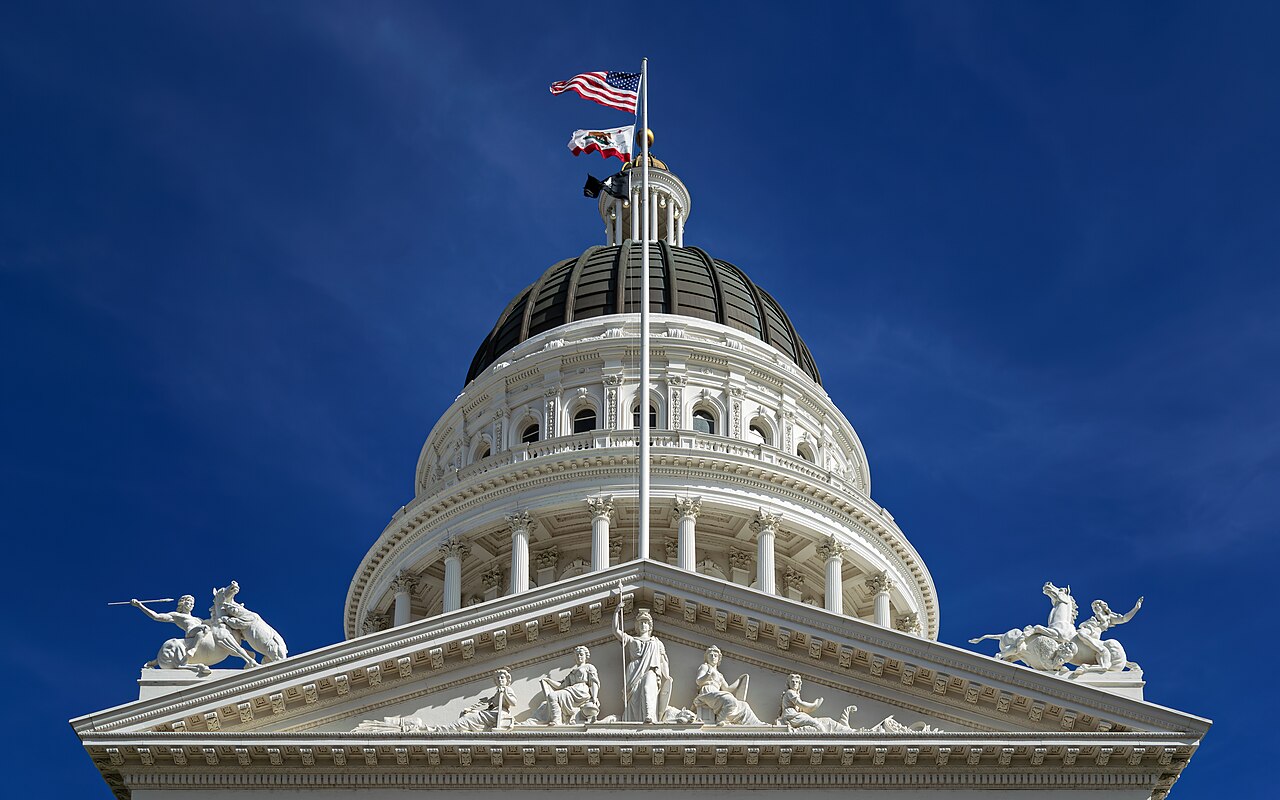
- Hero: California State Capitol (top), NW view up, photograph by Radomianin, public domain, via Wikimedia Commons. Archival photo of the building, not of the signings.
- In-body figure: Dome and pediment with sculptures, California State Capitol, Sacramento, 2011, by DimiTalen, CC0, via Wikimedia Commons.