California's AI Transparency Act, Senate Bill 942, becomes operative today, August 2, 2026. The law requires large generative AI providers to embed hidden provenance markers in the images, video, and audio their systems create, offer users an optional visible AI label, and run a free public tool that lets anyone check whether a piece of content came from their system. It is the first state-level content-provenance mandate of its kind to take effect in the United States, and it lands on the same calendar date as a comparable transparency regime across the Atlantic.
What SB 942 actually requires
SB 942 applies to "covered providers," defined as operators of publicly available generative AI systems with more than one million monthly visitors or users in California. That threshold pulls in the largest consumer AI products by default and leaves smaller or narrowly-scoped tools outside the law's reach, at least for now.
For every covered provider, the law sets three obligations:
- Latent disclosure. AI-generated or AI-altered images, video, and audio must carry a hidden, machine-readable provenance marker embedded in the content itself, using methods consistent with widely accepted industry standards. In practice, that points to the Coalition for Content Provenance and Authenticity (C2PA) specification, the same content-credentials framework already built into several major image-generation tools.
- Manifest disclosure. Providers must give users the option to attach a visible, human-readable "AI-generated" label to their output. Unlike the latent marker, this layer is optional for the end user to apply.
- A free detection tool. Each covered provider must operate a publicly accessible tool, at no cost, that lets anyone submit a piece of content and check whether that provider's system created or altered it.
Text-only output falls outside the latent-disclosure requirement, which is aimed specifically at image, video, and audio content, the categories where a synthetic clip is hardest to distinguish from a real one on sight.
From January 2026 to August 2026
SB 942 was not originally supposed to start today. As passed, the law's operative date was January 1, 2026. AB 853, signed by Governor Gavin Newsom on October 13, 2025, pushed that date back seven months to August 2, 2026, giving covered providers more runway to build the watermarking and detection infrastructure the law requires.
AB 853 did more than move a date. It also added a separate obligation for large online hosting platforms, the services that distribute generative AI tools and content rather than build them, which begins January 1, 2027. That provision prohibits knowingly distributing generative AI systems that fail to meet SB 942's disclosure requirements, extending accountability one step down the distribution chain.
 OpenAI
 Google
 Microsoft
Why provenance watermarking is technically hard
Embedding a durable, hidden marker inside a piece of AI-generated media sounds like a straightforward engineering problem. It is not. C2PA-style content credentials work by attaching a cryptographically signed metadata manifest to a file, but that manifest lives in the container format around the pixel or audio data, not in the pixels or audio themselves. A screenshot, a basic re-encode, a crop, or a repost through a platform that strips metadata on upload can separate the visible content from its provenance record entirely, leaving a copy of the image with no trace of where it came from.
That is the core tension SB 942 has to navigate. The law requires latent markers to use methods consistent with "widely accepted industry standards," which gives providers room to layer in more robust techniques, such as watermarks embedded directly in pixel or waveform data that survive common transformations better than metadata alone. But no current watermarking approach is unbreakable against a motivated actor willing to degrade quality to strip a marker, and interoperability across models compounds the problem: a detection tool built by one provider can only reliably recognize that provider's own watermark, not a rival's, so a full picture of a piece of content's provenance still depends on checking it against multiple providers' separate tools.
A hidden marker only proves something if it survives contact with the internet, and most of what happens to a file online is designed to strip everything but the pixels.
On the interoperability gap in AI content provenance
Who this actually binds, and who it does not
The one-million-monthly-user threshold means SB 942's near-term impact concentrates on a small number of large AI labs and consumer platforms rather than the broader field of AI-powered tools. A startup building a niche image generator with a few thousand California users has no obligation under the statute today, even if its underlying model is capable of the same synthetic output a covered provider's system produces. That asymmetry is deliberate: the legislature aimed the mandate at the systems most likely to reach a mass audience and, by extension, do the most damage if used to spread convincing but fabricated media.
It also means the law's real-world effect depends heavily on how consistently the largest providers implement it, since a handful of AI systems account for the overwhelming share of publicly consumed generative content in California. Enforcement runs through California's Attorney General, along with city attorneys and county counsel, and violations carry civil penalties of up to $5,000 per violation, with each day a provider remains out of compliance counted separately, alongside the possibility of injunctive relief.
A same-day convergence with the EU
August 2, 2026 is not only a California date. It is also the day the EU AI Act's Article 50 transparency rules, covering chatbot disclosure and synthetic-media labeling, take effect for any provider whose outputs reach EU users, regardless of where that provider is based. AB 853's drafters explicitly aligned SB 942's revised timeline with the EU framework rather than leaving California on its own separate schedule.
That convergence is the more interesting signal buried in an otherwise procedural date change. A US state and a supranational regulator reaching the same operative date for content-provenance disclosure, on different legal bases and through entirely separate legislative processes, suggests that watermarking and disclosure obligations are becoming a baseline compliance layer for generative AI rather than a feature any single jurisdiction can claim as a differentiator. Providers building for a global market are increasingly likely to standardize on one provenance approach, most plausibly C2PA, and apply it everywhere, rather than maintain separate disclosure logic per region.
For teams building on top of multiple AI models, that shift toward baseline, standards-based compliance is easier to absorb with infrastructure that is not locked into a single provider's stack. Metir AI, a platform that works across leading AI models rather than one vendor's, makes it simpler to keep disclosure and labeling behavior consistent as rules like SB 942 and the EU AI Act's Article 50 continue to evolve, without rebuilding a compliance layer each time a jurisdiction moves its date.
What comes next
Today's operative date is not the end of California's AI transparency timeline. The hosting-platform distribution restriction added by AB 853 arrives January 1, 2027, extending accountability to the services that carry generative AI tools and their output rather than the labs that build the underlying models. Compliance teams tracking SB 942 should treat August 2, 2026 as the first of at least two dates on the calendar, not the only one.
Sources:
- AB-853 Generative artificial intelligence: transparency | California Legislative Information
- California AI Transparency Act (SB 942): What Covered Providers Need to Know | AI Laws by State
- SB 942: California's AI Transparency Act | ClearPol
- California SB 942 AI Transparency Requirements | Encypher
- Understanding the California AI Transparency Act (SB 942) | Magic Mirror Security
Image credits
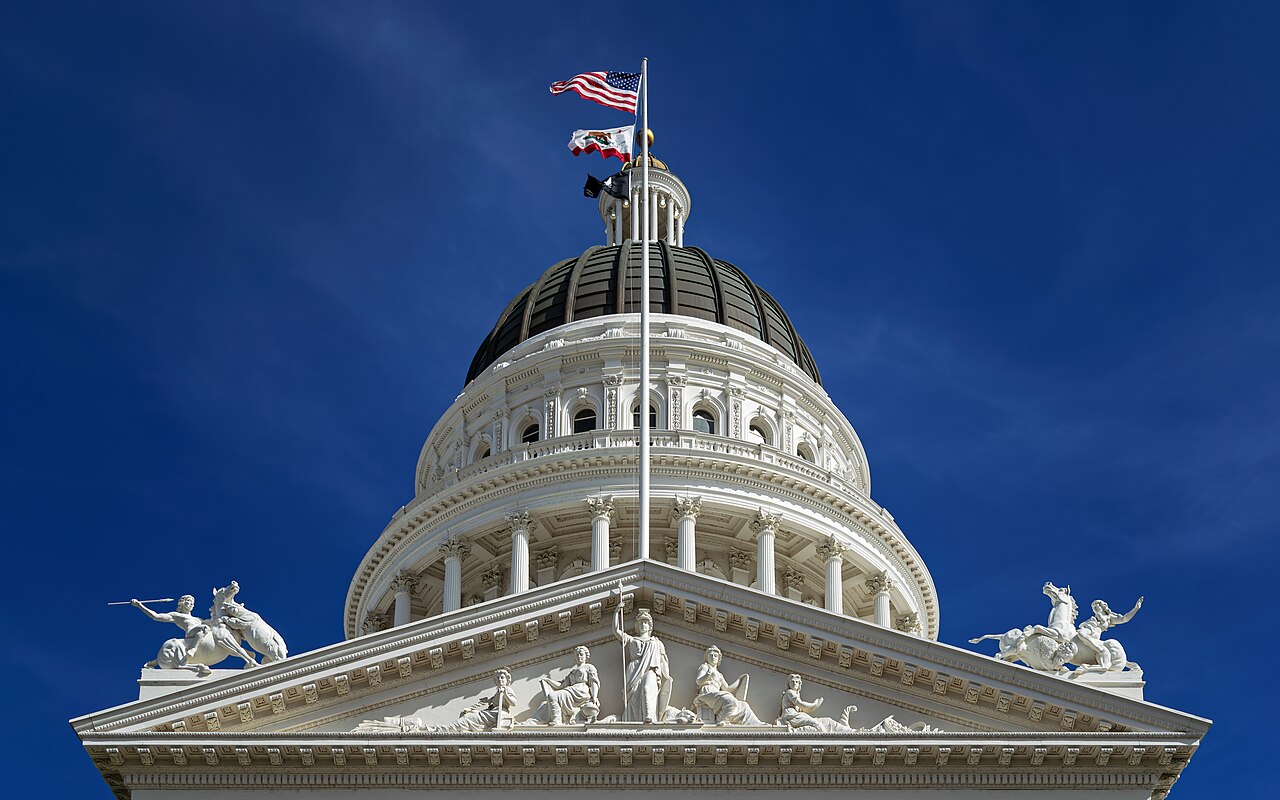
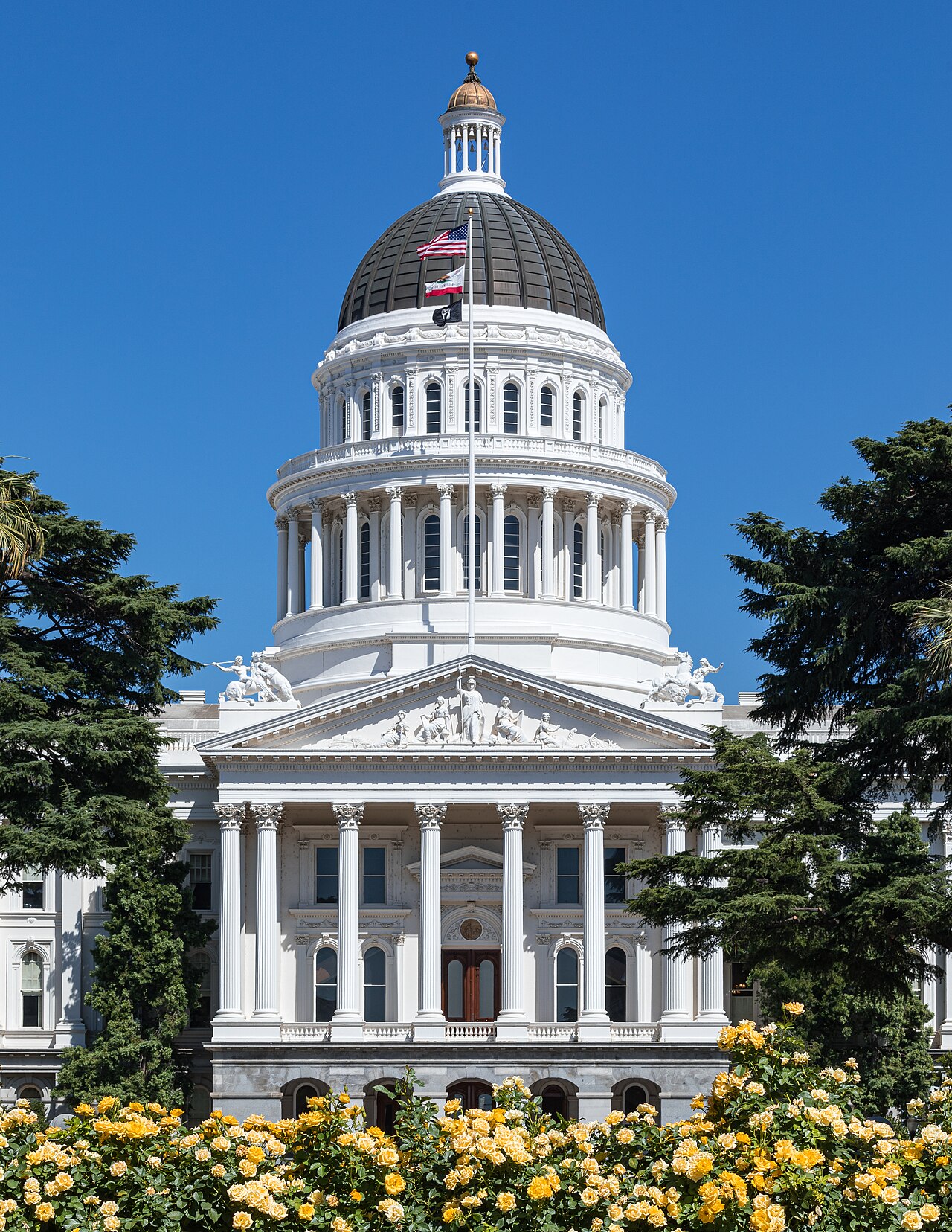
Header image: a close-up northwest view of the pediment, rotunda and dome of the California State Capitol in Sacramento, by Radomianin, public domain, via Wikimedia Commons. In-body image: the full front facade of the California State Capitol with its rose garden, June 2019, by Frank Schulenburg, CC BY-SA 4.0, via Wikimedia Commons.