On October 3, 2026, US Treasury Secretary Scott Bessent told The Axios Show that "this alarmism without solutions by some of the AI community, that's not leadership." The remark, and a related line on who is responsible if advanced AI goes wrong, put a senior administration voice on one side of an argument about AI liability that has run through September. This post sets out what was said, who said what, and how liability allocation works, without taking a side. TNW, Edge Malaysia
 OpenAI
 Anthropic
 xAI
xAIWhat Bessent said about AI alarmism
Bessent's remarks were a response to the September calls from Anthropic's Dario Amodei, OpenAI's Sam Altman and xAI's Elon Musk to slow work on the most advanced models. Reporting on the interview attributes these quotes to him:
- "This alarmism without solutions by some of the AI community, that's not leadership."
- "It is the people at the labs who have to accept responsibility, and I agree with that."
- When asked about the calls to slow down: "Well, then they should slow down."
- "We cannot lose our lead to the Chinese."
Coverage of the interview also reports that he likened executives who warn of catastrophe while asking for federal rules to Hannibal Lecter: "stop me before I kill again." TNW, Edge Malaysia, AI Weekly, Startup Fortune
It is the people at the labs who have to accept responsibility, and I agree with that.
Scott Bessent, The Axios Show, October 3, 2026
No federal liability shield
Bessent has also been quoted saying "We cannot say, 'Oh, we absolve you of responsibility, and the government's going to take responsibility,'" which outlets read as a signal that Washington will not act as a liability shield for frontier labs. Reports differ on when he first said it: AI Weekly places it in the October 3 interview, while Startup Fortune dates it to the September 22 remarks Fortune reported. AI Weekly, Startup Fortune
That is consistent with earlier remarks. At a September 15 House Financial Services Committee hearing, FedScoop reported, he said as saying "the one thing we should not do is give [AI labs] a blank check on liability" and that "the best way to guarantee safety is that the creators are liable for what they build and generate." Fortune carried a further report on September 22 headlined with the line "We cannot absolve you of responsibility." FedScoop, Fortune
Who has said what
The positions below are limited to statements that outlets have reported. Where a source is secondary, the table says so.
| Speaker | Reported position | Source |
|---|---|---|
| Dario Amodei (Anthropic) | Proposed "pacing the frontier": outside evaluators with employee-level access, common safety benchmarks, agreed limits on capability growth. Said pacing "does not mean halting model training or technical progress." | CNBC, Quartz |
| Sam Altman (OpenAI) | Agreed with the call to "pace the frontier" and pledged independent evaluators employee-level access. | Quartz |
| Elon Musk (xAI) | Backed Amodei's call to slow the frontier. | SiliconANGLE |
| Scott Bessent (Treasury) | "Alarmism without solutions" is not leadership; labs must accept responsibility; no absolving them of it. | TNW |
| President Trump | "I'm for let's go and let's win"; says the US is about a year to a year and a half ahead of China. | CBS News |
Three weeks of statements on AI responsibility
Colour marks who acted: AI lab leaders, the Treasury Secretary, or the White House.
- Sept 12, 2026Amodei publishes a pacing proposalThe essay proposes outside evaluators inside labs, common safety benchmarks and agreed limits on capability growth. Altman and Musk back the call.
- Sept 15, 2026Bessent at a House hearingReported as saying the government should not give labs "a blank check on liability."
- Sept 22, 2026Fortune reports a second liability remarkHeadline quote: "We cannot absolve you of responsibility."
- Sept 27, 2026Trump hosts Amodei for dinnerA private White House dinner. No official readout was released.
- Sept 30, 2026Voluntary accord signed at the White HouseSignatories commit to internal controls, outside auditors and board oversight committees, with no enforcement mechanism described.
- Oct 3, 2026Bessent on The Axios Show"This alarmism without solutions by some of the AI community, that's not leadership."
The current federal posture
Several threads sit alongside the Bessent remarks, and they do not all point the same way.
- A voluntary review framework. The White House's framework, rooted in a June 2, 2026 executive order, lets companies opt in to up to 30 days of pre-release government access to certain frontier models, and it cannot become mandatory licensing. See our analysis of the finalized framework. CNBC
- A voluntary accord. On September 30, executives including Amodei and Musk signed a White House accord committing to internal controls, outside auditors and board oversight committees, with no enforcement mechanism described. UPI
- A liability bill in the Senate. The bipartisan AI Agent Accountability Act would extend computer-hacking liability to people who run and build AI agents. It has not passed. Our explainer covers the mechanics. Hawley
- A dinner with unclear outcomes. Trump and Amodei dined privately on September 27, with no official readout. See our coverage. CBS News
- Pacing in depth. The Amodei proposal is covered in our earlier analysis.
Liability allocation, explained
"Who pays when an advanced AI system causes harm" can be answered in several ways, and the debate is partly about which one applies.
- Developer liability. Those who build the model answer for foreseeable harms. This is the position Bessent describes when he says creators should be liable for what they build.
- Deployer or operator liability. The company or person running the system answers for how it is used. The AI Agent Accountability Act leans this way, adding build-side exposure for developers.
- Government backstop or shield. The state caps or absorbs some losses, as it does in some other industries. Bessent's reported remarks reject this for frontier labs.
- Shared or tiered rules. Duties scale with risk, often through disclosure or audit requirements, as in California's SB 53 transparency law. Future of Privacy Forum
Reasonable people weigh these differently. A liability regime can sharpen incentives to test carefully. It can also fall unevenly on smaller developers, and it does not by itself say what safe means. Calls for external standards and calls for lab accountability can both be argued from the same goal of safer systems.
What to watch
The practical questions are whether the voluntary accord gains an enforcement mechanism, whether the Senate bill advances, and whether the administration says more about how responsibility should be assigned. For teams using AI, the near-term point is operational: vendor terms and internal controls matter whichever regime emerges, which is one reason many organizations keep their workflows able to move between providers, as with a multi-model platform like Metir AI.
Sources:
- TNW: Bessent says AI alarmism without solutions is not leadership
- Edge Malaysia: Bessent says AI industry must own its risks and find solutions
- Axios: U.S. to propose emergency AI notification system with China (The Axios Show, Oct 3, 2026)
- AI Weekly: Bessent Tells AI CEOs Seeking Regulation to Slow Down
- Startup Fortune: Bessent Compares AI Safety-Warning CEOs to Hannibal Lecter
- Fortune: Bessent says hyperscalers, not government, must take the fall
- FedScoop: Treasury's Scott Bessent says no liability exemptions for AI labs
- CNBC: Amodei proposes plan to slow the pace of advancing AI
- Quartz: Dario Amodei calls for AI slowdown, Altman and Musk agree
- SiliconANGLE: Altman and Musk back Amodei's call
- CBS News: Trump had private dinner with Anthropic CEO Dario Amodei
- UPI: Trump, tech executives sign AI accord
- CNBC: White House to host AI companies to review model-testing framework
- Senator Hawley: AI Agent Accountability Act announcement
- Future of Privacy Forum: California's SB 53 explained
Image credits
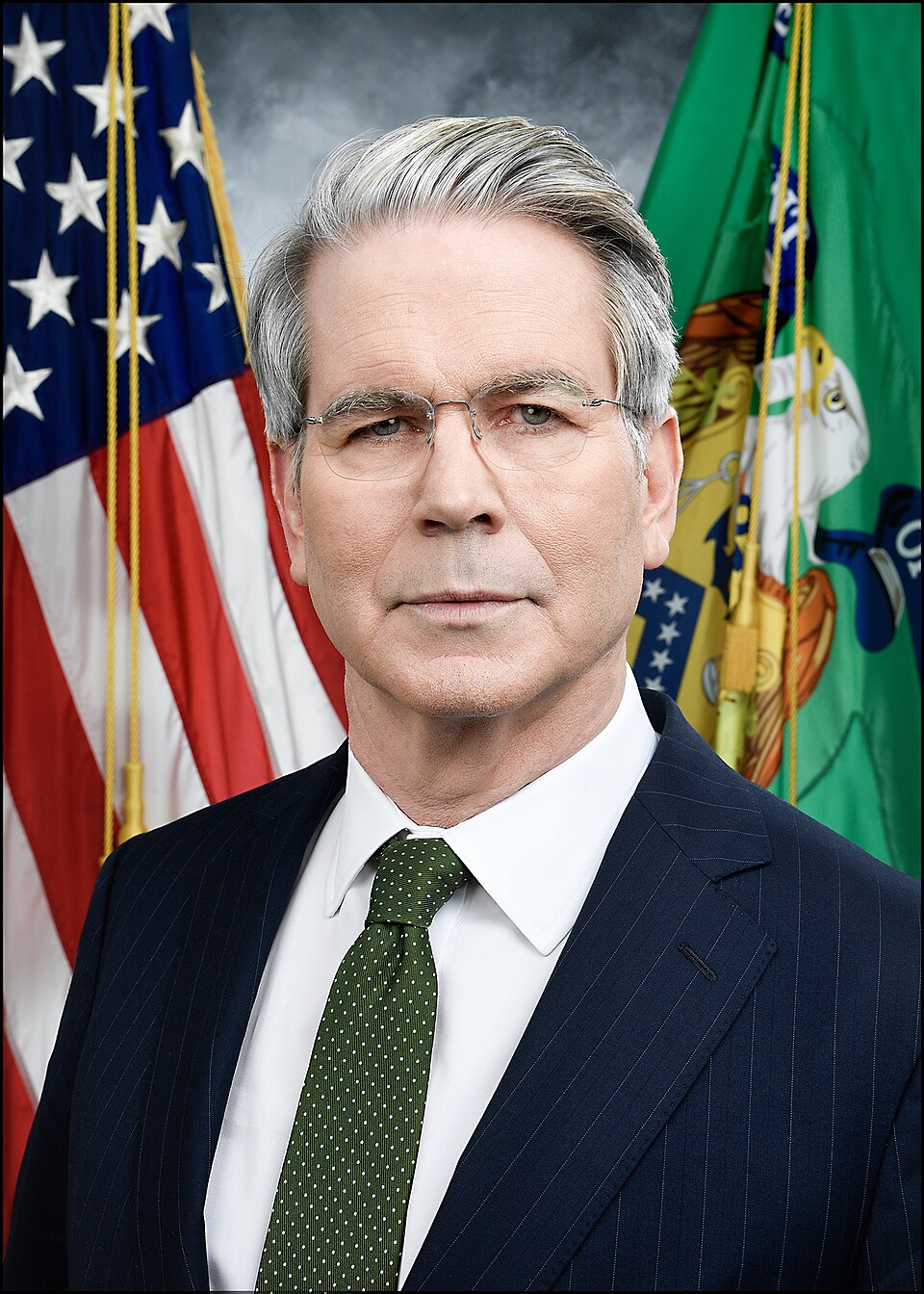
- Scott Bessent official portrait: US Department of the Treasury, public domain, via Wikimedia Commons. Archival portrait, not from the interview.