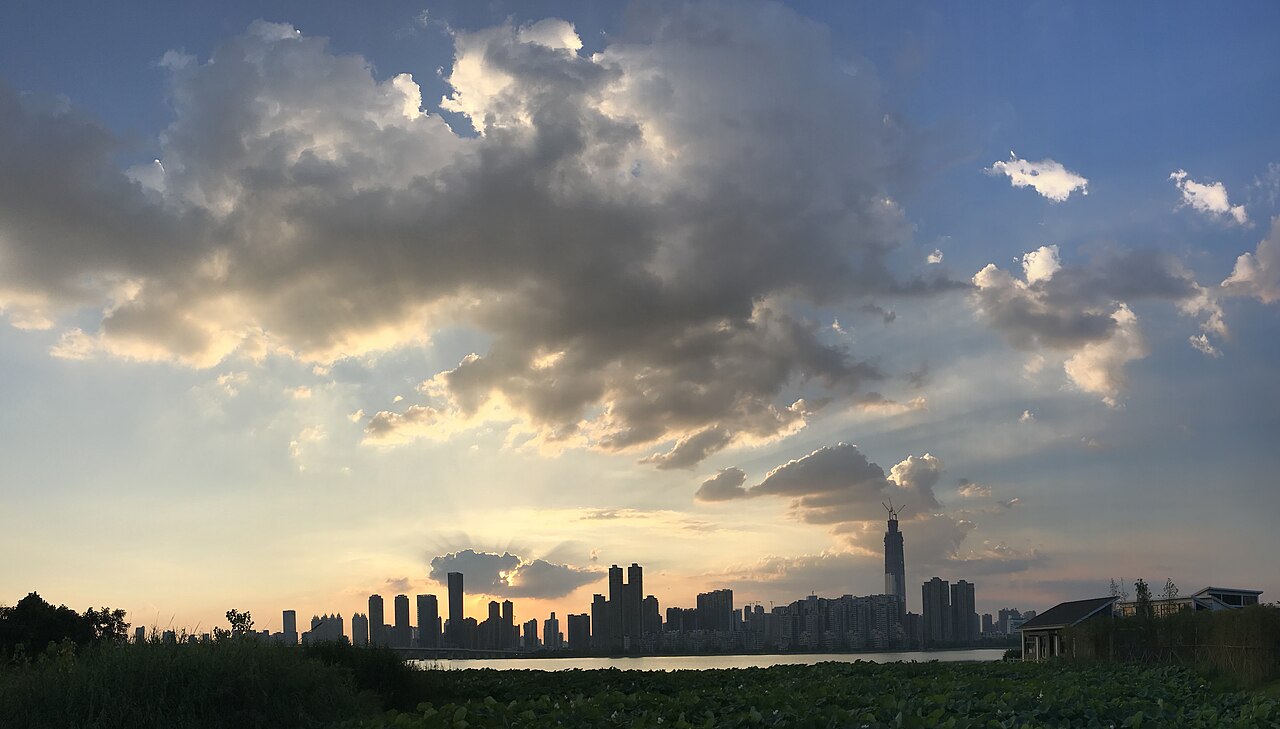
On September 23, 2026, the Jiang'an District People's Court in Wuhan, Hubei Province, closed a short copyright dispute over an AI-assisted drama series with an outcome that reads, at first glance, like a routine infringement case. A production company sued a copycat that had lifted its show wholesale. The court sided with the plaintiff and awarded RMB 20,000 in damages. Nothing about that outcome is new. What is new is a single line inside the court's damages calculation: alongside the usual factors of production length, audience reach and how long the infringement lasted, the court counted the computing costs of token consumption and the licensing fees for commercial AI tools as part of what the plaintiff had actually spent to make the work.
It is the first Hubei ruling to weigh AI compute costs in a copyright damages award, and it builds directly on a body of Chinese case law that has been more willing than courts in the United States or the European Union to recognize AI-assisted output as a protectable "work." Together the two threads, on copyrightability and on damages, point at a court system starting to treat the economics of generative AI production as legally relevant facts rather than background noise.
What actually happened
The plaintiff, a short-drama production company identified in reporting only as Company A, produced a 47-episode AI-assisted series called "Cloud Above XX," running about an hour in total. The show was registered with China's National Radio and Television Administration and released in early 2026 on the Hongguo Short Drama app and on WeChat Video Channel. One day after release, a second company copied the entire series without authorization, retitled it "Woman XX," reposted it through its own WeChat account, and ran commercial advertisements against it.
Company A sued for copyright infringement. The first question the court had to settle was not really about the copy, it was about the original: could an AI-assisted short drama be a copyrighted "work" at all under Chinese law.
The copyrightability question
Chinese copyright law, like most systems, protects "original intellectual achievements." The court applied that standard and looked past the fact that AI tools generated much of the visual and audio material, asking instead how much human judgment shaped the finished product. It found that Company A's creative staff had planned the plot, written the scripts, iteratively adjusted the prompts fed to the AI tools, selected which generated images and voice tracks to use and which to discard, chose scenes and characters, and edited the final cut together with synchronized subtitles and audio.
On that record, the court held the human contributors exercised what it called "foreseeability and substantive control over the final expression," with the AI tools serving only as a technical means to an end the humans had defined. The series qualified as a protected audiovisual work.
This is not a novel legal theory in China. It tracks the reasoning the Beijing Internet Court used in November 2023 in Li v. Liu, the first Chinese case to grant copyright to a Stable Diffusion image, where a plaintiff had used iterative prompting to produce a picture titled "Spring Breeze Brings Tenderness." That court found the image reflected the plaintiff's original intellectual investment through his choices of prompts, parameters and selections, and it awarded him 500 yuan (about seventy dollars) after a defendant reused the image without permission. The Wuhan ruling applies the same human-control logic to a longer, more complex production and extends it into a new province's case law.
Why the damages line is the real news
Copyright infringement damages in China, absent clear evidence of the plaintiff's actual losses or the infringer's actual profits, are often set as statutory damages, a figure a court arrives at by weighing a list of relevant factors rather than by running a precise accounting. Traditionally those factors have been things like how long the work took to make, how widely it was distributed, when it was released relative to the infringement, and how long the infringement continued.
In this case, the court added two AI-specific line items to that list: the computing costs tied to token consumption during content generation, and the licensing costs of the commercial AI tools used to make the drama. In other words, running the AI generation itself has an accounted-for price, and that price is now something a Chinese court will look at when it decides what a rights holder is owed.
Running the AI tools has a price, and now a court is willing to look at it when deciding what a rights holder is owed.
On the Wuhan court's damages reasoning
This matters for a reason that goes beyond one RMB 20,000 award. Statutory damages factors function as an implicit statement of what a court considers relevant to the value and cost of creative work. By naming token compute and tool licensing as factors, the Jiang'an court signaled that it sees AI production expenses the same way it has long seen the labor and time costs of traditional filmmaking, as legitimate inputs into what a work cost to make and therefore what infringing it should cost to remedy. That is a small step in a single district court's reasoning, but it is the kind of step other courts tend to notice and reuse.
It also creates, at least implicitly, a paper trail incentive. A rights holder who wants token and licensing costs recognized in a future damages calculation will need records of those costs, invoices, usage logs, subscription receipts, in a form a court can weigh. Chinese courts have increasingly asked AI-assisted creators to document their production process to establish authorship in the first place; this ruling extends that documentation habit to the financial side as well.
Where China, the US and the EU currently diverge
The Wuhan case sits inside a broader, ongoing divergence between how major jurisdictions decide whether AI-assisted output can be copyrighted at all. All three of the jurisdictions below now require some form of human creative control, but they differ in how much AI-mediated production they are willing to accept underneath that control.
Copyrightability of AI-assisted works, three jurisdictions
All three now converge on a human-authorship threshold. What differs is how much human involvement in the AI workflow is enough to clear it.
Compiled from court rulings and copyright office guidance current as of September 2026; each jurisdiction's case law is still developing.
The US Copyright Office's guidance treats meaningful human creative control over a work's expressive elements as the touchstone: AI-assisted work can be registered for its human-authored portions, but prompts by themselves are not considered enough control to make the prompter an author, and material an AI system determined autonomously is not protected and falls into the public domain on release. The European Union has no unified statute directly on point; case law from the Court of Justice of the European Union requires a work to reflect an author's "own intellectual creation" through free and creative choices, and EU member states have broadly converged on requiring significant human input, with purely AI-generated content presumed unprotected absent that showing. China's courts, across both the 2023 Beijing image case and this 2026 Wuhan drama case, have taken a comparatively permissive reading of the same underlying idea, looking holistically at planning, iteration, selection and editing across an entire production process rather than scrutinizing a single prompt in isolation.
None of the three systems will hand a copyright to a single unedited AI output with no human judgment behind it. The practical difference is where each one draws the line on how much of the AI-assisted process counts as sufficiently human, and China's courts have so far drawn that line to include more of the workflow than the initial guidance out of the US or the dominant reading in the EU.
What this means for creators using AI tools
For teams building AI-assisted content, whether short drama, marketing video, illustration or anything else, this case is a useful preview of two things courts will ask for.
- Document the creative process, not just the output. The Wuhan court's reasoning turned on specific, provable human contributions: script planning, prompt iteration, selection among generated options, scene and character choices, and final editing. A production log, version history or edit trail that shows those decisions is now evidence with legal weight, not just good project hygiene.
- Keep cost records for the AI tools themselves. Token usage logs, API billing statements and commercial tool license receipts are the kind of documentation a damages calculation like this one will look for. Treating AI compute spend as a tracked production cost, the way a studio tracks camera rental or editing-suite time, puts a creator in a stronger position if a dispute over the resulting work ever reaches a court.
This is also a reasonably good argument for working across tools rather than being locked into a single AI provider's record-keeping. A workspace like Metir AI, which lets teams draw on multiple leading AI models from one place, makes it easier to keep a single, coherent history of prompts, generations and edits across a project regardless of which underlying model produced which piece, which is exactly the kind of unified trail a court weighing human contribution and production cost would want to see.
The takeaway
The Wuhan ruling is a modest case by the numbers, a copied 47-episode short drama and a RMB 20,000 award. Its significance is in the reasoning, not the amount. It confirms, in a new province, that Chinese courts will extend copyright to AI-assisted work where human creators can show they controlled the final result, following the path the Beijing Internet Court opened in 2023. And for the first time, it treats the compute and licensing cost of actually running the AI tools as a fact relevant to what an infringer owes. Neither the US Copyright Office's current guidance nor the dominant reading in the EU has gone that far yet. Whether other Chinese courts adopt the same damages factor, and whether it spreads beyond China, is worth watching as AI production costs become a bigger and more documented share of how creative work gets made.
Sources:
- Wuhan Court Considers AI Token Costs in Calculating Damages for Copyright Infringement of AI-Generated Work | China IP Law Update
- Jiang'an District People's Court Sees First IP Case Involving AI | The National Law Review
- China court factors token costs into damages for copied AI short drama | MLex
- In China, a court recognized copyright for an AI series and considered token costs when determining compensation | sud.ua
- AI in litigation series: An update on AI copyright cases in 2026 | Norton Rose Fulbright
- Beijing Internet Court Releases Translation of Li vs. Liu Recognizing Copyright in Generative AI | China IP Law Update
- Landmark Ruling: China's Court Upholds Copyright for AI-Generated Images | China Justice Observer
- Beijing court rules AI-generated content covered by copyright, eschews US stand | South China Morning Post
- Who Owns What Technology Creates? The Human Authorship Requirement of AI Copyright | Bilzin Sumberg
- Copyrightability of AI Outputs: U.S. Copyright Office Analyzes Human Authorship Requirement | Jones Day
- Copyright of AI-generated works: Approaches in the EU and beyond | European Parliament Think Tank
Image credits
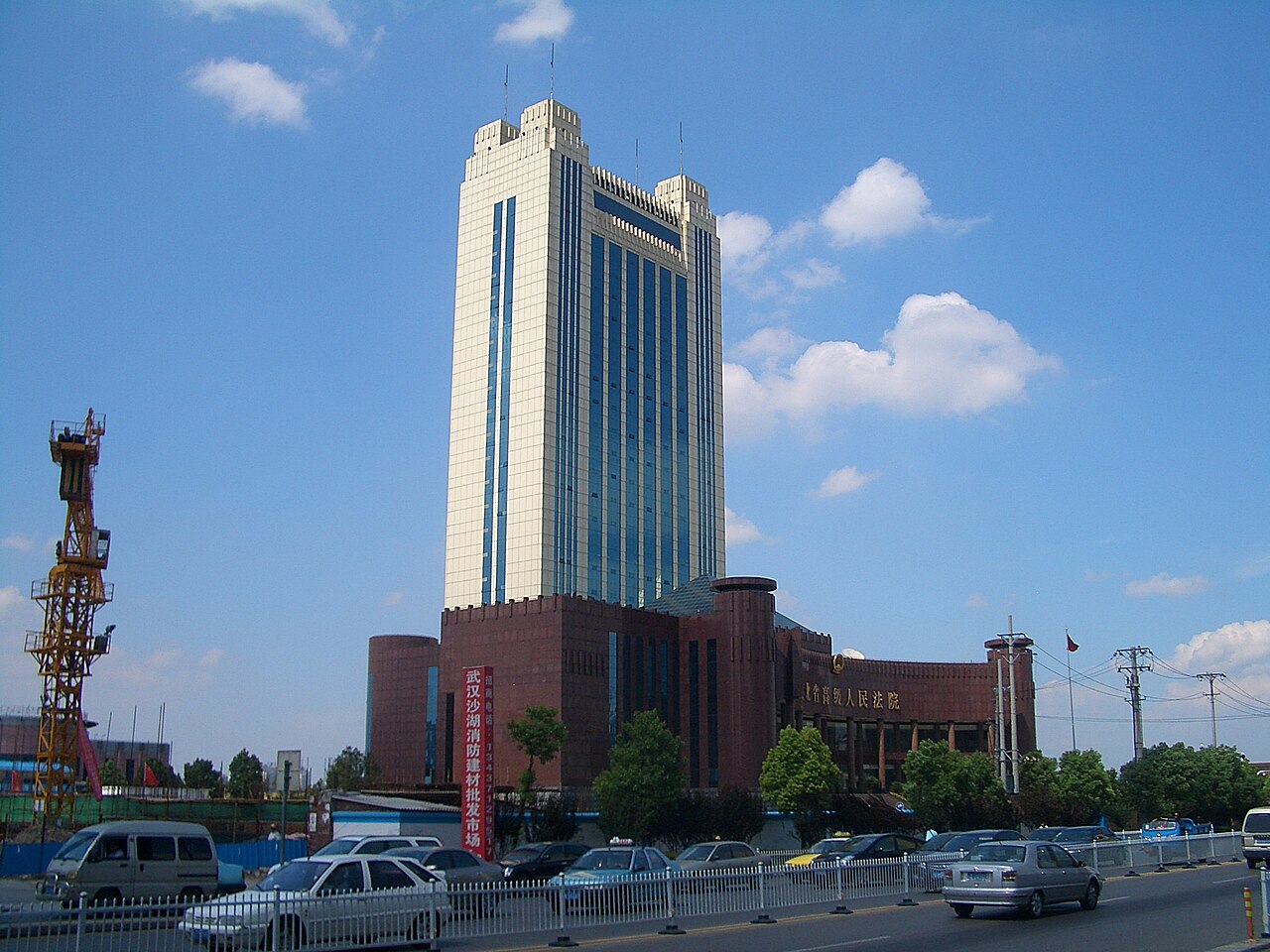
Header image: skyline of Wuhan, Hubei Province, China, by Charlie fong, CC BY-SA 4.0, via Wikimedia Commons. In-body image: the Higher People's Court of Hubei Province building in Wuhan, by Vmenkov, CC BY-SA 3.0, via Wikimedia Commons.