The default assumption in most AI coverage is that compute gets cheaper. Token prices have fallen steeply for two years, new chips deliver more performance per dollar, and competition keeps pushing prices down. So a July 29, 2026 essay by Dwarkesh Patel, titled "Why compute might get 10x more expensive," is a useful provocation precisely because it argues the opposite. Its claim is not that chips will get worse, but that the effective price of a unit of compute could rise sharply, because the demand for compute, tied to how much money AI can make, may grow several times faster than the physical supply of chips can. This piece walks through that argument on its own terms, checks the numbers it rests on, and lays out the strongest reasons it might not hold. The goal is not to endorse the conclusion but to understand the mechanism, which matters to anyone whose costs depend on AI.
The mechanism in one picture
The argument reduces to a race between two growth rates.
Why faster revenue can make compute more expensive, not cheaper
The argument is not that chips get worse. It is that demand, tied to revenue, grows several times faster than the supply of compute can.
If a leading lab keeps its recent trajectory, its willingness and ability to pay for compute rises roughly an order of magnitude annually.
Fabs, packaging, power and data centres expand far more slowly, bounded by lead times measured in years.
More money chases a slower-growing pool of chips and power. The gap has to clear somewhere.
The clearing mechanism is price. Effective cost of a unit of compute can climb even as the hardware itself gets more efficient.
This is a conditional argument. It holds only if revenue keeps compounding at recent rates, which is itself the open question.
On one side is revenue. Patel notes that at least one leading lab has seen revenue "10x year over year," and his thought experiment asks what would have to be true for that to continue: a lab ending 2026 with, by his estimate, $100 billion to $150 billion in revenue would need to reach roughly $1 trillion by the end of the following year to stay on the curve. On the other side is compute supply, which he argues grows far more slowly, at roughly 3x per year. When the willingness to pay for compute compounds much faster than the compute itself, something has to give, and in a market the thing that gives is price.
The gap that drives the whole argument
Approximate annual growth multiples used in the essay. Revenue is assumed to compound several times faster than compute can be built.
The figures are deliberately round. The point is the ratio between the two bars, not their exact height.
Patel decomposes that 3x figure in a way worth repeating, because it shows why compute supply is stubborn: about 1.4x comes from Moore's Law style improvements, about 1.2x from new fab construction, and about 1.8x from AI taking a growing share of leading-edge wafer capacity away from other devices. Two of those three levers are close to their limits. You can only shift so much wafer allocation to AI before it approaches saturation, and building new leading-edge fabrication capacity is a multi-year, multi-billion-dollar undertaking gated by a handful of suppliers.
Why prices, not just volumes, would move
The subtle part of the argument is why a supply-demand gap shows up as a higher price per unit of compute rather than simply more chips sold. The answer is that the value a buyer can extract from a chip is rising. Patel's sharpest illustration is a rental-price thought experiment: if an AI system running on a single high-end accelerator could do the work of a human software engineer, then at market rates for that labor, the accelerator "should rent for over $250k a year," which he pegs at roughly 15x today's spot prices. The point is that as models get more capable, the same hardware can be monetized far more effectively, so buyers can rationally bid far more for it. That bidding is what pulls the price up.
The claim is not that chips get worse. It is that the value you can extract from a chip may rise faster than the supply of chips can.
This is the distinction that resolves the apparent contradiction with falling token prices. The price of a specific unit of output, a million tokens from a given model, can keep falling thanks to efficiency and competition, at the same time as the price of raw frontier compute rises, because more capable models make that compute more valuable. Cheaper tokens from last year's model and more expensive access to this year's frontier are not contradictory; they are two different goods. Conflating them is the most common way this debate goes wrong.

The named bottlenecks
An argument about supply is only as strong as the specific constraints it points to, and here the essay is concrete. The binding limit it names sits at the most advanced end of chip manufacturing. Extreme-ultraviolet lithography tools, the machines required to make the leading-edge chips AI depends on, face supply bottlenecks that Patel expects to persist through at least 2030. And the share of the most advanced process node going to AI is projected to climb from around 60% toward 86% by the end of 2027, which means the easy lever of reallocating capacity from phones and laptops to AI is running out of room. Once AI already takes the overwhelming majority of leading-edge output, further growth has to come from genuinely new capacity, which is the slow, expensive kind.
The strongest reasons it might not hold
A good provocation invites scrutiny, and this one has several honest weak points that a careful reader should weigh. The first and largest is that the entire argument is conditional on revenue continuing to compound at extraordinary rates, and the author says as much: the trend "very well might not" continue. The $1 trillion-in-a-year figure is a thought experiment about what the trendline implies, not a forecast, and if revenue growth slows to something merely fast rather than order-of-magnitude, the demand side of the race decelerates and the price pressure eases. Much of the argument's force rests on an assumption that is itself the biggest open question in AI.
The second is demand elasticity. If frontier compute really did get 10x more expensive, buyers would not keep buying the same way; they would substitute toward smaller models, cheaper providers, more aggressive efficiency work, and workloads that do not need the frontier at all. High prices are self-correcting to a degree the raw supply-demand gap understates. The third is history's skepticism of scarcity predictions, which the essay acknowledges by citing the Simon-Ehrlich wager, the famous bet in which predicted commodity shortages failed to materialize because higher prices spurred more supply and substitution. Patel's rebuttal is that compute supply is "much less elastic" than commodity extraction, which is fair for the next few years but weaker over a longer horizon, since he himself notes that eventually automated manufacturing could push compute prices back down toward the cost of raw inputs.
Much of the argument's force rests on an assumption that is itself the biggest open question in AI: whether revenue keeps compounding.
What it means in practice
Strip away the specific multiples and the durable insight survives: for the next several years, the supply of frontier compute is far more rigid than the demand for it, and that asymmetry pushes in the direction of higher, not lower, prices for the most capable compute, even as prices for any fixed level of capability keep falling. For anyone building on AI, the practical implication is not to panic about a 10x number that may never arrive, but to treat frontier compute as a genuinely scarce input and to design around that scarcity. That means matching each task to the smallest model that can do it, avoiding lock-in to a single provider whose prices you cannot influence, and being able to move workloads as relative prices shift.
That last point is where a model-agnostic approach earns its keep. If the cost of compute becomes more volatile and more provider-specific, the ability to route a given task to whichever model offers the best price for adequate quality stops being a convenience and becomes a cost strategy. It is the principle Metir AI is built on: giving teams access to many leading models through one workspace, so that when relative prices move, the work can move with them rather than being stranded on a single, suddenly expensive stack. The essay's scenario, if it even partly comes true, is an argument for exactly that kind of flexibility.
The takeaway
"AI compute might get 10x more expensive" is a claim engineered to jolt an audience that assumes the opposite, and taken literally it is fragile, because it hangs on revenue growth continuing at a rate almost no business sustains for long. Taken as a lens, though, it is genuinely clarifying. It separates the price of capability, which keeps falling, from the price of frontier compute, which is governed by a supply chain that cannot flex on the timescale demand can. The honest reading is that the direction of the argument is more robust than its magnitude: frontier compute is likely to stay scarce and contested for years, the exact multiple is unknowable, and the sensible response is to build in a way that does not depend on any single guess about where the price lands.
Sources:
- Why compute might get 10x more expensive | Dwarkesh Patel (dwarkesh.com)
- Dwarkesh Patel argues AI compute could get much more expensive | Digg
- Dwarkesh Patel Is on the 2026 TIME100 Creators List | TIME
- Understanding Dwarkesh Patel's AI Scaling Thesis: Compute, Timelines, and What He Actually Believes | Luminix
Image credits
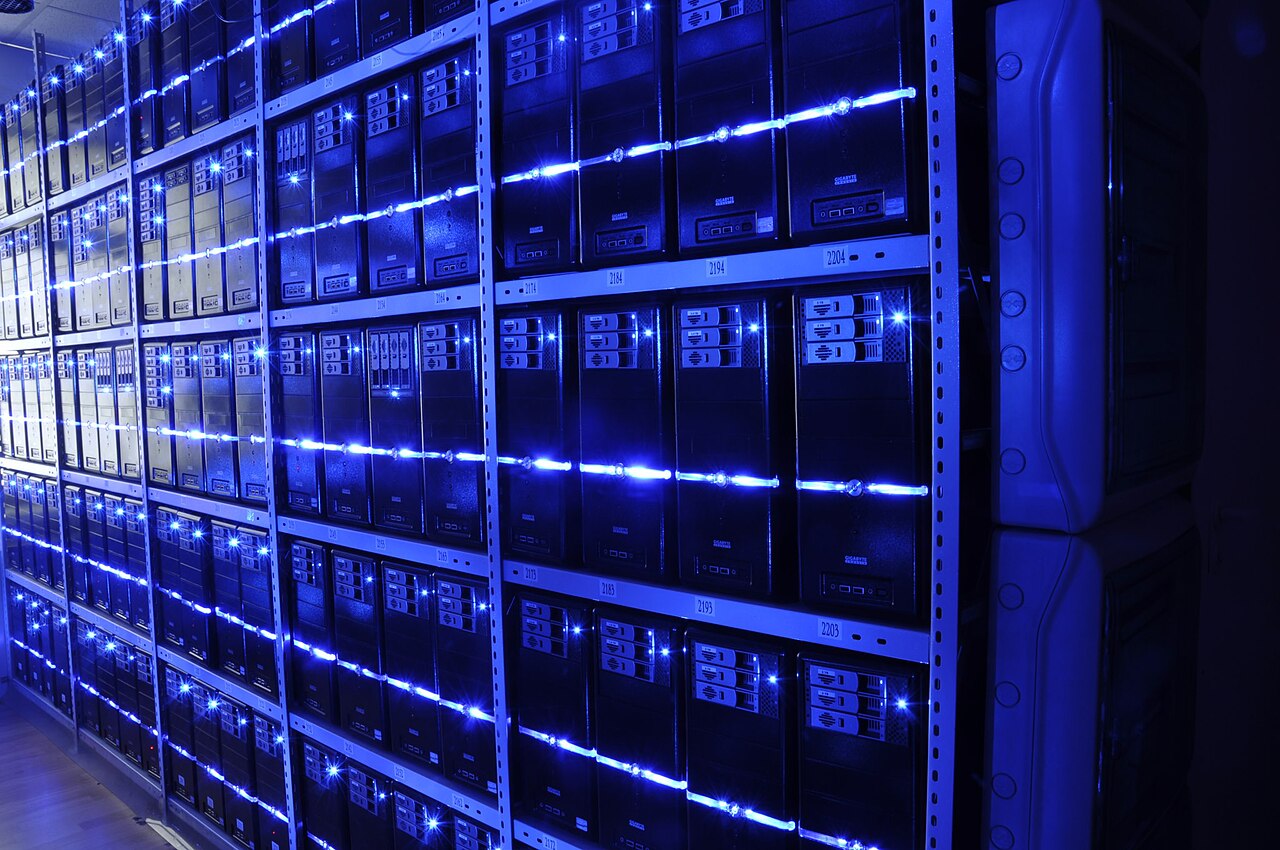
Header image: a data center server hall, by BalticServers.com via Wikimedia Commons, licensed under CC BY-SA 3.0. In-body photograph: Nvidia CEO Jensen Huang at Stanford in April 2026, by Anderseidesvik via Wikimedia Commons, licensed under CC BY-SA 4.0. The images depict general AI compute infrastructure and industry leadership rather than any specific facility discussed in the essay.