August 1, 2026 was supposed to be the day the federal government's frontier AI oversight machinery came into public view. It was the deadline Executive Order 14409 set for three separate deliverables: a classified benchmarking process for the most capable AI models, a voluntary disclosure framework for frontier labs, and a plan to expand the federal cybersecurity workforce. The date came and went. No Federal Register notice appeared. NIST and CISA published nothing. The Office of Science and Technology Policy issued no statement. The deadline simply lapsed.
This is the follow-up to the story of what the framework was supposed to do. In July, this publication covered the White House's negotiations with OpenAI, Google and Anthropic over a voluntary pre-release review window of up to thirty days for the most capable models. That framework was the centerpiece of what EO 14409 was building toward. This piece covers what happened, or did not happen, when the clock ran out.
 OpenAI
 Google
 Anthropic
What the deadline was for
Executive Order 14409 assigned three separate pieces of work an August 1, 2026 due date, each with a different set of agencies attached.
Three EO 14409 deliverables due August 1, 2026
As of the deadline, none had a public artifact: no Federal Register notice, no NIST or CISA publication, no OSTP statement.
Status reflects public agency and Federal Register activity as of August 1, 2026, per reporting cited in the article body.
The first was a classified process for benchmarking frontier AI systems, built jointly by the National Security Agency, the Cybersecurity and Infrastructure Security Agency, and the National Institute of Standards and Technology. The second was a voluntary disclosure framework for frontier AI, managed by the Treasury Department alongside NSA, CISA, and NIST, intended to formalize how the most capable labs would share information about their most capable models before or around release. The third, run through the Office of Personnel Management, was a plan to expand the federal government's cybersecurity workforce, a response to the dual-use nature of frontier AI capabilities in offensive and defensive cyber operations.
None of the three had a public artifact by August 1. No Federal Register notice was filed. NIST's and CISA's public-facing channels carried no related publication. OSTP, the White House office most associated with AI policy coordination, made no public statement acknowledging the deadline had passed.
The framework this deadline was building toward
The disclosure framework in EO 14409 was the underlying track for the negotiations covered here in July, when the White House was in final talks with OpenAI, Google, and Anthropic over a voluntary arrangement built around a pre-release government review window of up to thirty days for "covered frontier models," the threshold category the executive order asked agencies to define. That earlier reporting described a deal that was close but unresolved on the single hardest question: where the capability threshold triggering review would sit.
The August 1 deadline was where the classified-benchmarking half of that same executive order was due to become concrete. Benchmarks are what would let the government say, in a defensible and repeatable way, which models cross the "covered frontier" line the disclosure framework depends on. Without a published benchmarking process, the threshold question from July has not gained a public answer. It has instead lost its scheduled forcing function.
Voluntary on paper, mandatory in practice is the phrase reporting has used to describe the arrangement labs were negotiating. A deadline that lapses without deliverables leaves both halves of that description unresolved.
On the gap between the framework's design and its rollout
Why classified benchmarking is genuinely hard to ship on a fixed date
It is worth separating two different critiques that get collapsed into one. The first is that this is simply bureaucratic delay, the ordinary friction of federal rulemaking. The second is that it reflects something harder: classified, cross-agency benchmarking of dual-use AI capabilities is a genuinely difficult thing to stand up on a calendar-driven deadline, independent of political will.
The NSA and CISA are not building a public leaderboard. A classified process for evaluating frontier models against national-security-relevant cyber and offensive capabilities requires clearances, secure environments, coordination across agencies with different mandates and different classification authorities, and technical evaluation methods for a category of system, frontier AI, that itself keeps changing shape month to month. NIST's role adds a further layer, since NIST's public mission around measurement science and standards development sits awkwardly next to work that, by design, cannot be published in the way NIST's other AI work typically is. Reporting has not offered an official explanation for the miss, and none of the three agencies issued one by the deadline, but the structural difficulty of the underlying task is a documented feature of the assignment, not a rumor about why it slipped.
That context supports a genuinely neutral read. A missed deadline on a voluntary, non-statutory framework carries real but bounded stakes: nothing was legally due, and no enforcement mechanism was triggered. At the same time, commentary following the miss has described it less as routine slippage and more as a governance gap, on the reasoning that a government that set its own capability-based deadline and then produced no public accounting of it, not even an interim status update, is different in kind from a private company missing an internal roadmap date. Both readings are defensible from the same facts.

The federal layer slips while other rules advance
The timing makes the gap more visible than it might otherwise be. August 2, 2026, the day after this deadline lapsed, is also the date the EU AI Act's Article 50 transparency rules take effect for chatbot disclosure and AI-generated content labeling, and the date California's SB 942 AI transparency requirements come into force for covered generative AI systems. Both of those rules were finalized well in advance, with published implementation guidance and a fixed effective date that held.
Set side by side, the contrast is straightforward to describe without editorializing about which approach is better: state and foreign AI governance frameworks are advancing on published, held-to timelines, while a specific federal AI oversight deadline lapsed without any public output. That is a fact about sequencing and visibility, not necessarily a verdict on substance. The EU and California rules are narrower in scope, covering consumer-facing disclosure rather than classified national-security benchmarking, and comparing a transparency-labeling rule to a classified capability-assessment process is comparing different kinds of regulatory work. But the calendar coincidence is real, and it means frontier labs are entering an environment where sub-federal and foreign transparency obligations are concrete and binding while the federal government's own frontier-specific framework has no published shape at all.
What frontier labs are left navigating
The practical effect on AI labs is less about compliance risk, since nothing in EO 14409's August 1 deadline created a binding obligation on companies, and more about planning uncertainty. Labs still do not have a published, defensible answer to which of their systems would count as a "covered frontier model," the threshold category the voluntary review framework depends on. Without that, decisions about release timing, staged rollouts, and how much advance access to offer the government before a launch remain informal and case-by-case, continuing the pattern of ad hoc negotiation that shaped the Fable 5 and GPT-5.6 episodes earlier in the summer rather than replacing it with a predictable process.
For teams building on top of frontier models, the lesson is less about any single agency's timeline and more about the broader pattern: regulatory clarity at the federal AI level is arriving on a slower and less predictable schedule than the models it is meant to govern, even as parallel obligations from the EU and individual states move forward on schedule. Planning around a single jurisdiction's rules, or a single model provider's release calendar, is a narrower bet than the current environment rewards. Tools built to work across providers, such as Metir AI, which lets teams operate across the leading frontier models rather than commit to one, give teams a way to keep shipping while the federal picture around any specific model's status remains unsettled.
The takeaway
Executive Order 14409 set August 1, 2026 as the date three pieces of frontier AI oversight, classified benchmarking, a voluntary disclosure framework, and a cyber workforce plan, were due. None arrived with a public deliverable. Read one way, that is a low-stakes miss on a voluntary, non-statutory deadline with no legal consequence attached. Read another way, it is a meaningful accountability gap: a government-set deadline for governing the most consequential technology of the moment passed with no public accounting, on the same weekend that the EU and California's own AI transparency rules took effect as scheduled. Both readings are available from the same set of facts, and which one holds up will depend on whether the missing deliverables surface in the weeks after the deadline or whether the silence becomes the answer.
Build for a regulatory picture that is still taking shape
Frontier AI governance is moving at different speeds in different places at once, some rules landing on schedule, others slipping past their own deadlines. Metir AI keeps your workflows spread across the leading AI models in one workspace, so no single provider's regulatory status or release timeline becomes a bottleneck for your team. Try Metir AI free.
Sources:
- White House AI Framework Deadline Passes Without Deliverables | Yahoo Finance
- Voluntary on Paper, Mandatory in Practice: White House AI Review Hits August 1 Deadline | Tech Times
- White House Voluntary AI Frontier Model Standards | Eastern Herald
- New AI Executive Order Addresses Frontier Models and Cybersecurity Vulnerabilities | Wiley
- Frontier Model Review Framework | Vorp Labs AI Regulatory Updates
Image credits
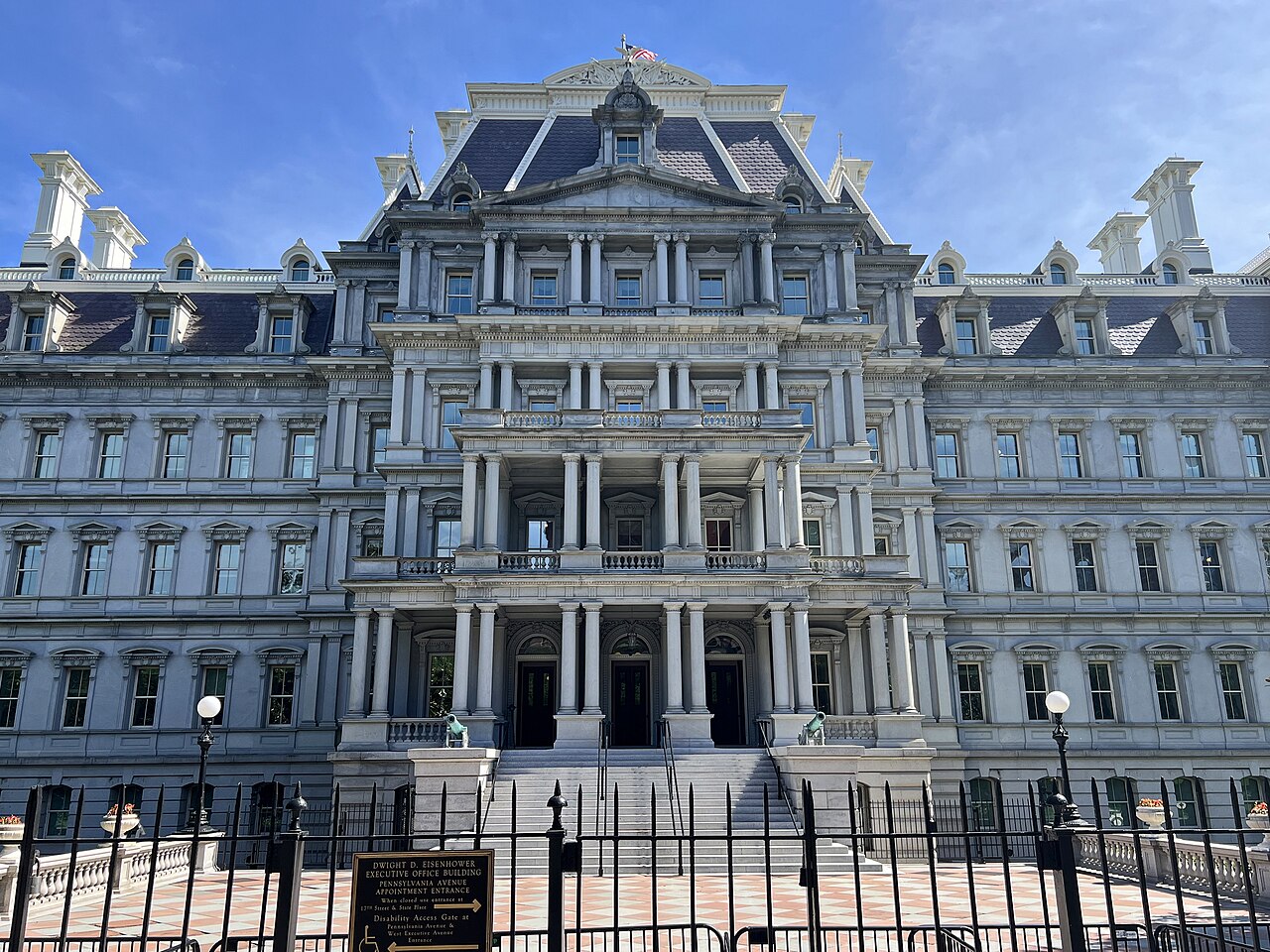
Header image: the Dwight D. Eisenhower Executive Office Building in Washington DC, which houses the Office of Science and Technology Policy, by Wikimedia Commons user 颐园居, CC BY 4.0, via Wikimedia Commons. In-body image: the NIST North Building at the National Institute of Standards and Technology headquarters campus in Gaithersburg, Maryland, by dokaspar, CC BY-SA 3.0, via Wikimedia Commons.