Tesla is now building several hundred Optimus V3 humanoid robots a week at its Fremont factory, roughly ten times its second-quarter pace, according to reporting from Electrek and others on September 25, 2026. That is a real ramp. It is also, on the company's own account, running into two walls that no production line can paper over: the robots' hands are still hard to build, and the robots themselves cannot yet generalize. This piece looks at the numbers, the two bottlenecks, and why they sit at the center of the humanoid question rather than at its edges.
 Tesla
TeslaThe ramp is real, and the gap to the vision is large
The trajectory Tesla describes is steep. Optimus V3 output climbed from a few dozen units a week in the second quarter of 2026 to several hundred a week by August. The near-term goal is an automated line capable of more than 1,000 robots a week by the end of the year. The long-term ambition, stated repeatedly by the company, is on the order of 20,000 a week.
Put those figures on one axis and the story reads clearly: the recent progress is genuine, and the distance still to travel is enormous.
A real 10x ramp, and a much larger distance still to cover
Reported and targeted Optimus V3 weekly output, on a logarithmic scale so each order of magnitude is one step. The two darker bars are reported; the lighter bars are a stated target and a long-term aim.
Heights are orders of magnitude, not exact counts; "dozens" and "hundreds" were reported as ranges, and the last two bars are goals, not output.
The jump from dozens to hundreds is the kind of order-of-magnitude gain that early manufacturing ramps can produce. The jump from hundreds to 20,000 is a different kind of problem, because it requires solving the things that are currently done by hand and the things that are currently done in a cage. Those are the two walls.
Wall one: the hands
Dexterity is the oldest unsolved problem in robotics, and Optimus runs straight into it. The robot's hands and forearms contain more than 100 small components that still require manual assembly, and the touch sensors have shown reliability problems, per the reporting. A part that must be assembled by a human is, by definition, a part that caps how fast the line can run and how cheap each unit can get.
A part that must be assembled by a human is, by definition, a part that caps how fast the line can run.
On the Optimus hand-assembly bottleneck
This is not a detail. The hand is what makes a humanoid worth building. A machine that cannot manipulate the objects a human workplace is full of, tools, boxes, cables, latches, is a very expensive way to do what a fixed arm already does. Elon Musk has called the supply chain for these components extremely challenging, and the difficulty is intrinsic: packing human-like degrees of freedom, force sensing, and durability into a hand-sized envelope is one of the hardest mechanical problems in the field. Building hundreds is possible with people in the loop. Building thousands cheaply is not, until the hand itself becomes manufacturable.
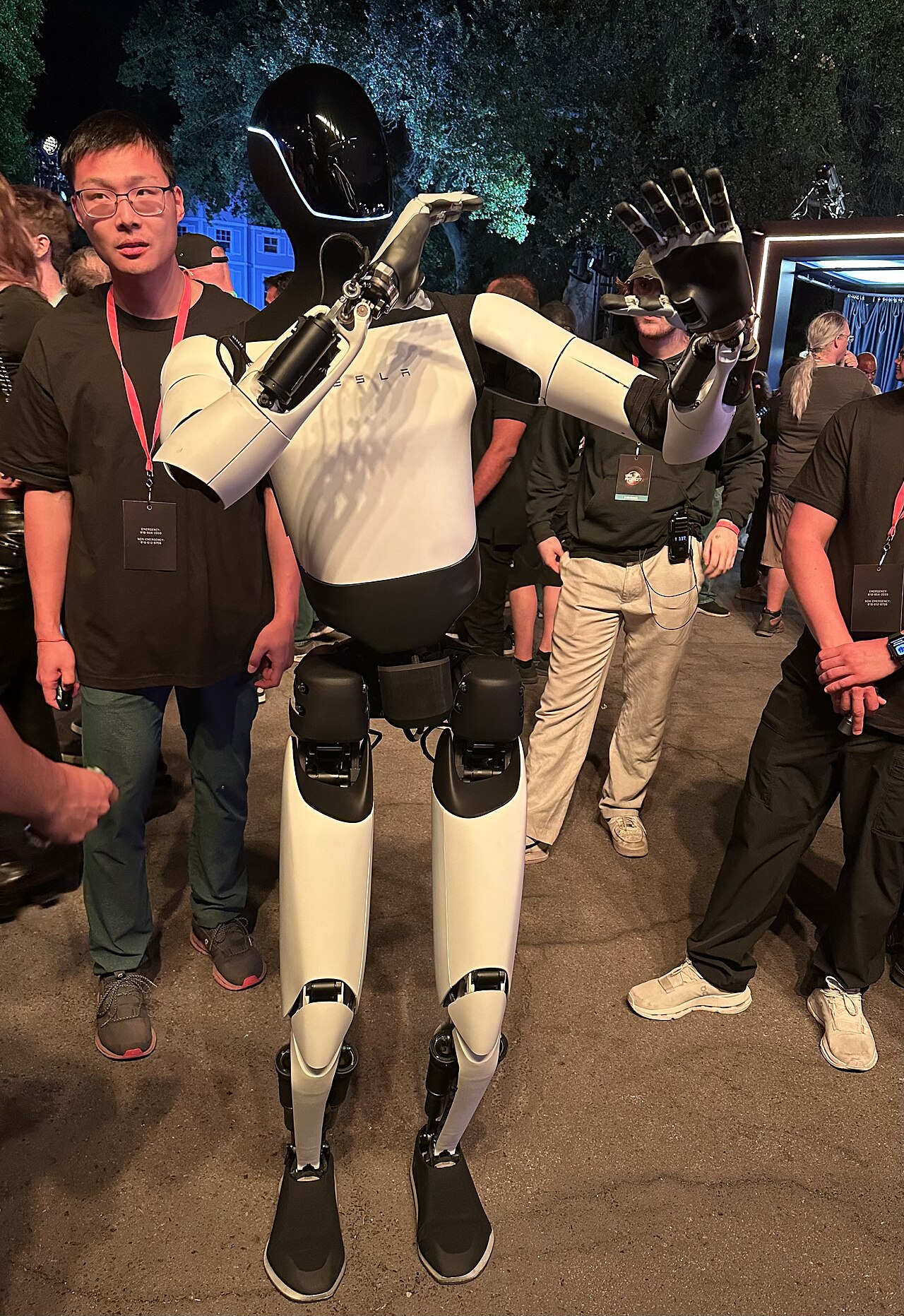
Wall two: the robots cannot yet generalize
The second wall is the AI one, and it is the more important of the two. According to the reporting, most Optimus units are used internally for testing, training, and data collection. The ones working inside Tesla's factories operate in tightly controlled, supervised areas and are programmed for specific tasks rather than running as general-purpose machines.
That is the crux. The entire economic case for a humanoid, as opposed to a purpose-built machine, is generality: one robot form that can be pointed at many jobs the way a human can. A humanoid that must be programmed for each task, confined to a controlled zone, and supervised, is doing what industrial automation has done for decades, in a more expensive and more complicated body. The value unlocks only when the robot can handle novel situations it was not explicitly trained for, and that capability is not there yet.
This is the same jagged-frontier pattern visible across AI: systems that are impressive in a demonstration and brittle the moment conditions drift from what they were trained on. In a chatbot, a brittle edge case is an annoyance. In a two-meter machine sharing a floor with people, it is a safety constraint, which is exactly why the working units stay in supervised cages.
Two walls, and the value is on the far side of both
Scaling a humanoid needs both a body that can be built cheaply at volume and a mind that generalizes. Solving one without the other does not unlock the economics.
The two problems compound: 20,000 single-task robots is a deployment problem, and a general robot whose hand takes an hour to build is too expensive to matter.
Why both walls have to fall together
The two problems compound rather than add. Suppose Tesla solves the hand tomorrow and can stamp out 20,000 robots a week. Without generalization, it has 20,000 single-task automatons that each need programming and supervision, a deployment problem as large as the manufacturing one it just solved. Now suppose the opposite: the AI becomes genuinely general, but the hands still take a human an hour each to assemble. Then the capable robot is too expensive and too slow to build to matter. Scale requires both a manufacturable body and a general mind, and progress on one does not buy progress on the other.
That is why a production number, on its own, is an incomplete way to track humanoids. Several hundred a week is a meaningful engineering result and a weak proxy for the thing that actually matters, which is whether a robot can be pointed at an unfamiliar task and simply do it.
The honest read
The neutral position is that Tesla has demonstrated it can build humanoids at a small but rapidly growing rate, and has not yet demonstrated that those humanoids can do general work or be built cheaply at volume. Both of those remain open. The ramp is evidence of manufacturing seriousness, not of the problem being solved. For anyone tracking physical AI, the metrics worth watching are not weekly unit counts but two harder ones: the share of the hand that comes off an automated line, and the share of tasks a robot can do without task-specific programming. Those are the numbers that will say whether the vision is arriving or receding, and neither is where the headline production figure sits.
For teams building with AI more broadly, the transferable lesson is the demo-to-deployment gap itself. A capability that shines in a controlled demonstration and degrades in the open is the rule, not the exception, and the discipline that pays off is designing for the messy real case rather than the clean one. It is the same reason a model-agnostic approach, the kind Metir AI takes by routing across providers, treats any single impressive result as one input rather than a finished answer: the frontier is uneven, and betting everything on one demonstration is how the gap catches you.
Sources:
- Tesla ramps Optimus to hundreds a week, but the robots can't generalize | Electrek
- Tesla Wants to Build 20,000 Optimus Robots a Week. First It Has to Figure Out Hands | Gizmodo
- Tesla Optimus Production Hits Hundreds Weekly, Hands Remain Challenge | Analytics Insight
- Tesla ramps up Optimus humanoid robot production tenfold, faces 'extremely challenging' supply chain hurdles | Crypto Briefing
Image credits
Header and in-body image: a Tesla Optimus humanoid robot, by Steve Jurvetson, via Wikimedia Commons, CC BY 2.0.