On September 14, 2026, Temporal, an infrastructure company based in Bellevue, Washington, said it had raised $550 million in a Series E at a $12.55 billion valuation. That is more than double the $5 billion mark it set in February on a $300 million Series D led by Andreessen Horowitz. The new round was led by Lightspeed with co-leads Wellington Management, Growth Equity at Goldman Sachs Alternatives and Tiger Global, and it brings Temporal's total capital raised to about $1.2 billion. The reason a company most end users have never heard of is worth this much is the least glamorous requirement in software: reliability.
What durable execution actually means
Temporal's core technology is called durable execution. The idea is simple to state and hard to build. Ordinary programs lose their place when something fails. If a server restarts, a network call times out, or a process crashes halfway through a multi-step job, the work is gone and the whole thing has to start over. Durable execution preserves the state of a running workflow so that when a failure happens, the work resumes from exactly where it stopped rather than from the beginning.
That guarantee has always been useful for things like payments and order processing, where restarting from zero can double-charge a customer or drop an order. What changed in 2026 is that a new and demanding workload arrived that needs the same property even more: AI agents.
Why long-running agents break without it
Consider what an agentic workflow looks like in production. A single task might call several models, hit a dozen external APIs, wait on a tool to return, pause for a human approval, and run for minutes or hours rather than milliseconds. Every one of those steps is a chance to fail. The model endpoint rate-limits. An API times out. The process gets rescheduled onto a different machine. In a naive setup, any of those events throws away the entire run, and with it whatever money and time the agent already spent.
That fragility is the quiet reason many agent demos never make it to production. A workflow that works nine times out of ten in a controlled test is a liability when it is spending real money on real infrastructure and touching real systems. The failure is not the model being wrong. It is the plumbing losing its place. Durable execution attacks exactly that problem, which is why an infrastructure layer built years before the agent wave suddenly found itself in the center of it.
Temporal's reported year-over-year growth
Four usage and revenue measures the company disclosed alongside its Series E.
Source: Temporal Series E disclosures, September 2026. Bar lengths scale to the growth rate, not the absolute value.
The growth Temporal disclosed tracks that shift. Its annualized revenue run rate passed $250 million, up more than 200 percent year over year. In August alone the platform processed 1.9 trillion billable actions, up more than 350 percent, while open-source installs passed 43 million and paying customers passed 4,300, up 139 percent. The named customers include OpenAI, Snap and NVIDIA, which points at adoption inside exactly the companies running agents at the largest scale.
 OpenAI
 NVIDIA
The pattern: value moving from the model to the orchestration
The Temporal round is a data point in a larger repricing. For two years the money and the attention went to the models. In 2026 a growing share is going to the layer that makes models usable in production: the orchestration, the reliability, the state management, the retries, the human-in-the-loop checkpoints. That is not because models stopped mattering. It is because a capable model is necessary but not sufficient. Turning it into something a business can depend on requires a great deal of unglamorous engineering that sits below the model and around it.
The failure that kills an agent in production is usually not the model being wrong. It is the plumbing losing its place.
This is the same insight arriving from several directions at once. An agent that runs across many models and many tools needs a layer that survives failure, retries safely, and never repeats an action that already spent money. Whether that reliability is provided by a dedicated durable-execution engine like Temporal or built into a model-agnostic orchestration platform such as Metir, the requirement is identical: the value increasingly lives in the system that coordinates the work, not only in the model that does a single step of it. As agents move from demo to deployment, the coordination layer is where the hard problems, and a growing share of the economics, are settling.
Reading the valuation
A jump from $5 billion to $12.55 billion in about seven months is a rich re-mark, and it should be read the way the rest of the 2026 private market should be read: priced on a trajectory, not a trailing profit. The bull case is that agentic AI is moving into production across thousands of companies and that every serious deployment needs exactly the reliability Temporal sells, which makes it a pick-and-shovel supplier to the whole category rather than a bet on any one application.
The honest counterweight is that durable execution is a known engineering problem with open-source options, including Temporal's own widely installed core, and large cloud providers have every incentive to offer competing managed services. A premium multiple assumes Temporal stays the default even as the category it serves matures and attracts more suppliers. The usage growth is real and unusually steep, which is the strongest argument for the number. Whether the position holds as agents become ordinary infrastructure, rather than a frontier, is the question the next few quarters will answer.
Sources:
- Temporal raises $550M at a $12.55B valuation as demand grows for reliable AI infrastructure (Temporal)
- Temporal raises $550M, hits $12.55B valuation as agentic AI wave fuels massive growth (GeekWire)
- Temporal Closes $550M Funding Round at a $12.55B Valuation (The AI Insider)
- Temporal Raises $550M Series E At $12.55 Billion Valuation (Pulse 2.0)
Image credits
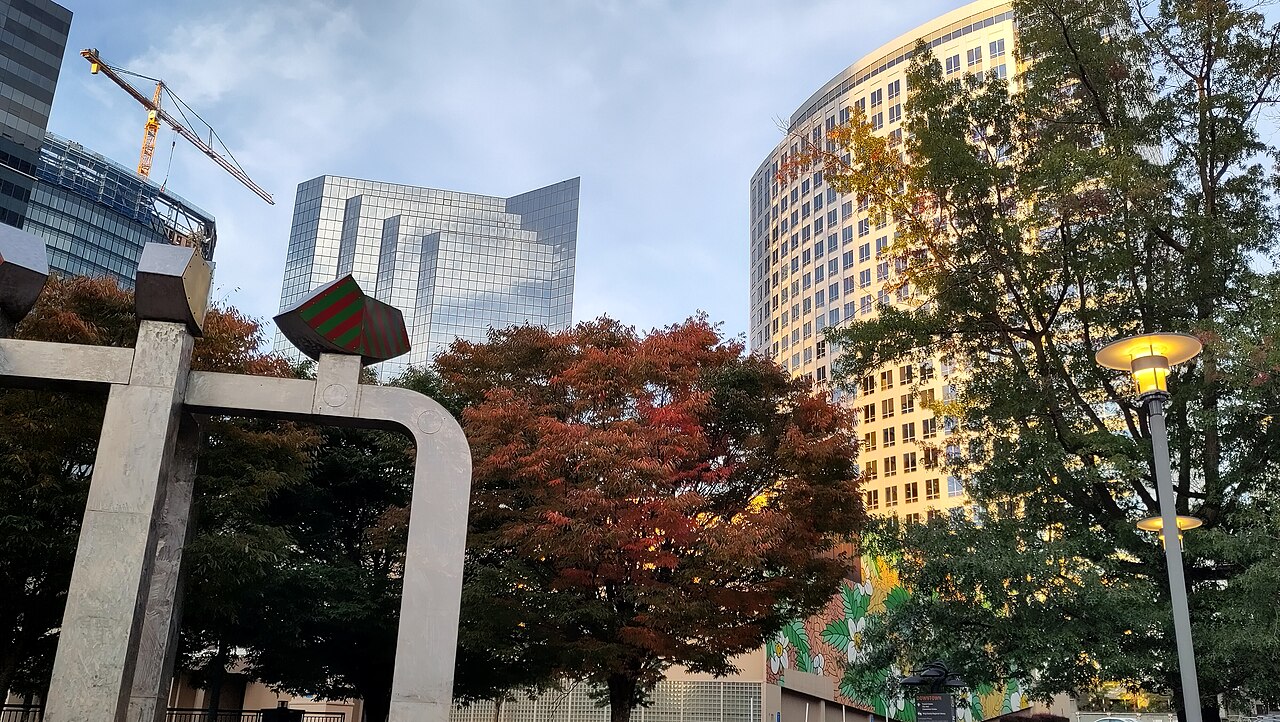
- Hero: "Downtown Bellevue" by Exilexi, via Wikimedia Commons, licensed CC BY 4.0. Retrieved September 18, 2026. The photograph depicts the city where Temporal is headquartered.