On November 3, 2026, Super Micro Computer (Supermicro) reported results for the first quarter of its fiscal year 2027, the three months ended September 30, 2026. Net sales were about $19.9 billion ($19.946 billion in the company's slide deck), up roughly 79% from the prior quarter and 298% from the $5.0 billion reported a year earlier. Management also raised its fiscal 2027 revenue outlook to $72 billion to $82 billion, from $65 billion to $72 billion.
The headline is large, but the more useful reading is in the details: how profitable that revenue is, how much of it came from a single buyer, and how much of the quarter was a one-off catch-up. This post works through those three questions using the company's own figures and the earnings call.
The quarter in numbers
According to Supermicro's results release, GAAP gross margin was 12.7% (12.8% non-GAAP), operating income was $2.06 billion, net income was $1.59 billion and diluted GAAP EPS was $1.75 (non-GAAP $1.81). A year earlier, in Q1 FY2026, the company reported $5.0 billion of net sales, a 9.3% GAAP gross margin, $168 million of net income and $0.26 of diluted EPS.
Supermicro had already told investors where the quarter was heading. On October 20, 2026 it issued a preliminary update estimating revenue of $18.5 billion to $19.5 billion and gross margin of 12.0% to 12.5%, against its original August guidance of $14.5 billion to $15.5 billion and 10.4% to 10.8%. The final figures landed above the top of both preliminary ranges. By our own arithmetic, reported revenue was about $4.4 billion above the top of the original guidance range, which makes this less a forecasting miss than a demand and delivery-timing surprise that the company chose to flag early.
Supermicro net sales by quarter
Net sales in billions of dollars. The path from $5.0B to $19.9B was not a straight line: two quarters in the middle fell or stalled.
Q1 FY27 includes about $2.3B of catch-up revenue from deployments originally scheduled for earlier periods, per the earnings call.
Where the quarterly path actually went
Fiscal 2026, which ended June 30, 2026, produced $39.1 billion of net sales against $22.0 billion in fiscal 2025. The quarterly shape was uneven: roughly $5.0 billion, $12.7 billion, $10.2 billion and $11.1 billion across the four quarters. Q3 FY2026 net sales fell about 19% sequentially. The company's Q4 report showed GAAP gross margin recovering to 17.5% from 9.9% in Q3.
That history matters for how to read the new number. Server revenue tied to very large AI deployments is lumpy, because it depends on when customer data halls, power and GPUs are ready to receive racks. A single strong quarter does not by itself establish a run rate, and Supermicro's own recent record shows quarters going both directions.
Margins: the part the headline does not show
Gross margin fell 480 basis points from Q4's 17.5% to 12.7%, even as revenue rose 79%. Management attributed the decline mainly to mix: AI platforms rose to 71% of revenue from 59% in the previous quarter, and large AI deployments carry lower margins than enterprise or general-purpose systems, per the call. Tariff relief and lower inventory reserves were described as largely offset by lower-margin deferred revenue recognized in the quarter. As Chief Financial Officer Mark Long put it, "The sequential decline is not evidence that AI platform revenue lacks margin," a framing that argues the Q4 level was the unusual quarter rather than the Q1 level.
Using the reported figures, here is our own calculation of the profitability stack. These ratios are derived, not company-reported:
- Net margin: $1.59 billion divided by $19.95 billion is about 8.0%.
- Operating margin: $2.06 billion divided by $19.95 billion is about 10.3%.
- Q4 FY2026 net margin: $1.18 billion divided by $11.1 billion is about 10.6%.
- Q1 FY2026 net margin: $168 million divided by $5.0 billion is about 3.4%.
So net margin is lower than in the prior quarter but well above where it was a year ago. Gross profit at a 12.7% margin is roughly $2.5 billion on our math, which means operating expenses were only around $0.5 billion, or about 2.4% of revenue. That is a very thin overhead layer, and it explains why a modest gross margin still converts to a high-single-digit net margin: the model is high volume, low overhead, and sensitive to gross margin in both directions. Management guided Q2 gross margin to 12% to 12.5% and full-year FY2027 to 11.8% to 12.2%, so the base case is margins settling around 12%, not returning to Q4's level.
A single deployment today can exceed our total quarterly revenue from just one year ago.
Mark Long, Supermicro CFO, Q1 FY2027 earnings call (via third-party transcript summary)
Customer concentration: one buyer at 44%
The most consequential disclosure may be concentration. On the call, management said one large data-center customer represented 44% of Q1 revenue, up from 28% for fiscal 2026. Two customers accounted for 49% and 17% of receivables at quarter end. Applying 44% to $19.95 billion implies roughly $8.8 billion of revenue from that single customer (our calculation). Management said it expects concentration to "stay elevated" while large build-outs continue, and the company's forward-looking statements note that its customer base may become more concentrated as it targets larger customers, with potentially lower margins and less predictable sales.
Concentration cuts two ways. A buyer taking this much capacity signals that Supermicro is winning very large builds. It also means quarterly results hinge on that buyer's own schedule, financing and vendor mix. The company said it added several hundred enterprise and other customers over the past year, which is the diversification story, but at 44% for one account the near-term numbers are dominated by the largest relationship.
How much was catch-up?
About $2.3 billion of Q1 revenue came from deployments that were originally scheduled for earlier periods, according to the call. Excluding that, underlying revenue would be about $17.6 billion (our subtraction). Management said the full-year outlook does not assume the catch-up repeats. That is a useful anchor for the guidance: the $19.5 billion to $21.5 billion Q2 range sits above the underlying Q1 figure, which implies sequential growth in the underlying business rather than a simple repeat.
What the guidance implies
The Q2 FY2027 guide of $19.5 billion to $21.5 billion has a midpoint of $20.5 billion, with GAAP diluted EPS of $1.59 to $1.83. Pairing Q1 actual with the Q2 midpoint gives about $40.4 billion for the first half. Against the new full-year range, our arithmetic shows the following for the second half:
- At the low end ($72 billion), the second half would total about $31.6 billion, or roughly $15.8 billion per quarter.
- At the midpoint ($77 billion), about $36.6 billion, or roughly $18.3 billion per quarter.
- At the high end ($82 billion), about $41.6 billion, or roughly $20.8 billion per quarter.
Only the top of the range requires the second half to run at or above the first-half pace. The lower half of the range allows for a sequential decline, which is consistent with management's remark that the range is governed by supply rather than demand: "What governs the range is not demand and it is not our ability to build." Management named key-component shortages, including GPUs, as the main constraint.
Cash, inventory and the balance sheet
Profit and cash moved in opposite directions this quarter. Operating cash flow was negative $434 million despite $1.59 billion of net income, the pattern typical of a company financing rapid growth with working capital. Cash and equivalents were $6.9 billion (down from $7.5 billion at June 30), against $8.6 billion of bank debt and convertible notes, which is about $1.7 billion of net debt on our math. Deferred revenue rose about $3.1 billion, mostly from customer prepayments, which is one source of cash that partly cushions the build. Coverage of the company's slides also cites inventory of $15.1 billion and a shorter cash conversion cycle, though readers should check those secondary figures against the 10-Q when filed.
Liquid cooling, DCBBS and the Blackwell to Vera Rubin transition
Supermicro's strategic pitch is Data Center Building Block Solutions (DCBBS), a portfolio that spans rack-scale systems, liquid cooling, networking, software and services, sold to customers ranging from gigawatt-scale data centers to single-container deployments. In the release CEO Charles Liang said, "DCBBS is driving significant value for our customers." The company did not break out DCBBS or liquid-cooling revenue, so there is no way to size those contributions from the disclosures reviewed here.
On capacity, the call and slides pointed to a target of more than 8,000 racks per month by December, including about 4,000 direct liquid cooled (DLC) racks, with rack power density rising. Liquid cooling matters because denser NVIDIA rack-scale systems are hard to air cool, so cooling is increasingly part of the system sale rather than a facilities afterthought. Slide coverage names GB300 NVL72 and HGX B300 (Blackwell generation) alongside Vera Rubin products, and a third-party call transcript summary quotes Liang saying Vera Rubin racks are ready to ship, though that summary notes garbled product names and the detail should be checked against the replay. The company has not published Blackwell versus Vera Rubin revenue splits, so how quickly the mix shifts is a key item to watch. A product transition is a classic source of both opportunity and lumpiness: customers may delay orders for the next platform, and early-ramp yields can pressure margins.
 NVIDIA
An open item: the export-control review
Earlier releases from August and October stated that the company's board was conducting an independent review of certain transactions related to export-control issues, and that the outcome could affect forecasts, preliminary results and prior-period results. The Q1 results release and the call summaries reviewed for this post did not discuss the review, so its current status is not something we could confirm. It remains an unquantified risk factor in the company's own disclosures.
What to watch next
- Concentration: whether the 44% customer stays above 40% in Q2 or whether the several hundred newer customers begin to dilute it.
- Gross margin versus the 12% to 12.5% Q2 guide, and whether the mix between AI and enterprise keeps moving.
- Cash conversion: whether operating cash flow turns positive as deferred revenue and inventory normalize.
- The Vera Rubin ramp: timing of volume shipments versus Blackwell-generation systems.
- Component supply, since management says GPUs and other parts, not demand, set the ceiling.
- Resolution of the export-control review.
Teams building on AI infrastructure face a similar portability question at the software layer: hardware supply is volatile and concentrated, which is one reason model-agnostic tools such as Metir let workloads move across providers instead of tying them to one vendor's capacity.
Sources:
- Supermicro Announces First Quarter of Fiscal Year 2027 Financial Results, Supermicro Investor Relations
- Supermicro Provides First Quarter of Fiscal Year 2027 Preliminary Business Update, Supermicro Investor Relations
- Supermicro Announces Fourth Quarter and Full Fiscal Year 2026 Financial Results, Supermicro Investor Relations
- Super Micro Computer Q1 2027 earnings call transcript, Benzinga
- Supermicro (SMCI) Q1 2027 earnings call transcript and summary, Gloom
- Supermicro Q1 FY2027 slides: $20B revenue milestone, Investing.com
- Supermicro: New orders top $60 billion as fiscal 2027 revenue targets up to $72 billion, Pulse 2.0
- Super Micro beats Q1 expectations and lifts full-year revenue guidance to $72 billion to $82 billion, Crypto Briefing
Image credits
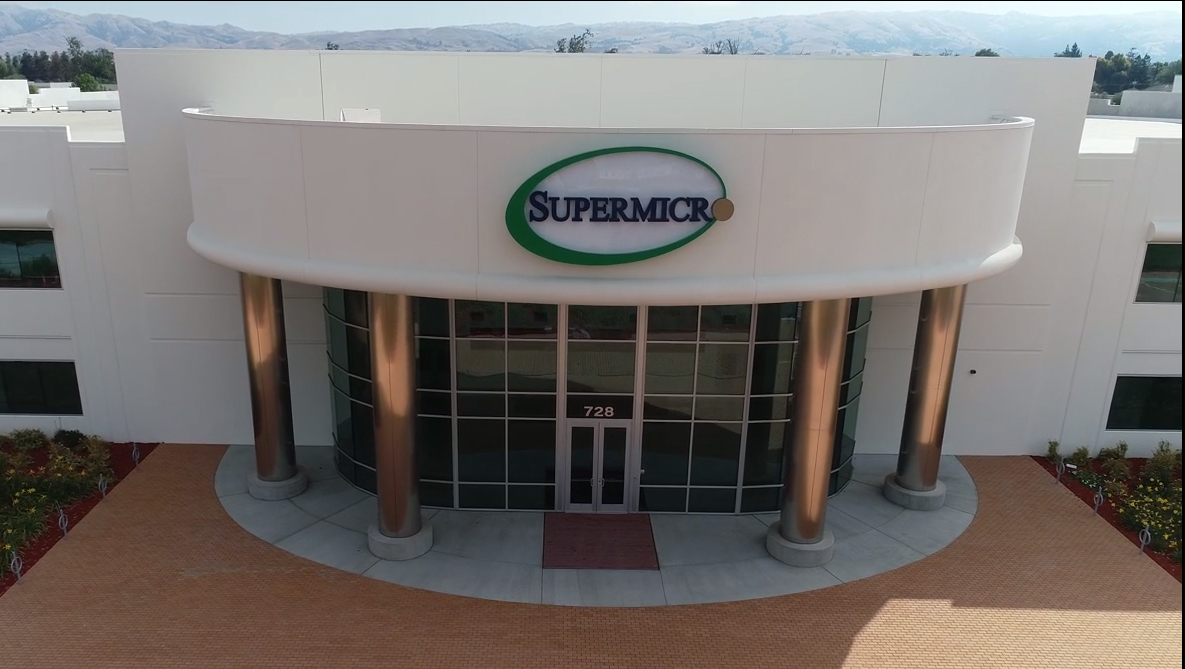
- Hero: "Supermicro Green Computing Park" by SMCI, licensed CC BY-SA 4.0, via Wikimedia Commons (https://commons.wikimedia.org/wiki/File:Supermicro_Green_Computing_Park.jpg). Shows the Supermicro Green Computing Park in San Jose, California; the file is dated 2022 and was retrieved November 4, 2026 and visually reviewed before use.
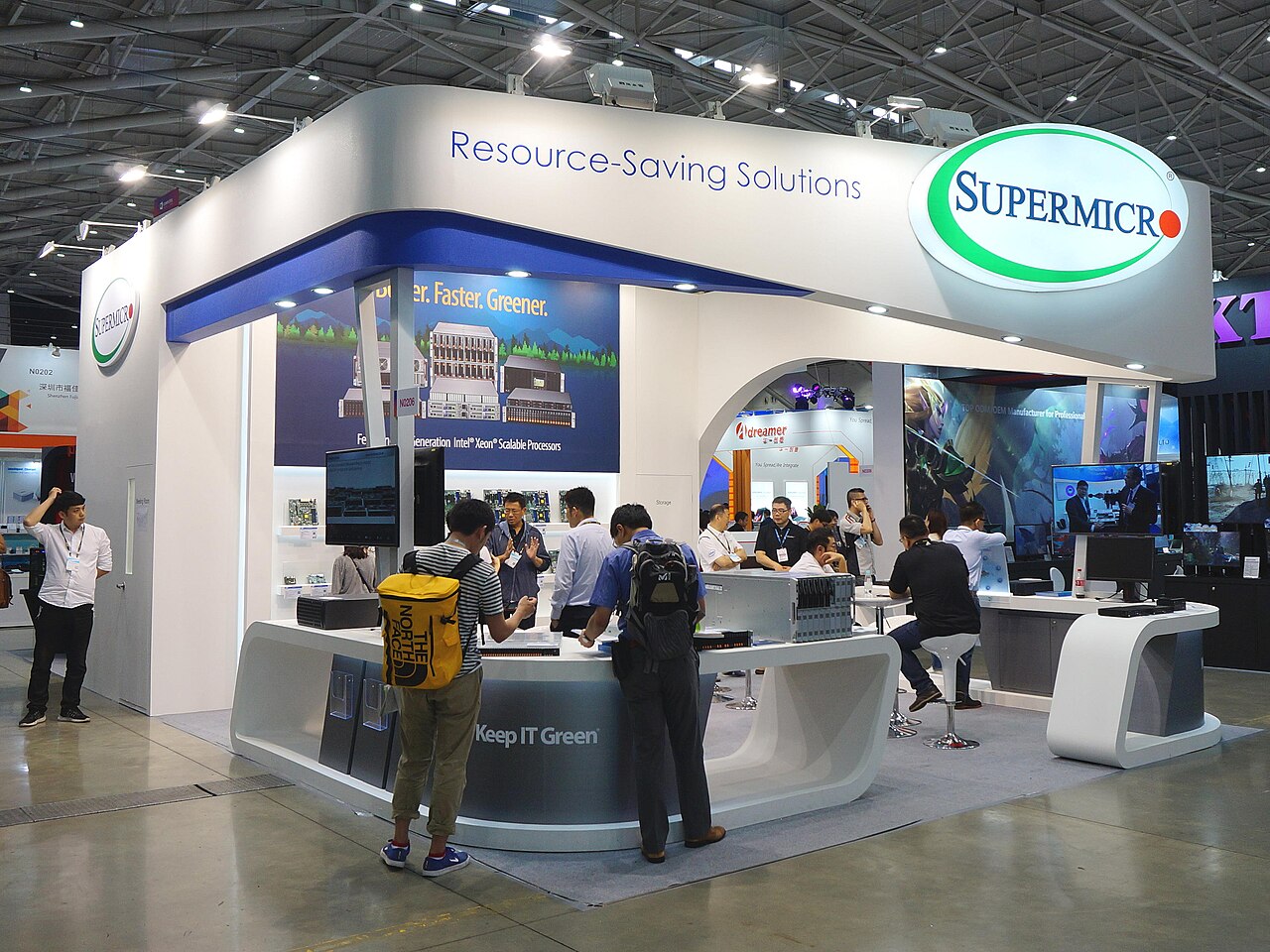
- In-body: "Super Micro Computer booth" by Solomon203, licensed CC BY-SA 4.0, via Wikimedia Commons (https://commons.wikimedia.org/wiki/File:Super_Micro_Computer_booth_20190601.jpg). Shows the company's booth at Computex Taipei 2019; retrieved November 4, 2026 and visually reviewed before use.