Starcloud, a startup building data centers designed to run in orbit rather than on the ground, said on August 21, 2026 that it had added $250 million to its Series A round at a $2.3 billion valuation. Nvidia joined the round alongside Cisco Investments and a group of new and existing backers, and the raise brings Starcloud's total funding to roughly $450 million. The valuation has more than doubled since late March, when the company raised $170 million at a $1.1 billion mark. The pitch behind those numbers is unusual enough to be worth taking seriously and skeptically at the same time: put the compute in space, where sunlight is constant and cooling is free.
 NVIDIA
Orbital data centers sound like science fiction, and the engineering challenges are real. But the reasons investors are funding the idea trace back to two constraints that are very much of the moment: power and heat.
Why Anyone Would Put a Data Center in Space
The case for orbital compute starts with the two things that increasingly bottleneck data centers on Earth: getting enough electricity, and getting rid of the heat that electricity turns into. AI data centers are colliding with both. Reporting through 2026 has repeatedly described power as the binding constraint on new AI buildouts, with grid interconnection queues stretching years and some requested capacity unlikely ever to be delivered. Cooling adds another large slice of a data center's energy budget and water footprint.
From one GPU in orbit to 20 gigawatts
Starcloud's stated roadmap, from its first satellite to a full orbital-compute constellation.
Carried what the company called the first Nvidia H100 GPU in orbit.
Nvidia states ~25x the in-space compute capability of the H100.
Targeting roughly 20 gigawatts of orbital compute at full scale.
In orbit, the argument goes, both problems change shape. A satellite in the right orbit can sit in near-continuous sunlight, giving solar panels a far higher duty cycle than anything on the ground, with no night and no weather. And the heat problem inverts: space is a vacuum, so there is no air to cool with, but there is also nothing to trap heat, and a radiator facing deep space can shed thermal energy by radiation continuously. Starcloud's long-term vision, a constellation it describes as reaching roughly 88,000 satellites and around 20 gigawatts of compute, is essentially a bet that abundant solar power and radiative cooling in orbit can eventually beat the cost of fighting for grid power and water on Earth.
The Hardware, and Nvidia's Role
The physical roadmap is concrete enough to evaluate. Starcloud launched its first satellite, Starcloud-1, in November 2025, carrying what the company said was the first Nvidia H100 GPU to operate in orbit. Future satellites are slated to carry Nvidia's Space-1 Vera Rubin module, which Nvidia says will deliver about 25 times the in-space compute capability of that first H100. Nvidia's decision to both supply the silicon and invest in the round is the clearest signal of how seriously at least one major player is taking the concept, even if the investment is modest relative to Nvidia's scale.

Nvidia's involvement also fits a pattern visible across the AI infrastructure landscape this year, in which the dominant chip supplier takes equity stakes in the companies that will deploy its hardware. Whether that is a vote of confidence in orbital compute specifically or a low-cost option on an emerging market is impossible to know from the outside, and both can be true at once. The useful read is narrower: the company whose chips would fly is willing to put money behind the idea, not just sell into it.
The bet is not that space is a nicer place to run a server. It is that power and cooling on Earth are getting expensive enough to make orbit worth the trouble.
On the economics of orbital compute
The Physics That Cuts the Other Way
A neutral assessment has to give equal weight to why this is extraordinarily hard, because the same environment that offers free cooling and constant sun imposes brutal constraints. Launch is the first: putting mass into orbit still costs a great deal per kilogram, and a data center is heavy, so the economics depend on launch costs continuing to fall and on GPUs dense enough to justify the ride. One of the August news reports framed the raise partly around launch capacity being tight, which is a reminder that access to space is itself a scarce input.
Then there is the environment. Radiation in orbit degrades electronics that were designed for climate-controlled rooms, requiring either radiation-hardened parts or clever shielding and redundancy, both of which add cost and weight. Radiative cooling, while continuous, is also slow compared with pumping cold air or water, which limits how much heat a given radiator area can shed and therefore how densely compute can be packed. Maintenance is effectively impossible: a failed component on the ground is swapped in minutes, while a failed component in orbit is usually gone for good. And connectivity matters, since moving large volumes of data to and from orbit requires ground-station capacity and introduces latency that makes some workloads unsuitable.
What Orbital Compute Is Actually For
Those constraints shape what the technology could plausibly be good for, and it is not everything. Latency-sensitive, interactive workloads, the kind that serve a chat response in real time, are a poor fit for a data center that is hundreds or thousands of kilometers away with intermittent ground links. The better fit is large batch computation that is not time-critical: training runs, bulk inference over data already in orbit such as satellite imagery, and scientific processing where the data originates in space in the first place. Framed that way, orbital compute is less a replacement for terrestrial data centers than a specialized tier for particular jobs, at least for the foreseeable future.
That framing also sets a realistic bar for the valuation. A $2.3 billion valuation on a company at this stage prices in a large, distant market and meaningful execution risk. Whether it proves reasonable depends on launch costs, on how much of the AI workload turns out to tolerate orbital latency, and on whether radiative cooling and radiation-hardening can be solved at a cost that beats simply building more terrestrial capacity as grids expand. None of that is settled, which is exactly what an early-stage bet on a hard problem looks like.
The Broader Signal
Set aside whether Starcloud specifically succeeds, and the raise still says something about the industry. Investors are now willing to fund genuinely exotic answers to the AI power problem, because the conventional answer, building more data centers on the existing grid, is running into physical and permitting limits fast enough to make alternatives worth exploring. Orbital compute sits alongside nuclear power purchase agreements, off-grid gas plants and other unconventional energy moves as evidence that the constraint on AI has shifted from chips to the electricity and cooling to run them. That shift is the real story, and it is visible whether or not any single orbital satellite ever turns a profit.
For teams building AI products, none of this changes the day-to-day, but it underscores a durable point: the infrastructure beneath AI is being rethought from the ground up, or in this case from the ground off, and the cost and availability of compute will keep moving as a result. Staying flexible about where and how models run, rather than hard-wiring a product to one provider or one assumption about compute economics, is the sensible posture. That is the same reasoning behind a model-agnostic platform like Metir AI, which routes across providers so the underlying compute can shift without the product having to.
Sources:
- Starcloud Adds $250M to Series A at a $2.3B Valuation | Via Satellite
- Starcloud raises $250M to support the creation of data center satellite network in league with Nvidia | GeekWire
- Starcloud raises $250 million for orbital data centers as launch options dry up | TechCrunch
- Nvidia joins Starcloud's $250 million orbital data center funding round | SpaceNews
- Starcloud Raises $250 Million at $2.3 Billion Valuation to Scale AI with Orbital Data Centers | Business Wire
Image credits
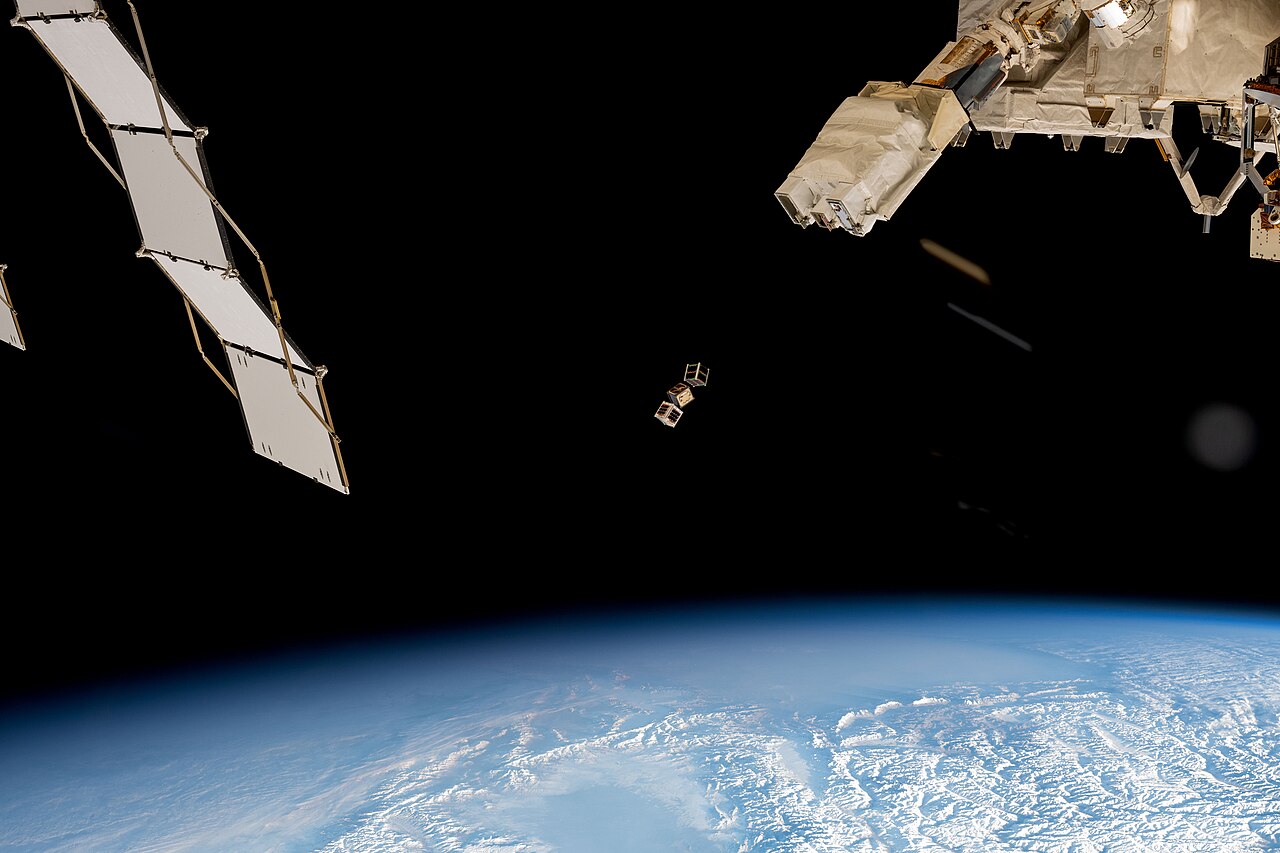
Header image: A trio of CubeSats deployed into Earth orbit from the International Space Station, by NASA Johnson Space Center via Wikimedia Commons, public domain. This illustrates small-satellite deployment in general and is not a Starcloud craft. In-body image of Earth from orbit by NASA/NOAA (Suomi NPP/VIIRS, Norman Kuring) via Wikimedia Commons, public domain.