On August 4, 2026, SpaceX filed its first quarterly earnings as a public company, roughly seven weeks after its June 12 debut on the Nasdaq under the ticker SPCX. The report is notable less for what it says about rockets than for what it says about artificial intelligence. After absorbing Elon Musk's xAI in a February 2026 merger, SpaceX now runs one of the largest AI-compute build-outs in the industry, and the quarter's numbers make that unmistakable: the company spent more than twice its total revenue on capital projects, with the overwhelming majority going to AI infrastructure. This piece walks through the reported figures, separates the growth story from the cash-burn story, and explains why the same report sent the stock lower.
 xAI
xAI Anthropic
 Google
 NVIDIA
What the top line actually shows
Total revenue of $7.8 billion for the quarter, up 92% year over year, is a large number, and the growth rate is genuinely fast for a company of this size. The more striking figure sits one level down. The AI division, the former xAI, reported $2.56 billion in revenue, up 247% from $737 million in the same quarter a year earlier. That means roughly a third of SpaceX's revenue now comes from an AI business that barely existed at this scale twelve months ago, and it is the fastest-growing part of the company by a wide margin.
The AI division still loses money at the operating line, $1.25 billion for the quarter, though that loss narrowed from $1.54 billion a year earlier. At the company level, SpaceX reported a net loss of $541 million, an improvement from roughly $1 billion in the year-ago period. So the direction of travel on profitability is positive even as the absolute numbers stay negative. A reader looking only at growth and narrowing losses would come away encouraged.
Roughly a third of SpaceX's revenue now comes from an AI business that barely existed at this scale a year ago.
On the xAI merger's contribution
The number that moved the stock
The market's attention went somewhere else: capital expenditure. Total capex jumped more than sixfold year over year to about $18.4 billion for the quarter, and $15.8 billion of that went into AI infrastructure. For context, SpaceX spent more than twice its entire quarterly revenue on capital projects, and the AI capex alone was roughly six times the AI division's revenue. The launch business, by comparison, spent about $1.17 billion.
Spending ran well ahead of revenue in Q2 2026
SpaceX reported $7.8 billion of total revenue for the quarter and spent $18.4 billion on capital projects, most of it, $15.8 billion, on AI infrastructure. The AI division alone brought in $2.56 billion.
Reported figures for the quarter ended June 2026, not a forecast. Total capex includes both the AI and launch divisions.
That gap is the crux of the report. Spending far ahead of revenue is the defining shape of an infrastructure build-out, and it is not, by itself, a sign of trouble; it is what building large-scale compute capacity ahead of demand looks like on a cash-flow statement. But the scale here is unusual even by 2026 standards, and it exceeded the roughly $13.2 billion capex figure analysts had modeled, according to FactSet consensus. Markets dislike surprises in the direction of more spending and less near-term cash, and the stock fell more than 8% at one point after the release, with reports that some insiders were preparing to sell shares. The same quarter that showed 247% AI revenue growth also showed why investors are nervous, and both readings come from the same page of the same filing.
Where the money is going, and who is paying it back
Two disclosures explain both the spending and part of the confidence behind it. First, SpaceX is building out Colossus II, the next stage of the AI-compute infrastructure it inherited and expanded through the xAI merger. Second, the revenue is increasingly contracted rather than speculative. SpaceX's cloud-services agreements now include a commitment from Anthropic to pay roughly $1.25 billion per month through May 2029 for access to the earlier Colossus 1 system, alongside a separate arrangement with Google.
A monthly payment of that size, locked in for years, is exactly the kind of anchor tenant that justifies building capacity ahead of demand. It also illustrates how tightly the AI economy is now wired together: one frontier lab's multi-year compute bill becomes another company's contracted revenue, which in turn underwrites the debt and equity funding the next data center. The strength of that structure depends on every link holding, which is why the concentration of revenue in a small number of very large AI customers is worth watching as closely as the growth rate.
The Cursor acquisition sitting on top of all this
The quarter also carried a reminder of SpaceX's pending $60 billion all-stock acquisition of Anysphere, the maker of the AI coding tool Cursor, announced in June and expected to close during the third quarter pending regulatory approval. Cursor reportedly runs at roughly $2.6 billion in annualized revenue, so the price implies a rich multiple, and the deal signals that SpaceX intends to compete directly in the AI application layer, not only sell raw compute. Layering a $60 billion acquisition on top of an $18.4 billion capex quarter is a large simultaneous bet on both the infrastructure and the software ends of the AI stack.
How to read a report that points two ways at once
The disciplined way to hold this quarter is to keep both stories in view rather than collapse them into a verdict.
The constructive reading: this is a hyper-growth AI infrastructure business with real, fast-growing, increasingly contracted revenue, narrowing losses, and an anchor customer paying more than a billion dollars a month. Building compute capacity ahead of demand is the correct strategy if you believe demand keeps climbing, and the multi-year Anthropic commitment is evidence that at least one major buyer does.
The cautious reading: capex running at more than twice revenue, and well above what analysts expected, is a heavy cash burn that depends on continued cheap access to capital and on those contracted customers scaling on schedule. If AI demand growth slows, or if a large customer's own finances wobble, a build-out this aggressive becomes much harder to fund, and the market repriced that risk the moment the capex number landed.
Both readings are supported by the same filing, and the honest position in August 2026 is that the quarter does not settle the question. It sharpens it.
The wider signal
Set against the rest of the sector, SpaceX's report is another data point in the year's central debate over AI capital intensity. Hyperscalers, neoclouds, and now a newly public SpaceX are all spending at a pace that assumes demand will keep compounding, and the market is increasingly asking each of them the same question: when does the spending convert into durable free cash flow. SpaceX's answer, for now, is a monthly check from Anthropic and a bet that Colossus II fills up as fast as Colossus 1 did.
For companies building on top of this infrastructure rather than financing it, the practical takeaway is about exposure. When a handful of compute providers and a handful of frontier labs are this financially entangled, an application-layer business tied tightly to any single provider inherits that provider's balance-sheet risk alongside its technology. Keeping software portable across models and compute vendors, the model-agnostic approach Metir AI takes rather than binding to one stack, is one way to keep a company's own fortunes separate from any single infrastructure bet.
The takeaway
None of this is investment advice, and nothing here forecasts whether SpaceX's AI wager pays off. What is verifiable from the filing is narrower and more useful: in its first public quarter, SpaceX grew AI revenue 247%, narrowed its losses, and spent $15.8 billion on AI infrastructure against $7.8 billion of total revenue, a gap large enough to send the stock down even on a strong growth print. Whether that spending marks disciplined capacity-building ahead of real demand or a burn rate that outruns it is the question the next several quarters, and the fate of Colossus II, will answer.
Sources:
- SpaceX's first public earnings statement shows the financials of an AI company in 2026 | Engadget
- SpaceX (SPCX) Q2 2026 Earnings Report: Live updates | CNBC
- SpaceX's Q2 results top estimates but stock drops on AI capex costs | Yahoo Finance
- SpaceX hit by surging AI costs as insiders prepare to sell their shares | NBC News
- SpaceX Q2 revenue 92%, AI income 247%, capex double, stock drop | TradingKey
- SpaceX to acquire the AI coding startup Cursor for $60 billion | CNBC
Image credits
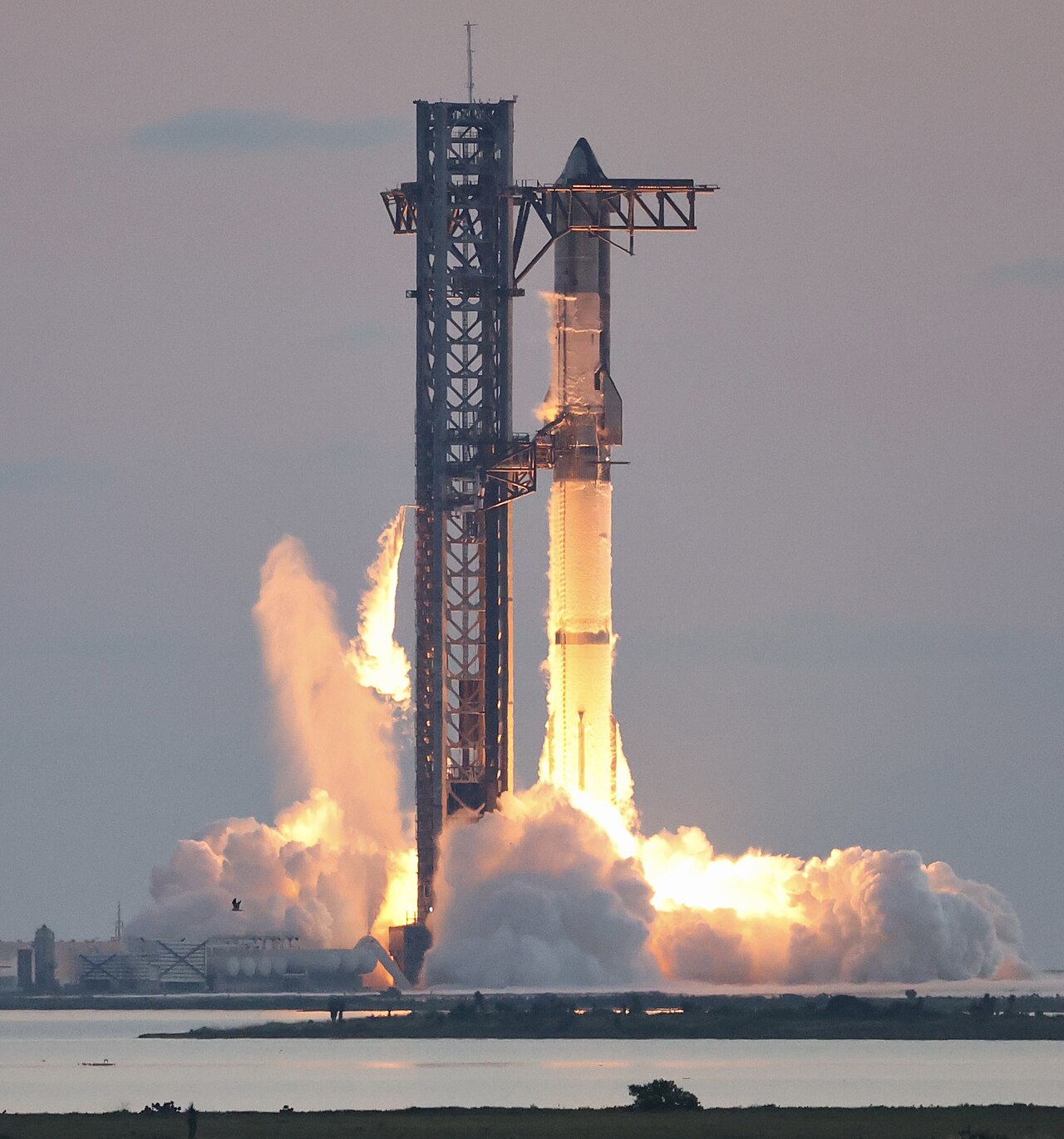
Header image: a SpaceX Starship stack igniting at liftoff, via Wikimedia Commons, licensed under CC BY 2.0. It depicts SpaceX's launch business, not its AI data centers. In-body photograph of Dell server racks in a data center, via Wikimedia Commons, licensed under CC BY-SA 3.0; it is an illustrative data center, not a SpaceX facility. Both images were reviewed before use.