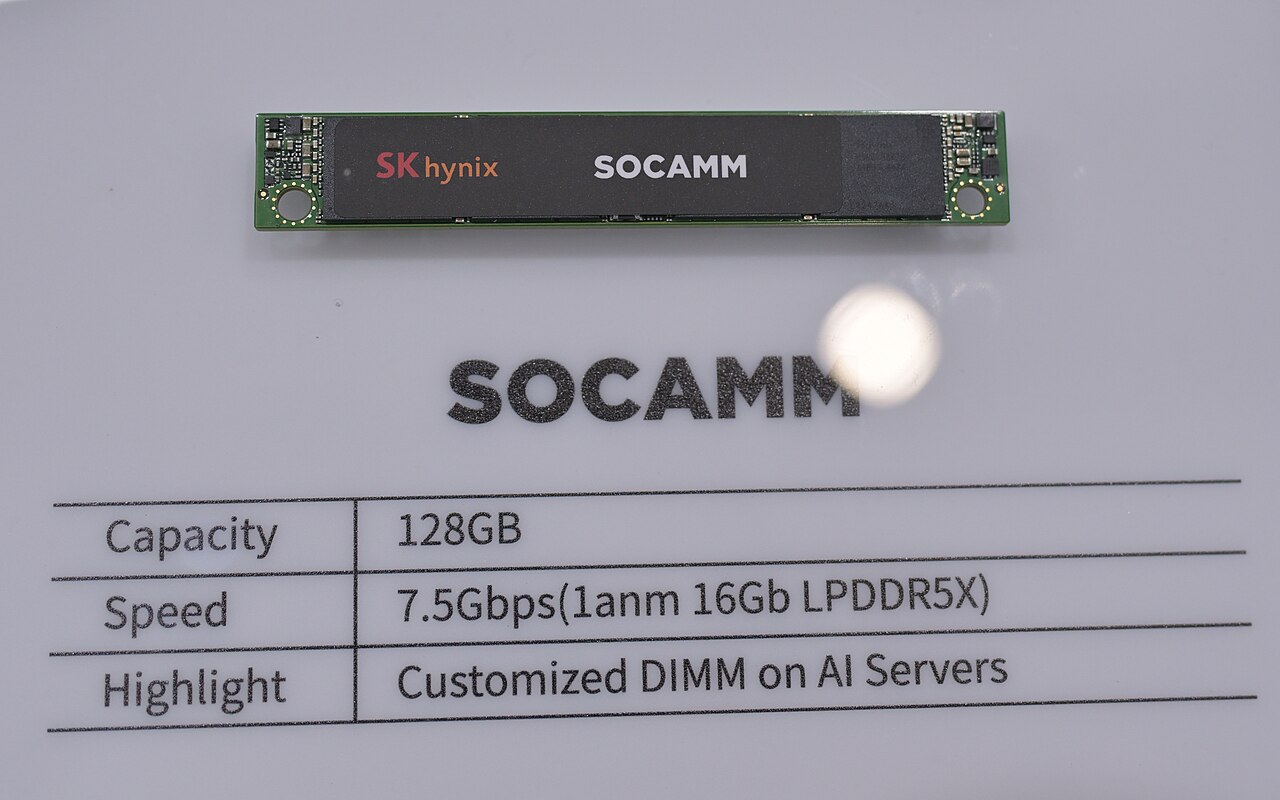
On July 10, 2026, SK Hynix began trading on the Nasdaq and rose about 13 percent on its first day, closing at $168.01 after pricing its American depositary receipts at $149. The listing raised roughly $26.5 billion, one of the largest capital raises of the year, and it put a company most consumers have never heard of at the center of the AI story. This piece explains why a Korean memory maker matters so much to artificial intelligence, what the market was actually pricing, and where the risks sit beneath a record set of numbers.
The part of an AI chip nobody photographs
When people picture AI hardware, they picture a GPU. But a modern AI accelerator is useless without the memory stacked right next to it, and that memory has become the genuine bottleneck. High bandwidth memory, or HBM, is a specialised type of DRAM built in vertical stacks and wired directly alongside the processor so that data can move fast enough to keep thousands of compute cores fed. Training and serving large models is, at the hardware level, largely a problem of moving weights and activations in and out of memory quickly. HBM is what makes that possible, and it is hard to manufacture at scale.
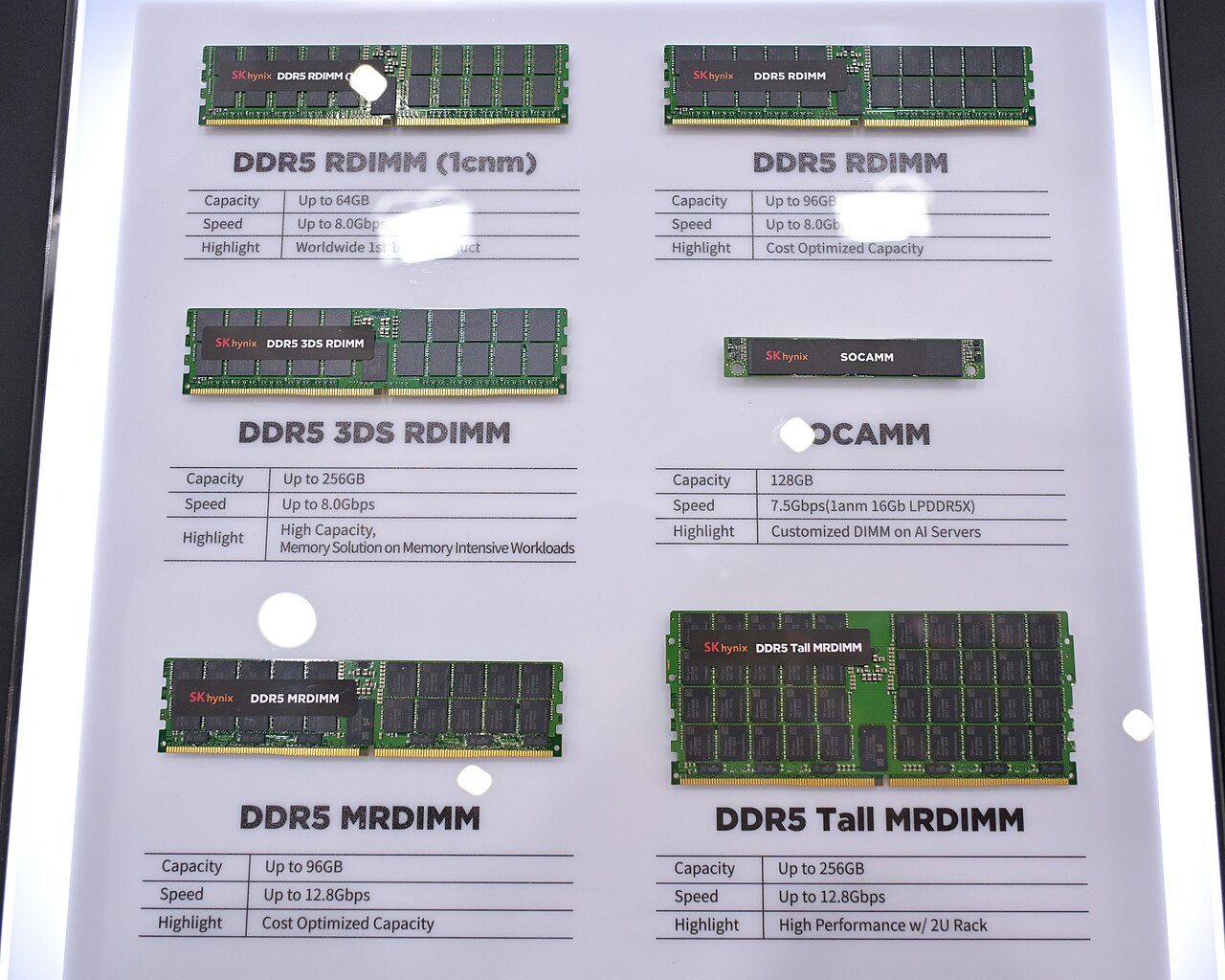
That is where SK Hynix sits. Every Nvidia GPU powering today's AI data centers relies on this class of memory, and SK Hynix is the leading supplier of it. By its own IPO disclosure the company held a 56.4 percent share of the HBM market, and independent trackers put its lead near 58 percent, with Samsung and Micron roughly level behind it.
Who supplies AI memory: global HBM share, Q1 2026
High bandwidth memory is the bottleneck component stacked next to every AI accelerator. SK Hynix supplies well over half of it, which is the business investors were pricing in the Nasdaq debut.
Global HBM revenue share, Q1 2026. SK Hynix's own IPO disclosure cited a 56.4% share; independent market trackers put it at roughly 58%, with Samsung and Micron near 21% each.
The reason this share matters is that HBM supply, not raw GPU design, is frequently the thing that gates how many AI accelerators can actually ship. UBS estimates SK Hynix will supply roughly 70 percent of the HBM4 used in Nvidia's next-generation Vera Rubin platform. When a single company provides the majority of a component that every AI buildout depends on, its capacity plans become everyone's capacity plans, which is a large part of why it chose to raise $26.5 billion in expansion capital now.
HBM supply, not raw GPU design, is frequently the thing that gates how many AI accelerators can actually ship.
What the numbers say, and what they leave out
SK Hynix did not come to market as a speculative story. It came with a record quarter: Q1 2026 revenue of about $34.9 billion, a record operating margin near 72 percent, and net profit of roughly $26.7 billion. Those are extraordinary figures for a memory company, an industry historically known for brutal boom-and-bust cycles and thin margins. The AI buildout has, for now, turned a commodity business into something closer to a specialty one.
The company's dominance is also uneven across its own product lines in a telling way. Its lead is far larger in HBM than in the broader memory markets it also serves.
SK Hynix is strongest exactly where AI demand concentrates
The company's market share by memory segment, Q1 2026. Its lead is far larger in HBM, the memory bolted to AI accelerators, than in the broader DRAM and NAND markets.
SK Hynix share by memory segment, Q1 2026, from company disclosures around the July 2026 listing.
This is the whole thesis in one chart. SK Hynix is a strong player across DRAM and NAND, but it is a near-majority supplier specifically in the AI-driven HBM segment. The business is levered to AI in a way the headline "memory company" label understates.
And yet the valuation carried a note of caution. The ADRs priced at a forward price-to-earnings ratio of roughly 6.2, a strikingly low multiple for a company posting record growth. That gap between blistering current results and a modest earnings multiple is the market saying something specific: memory is cyclical, and buyers are not fully convinced that today's margins are the new normal rather than the peak of an AI-driven cycle. Both readings are defensible, and the honest position is that the durability of HBM economics is genuinely unsettled.
The concentration question cuts both ways
The most important analytical point about SK Hynix is that its fortunes and the AI capital-expenditure cycle are now tightly coupled. That coupling is exactly why the stock is attractive and exactly why it is risky.
On the upside, if AI infrastructure spending keeps compounding, the supplier of the scarce component that gates it captures durable, high-margin demand. On the downside, that revenue is concentrated among a small number of very large customers, chiefly the AI accelerator makers, and it rides an investment cycle that is itself the subject of intense debate about whether it is sustainable or a bubble. A slowdown in AI capital spending would hit a memory maker levered to it harder than a diversified chipmaker. Concentration is leverage, and leverage works in both directions.
Why a software audience should care
It is tempting to file a memory IPO under hardware and move on. That would miss the connection. The price a developer pays per token traces, eventually, back to the cost and availability of the compute and memory underneath the model. When HBM is scarce and expensive, accelerators are scarce and expensive, and that pressure shows up in inference prices. The memory supply chain is the deep foundation of the AI cost stack, and its economics ripple all the way up to the API bill.
For teams building on models, the practical lesson is not to trade memory stocks; it is that hardware supply is one more variable outside their control that moves the cost of the models they depend on. The defensible response is the same one that applies to model choice generally: avoid hard-wiring your stack to a single provider whose pricing rides constraints you cannot see, and keep the freedom to move work to whoever passes on lower costs. A model-agnostic workspace such as Metir AI is one way to keep that optionality, so a shift in the underlying economics becomes a routing decision rather than a rebuild.
The bigger picture
SK Hynix's Nasdaq debut is a clean marker of where the AI trade has traveled. Two years ago the attention was almost entirely on models and the GPUs that ran them. Now the market is bidding up the supplier of the memory bolted to those GPUs, because that memory turned out to be the constraint that actually limits how fast AI can scale. The record margins say the constraint is real today. The cautious valuation multiple says the market is not sure how long it lasts. Both can be true, and watching which one wins out will be one of the more informative signals about the durability of the entire AI infrastructure boom.
Sources:
- SK Hynix rises 13% in Nasdaq debut, chairman says 'demand is enormous' | CNBC
- Meet SK Hynix, the trillion-dollar chipmaker debuting on US markets | CNBC
- SK Hynix IPO listing on Nasdaq: impact on Micron and AI memory | INDmoney
- SK Hynix makes jaw-dropping gains in wild Nasdaq trading debut | TheStreet
- SK hynix holds 62% of HBM, Micron overtakes Samsung | Astute Group
Image credits
Header image: an SK Hynix SOCAMM memory module for AI servers, shown at Computex 2025, by 4300streetcar via Wikimedia Commons, licensed under CC BY 4.0. In-body photograph of SK Hynix DDR5 server memory form factors at Computex 2025 by 4300streetcar via Wikimedia Commons, licensed under CC BY 4.0.