On July 24, 2026, SK Group and Nvidia announced a comprehensive partnership the two companies value at more than $500 billion, spanning both a new AI factory in South Korea and a long-term agreement to secure next-generation memory supply. The companies signed letters of intent (LOIs) rather than final, binding contracts, a distinction worth holding onto throughout this piece. Under the plan, SK Telecom will build a 2-gigawatt "AI factory" using Nvidia's DSX platform and upcoming Vera Rubin architecture, powered by SK Hynix HBM4 memory, with the first facility targeted online in 2027. Separately, Nvidia and SK Hynix established a long-term partnership to jointly secure and co-develop next-generation AI memory. This piece explains what was actually agreed, why memory rather than GPU count has become the thing that gates AI buildouts, and what a 2-gigawatt facility means in concrete power terms.
 NVIDIA
What was actually announced
The headline number, $500 billion-plus, covers two linked but distinct agreements rather than a single check. The first is infrastructure: SK Telecom will construct a 2-gigawatt AI cloud facility in Korea, built on Nvidia's DSX full-stack AI factory platform and Nvidia's Vera Rubin accelerated computing, with SK Hynix HBM4 memory inside it. The second is supply: Nvidia and SK Hynix will jointly develop and optimize next-generation AI memory, including HBM, to serve workloads from large language model training to agentic and physical AI. Both companies describe the target markets as sovereign, physical, agentic, and enterprise AI services across Korea and the wider Asia-Pacific region.
SK Group Chairman Chey Tae-won framed the deal as a shift in national posture: "In the AI era, competitiveness depends not just on how effectively AI is utilized, but on how much intelligence we can produce. By leveraging SK Hynix's AI memory and SK Telecom's AI infrastructure capabilities, SK will collaborate with Nvidia to build a world-class AI factory, helping Korea transcend its role as a leading adopter of AI and become a global hub that drives AI innovation." Nvidia CEO Jensen Huang echoed the framing: "South Korea has all the ingredients to become a global AI powerhouse: world-class networks and data centers, leadership in chip technology and vast industrial scale. Together with SK Telecom and SK Hynix, we are building a new generation of AI factories that will power Korea's next wave of growth."
Why memory, not just GPUs, is the actual constraint
It is easy to read an Nvidia announcement and assume the story is about chips. Increasingly, it is not. High bandwidth memory, or HBM, is a specialized type of DRAM stacked vertically and wired directly next to a GPU so data can move fast enough to keep thousands of compute cores fed. Training and serving large models is, at the hardware level, mostly a problem of moving weights and activations in and out of memory quickly, and HBM is hard to manufacture at the scale AI demand now requires. CNBC's coverage of this deal was blunt about the framing, describing it as Nvidia moving to "lock down" memory supply from SK Hynix rather than simply buying more of it on the open market.
Who supplies AI memory: global HBM share, Q1 2026
High bandwidth memory is the bottleneck component stacked next to every AI accelerator. SK Hynix supplies well over half of it, which is why a long-term memory commitment sits at the center of the SK Group and Nvidia partnership.
Global HBM revenue share, Q1 2026. Independent market trackers put SK Hynix at roughly 58 percent, with Samsung and Micron near 21 percent each.
Only three companies in the world can currently produce HBM at the volumes AI accelerators need: SK Hynix, Samsung, and Micron. SK Hynix has led that market since HBM became critical to AI training, with independent estimates putting its overall HBM share in the high 50s to low 60s percent as of mid-2026. For Nvidia's specific next-generation Vera Rubin platform, analysts at UBS and reporting from The Motley Fool put SK Hynix's share of HBM4 orders at roughly 70 percent, a concentration that makes SK Hynix's production capacity a direct input into how many Vera Rubin systems Nvidia can actually ship. That is the practical logic behind formalizing a long-term, co-development relationship rather than leaving the relationship to spot purchasing.
Nvidia locks down memory supply from SK Hynix as part of $500 billion AI deal.
CNBC headline, July 25, 2026
What 2 gigawatts actually means
Nvidia and SK Group describe the planned facility as a 2-gigawatt AI factory, and that figure is easy to skim past without registering its scale. A gigawatt of continuous draw is roughly the output of a large power plant. The US Energy Information Administration puts the average American commercial nuclear reactor at about 971 megawatts of capacity, and industry trackers describe a single "hyperscale" AI data center building as requiring up to about 100 megawatts. Put those next to each other and SK Telecom's planned factory works out to roughly 20 times a typical AI data center building, and close to twice the output of an average nuclear reactor, running continuously rather than at peak.
A 2-gigawatt AI factory is roughly two nuclear reactors of continuous power
Planned power draw, in megawatts. SK Telecom's facility would run at roughly 20 times a single AI data center building and about twice the output of the average US nuclear reactor, continuously.
SK Telecom's 2-gigawatt figure is the companies' own planning figure for the first facility, targeted online in 2027. The AI data center and nuclear reactor figures are independent reference points, not part of the deal.
That scale is precisely why power, not chip allocation, has become the practical bottleneck on how fast any AI factory announcement can turn into an operating facility. Building the compute is one problem; securing 2 gigawatts of reliable grid capacity, cooling, and interconnection in time for a 2027 target is a separate, and arguably harder, one. Neither the Nvidia nor SK Group release specifies where in Korea the power will be sourced from or what mix of grid and dedicated generation the facility will use, which is one of several details that remain unresolved at the LOI stage.

Korea's sovereign AI push, and where this deal sits inside it
This partnership does not exist in isolation. South Korea's AI Basic Act took effect in January 2026, part of a broader national push to build domestic AI computing capacity that includes government-backed GPU procurement through a National AI Computing Centre and a sixth national supercomputer. The SK Group and Nvidia deal is a private-sector agreement, distinct from that government program, but both point in the same direction: Korea positioning itself as a country that builds and operates frontier AI infrastructure domestically rather than only consuming AI services built elsewhere. The "sovereign AI" language both companies used in their announcement, alongside physical, agentic, and enterprise AI, reflects that same ambition applied to a single, very large facility rather than a national grid of them.
The honest caveats
A few things are worth holding onto before treating this as a settled outcome. First, this is a letters-of-intent agreement, not a signed, binding construction or supply contract; LOIs formalize direction and intent, and the specific financial terms, site details, and construction milestones have not been disclosed. Second, the $500 billion figure is the companies' own framing of combined value across both agreements over time, not an audited order book, and should be read the same way analysts read Nvidia's other long-range demand figures this year: a signal of confidence rather than a guarantee. Third, HBM market share estimates vary meaningfully by source and by segment (overall HBM versus HBM4 specifically for one platform), so the roughly 70 percent Vera Rubin figure is an analyst estimate, not a disclosed contract term. None of that makes the announcement less real; it means the appropriate posture is to watch for the construction and supply milestones over the next several quarters rather than treat the headline number as already banked.
Why this matters beyond one supply deal
The underlying logic of this deal, that compute is now inseparable from a very specific, very scarce memory component, is a reminder of how much of the AI stack's economics sit below the model layer entirely. A 2-gigawatt AI factory full of Vera Rubin GPUs and SK Hynix HBM4 is not built to run one company's model; it is built to run whichever workloads its owner and customers choose to route through it, priced by whatever the underlying memory and power constraints allow. That same logic holds a layer up, in the tools people actually use to work with AI day to day. Betting everything on a single model provider concentrates risk in exactly the way a single-vendor memory supply chain does. A model-agnostic workspace such as Metir AI applies that same principle at the application layer, letting teams route work across leading models rather than locking into one, so shifts in the underlying compute and memory economics show up as more capable tools rather than dependency on any single lab's roadmap.
The takeaway
SK Group and Nvidia's $500 billion-plus announcement is really two agreements bundled into one narrative: a 2-gigawatt AI factory that would rank among the largest single AI facilities announced anywhere, and a long-term memory partnership that formalizes just how central SK Hynix's HBM has become to Nvidia's roadmap. Both are letters of intent rather than finished contracts, and the real test will be whether SK Telecom's facility comes online on schedule in 2027 and whether the HBM4 co-development translates into the supply Nvidia is counting on for Vera Rubin. What is already clear is that memory, not GPU count alone, is doing as much work in this announcement as the chips it is designed to feed.
Sources:
- SK Group and NVIDIA Expand Strategic Partnership Across AI Factories and Next-Generation Memory | NVIDIA Newsroom
- SK Group and NVIDIA Expand Strategic Partnership Across AI Factories and Next-Generation Memory | SK hynix Newsroom
- SK Group and NVIDIA Expand Strategic Partnership Across AI Factories and Next-Generation Memory | GlobeNewswire
- Nvidia locks down memory supply from SK Hynix as part of $500 billion AI deal | CNBC
- SK Telecom Plans 2-Gigawatt AI Factory to Come Online in 2027 | StockTitan
- SK Group and NVIDIA Outline $500B-Plus AI Initiative Around 2GW Vera Rubin Cloud | Converge Digest
- Jensen Huang Said Nvidia Will Be the First Customer for HBM4. Here's the AI Memory Stock That Has Reportedly Locked Up 70% of Those Orders | The Motley Fool
- SK hynix holds 62% of HBM, Micron overtakes Samsung, 2026 battle pivots to HBM4 | Astute Group
- SK Hynix rises 13% in Nasdaq debut, chairman says 'demand is enormous' | CNBC
- Modern AI Data Centers Require Up to 100 MW per Building | Datacenters.com
- U.S. Nuclear Generation of Electricity | U.S. Energy Information Administration
- South Korea unveils national AI infrastructure strategy | Digital Watch Observatory
Image credits
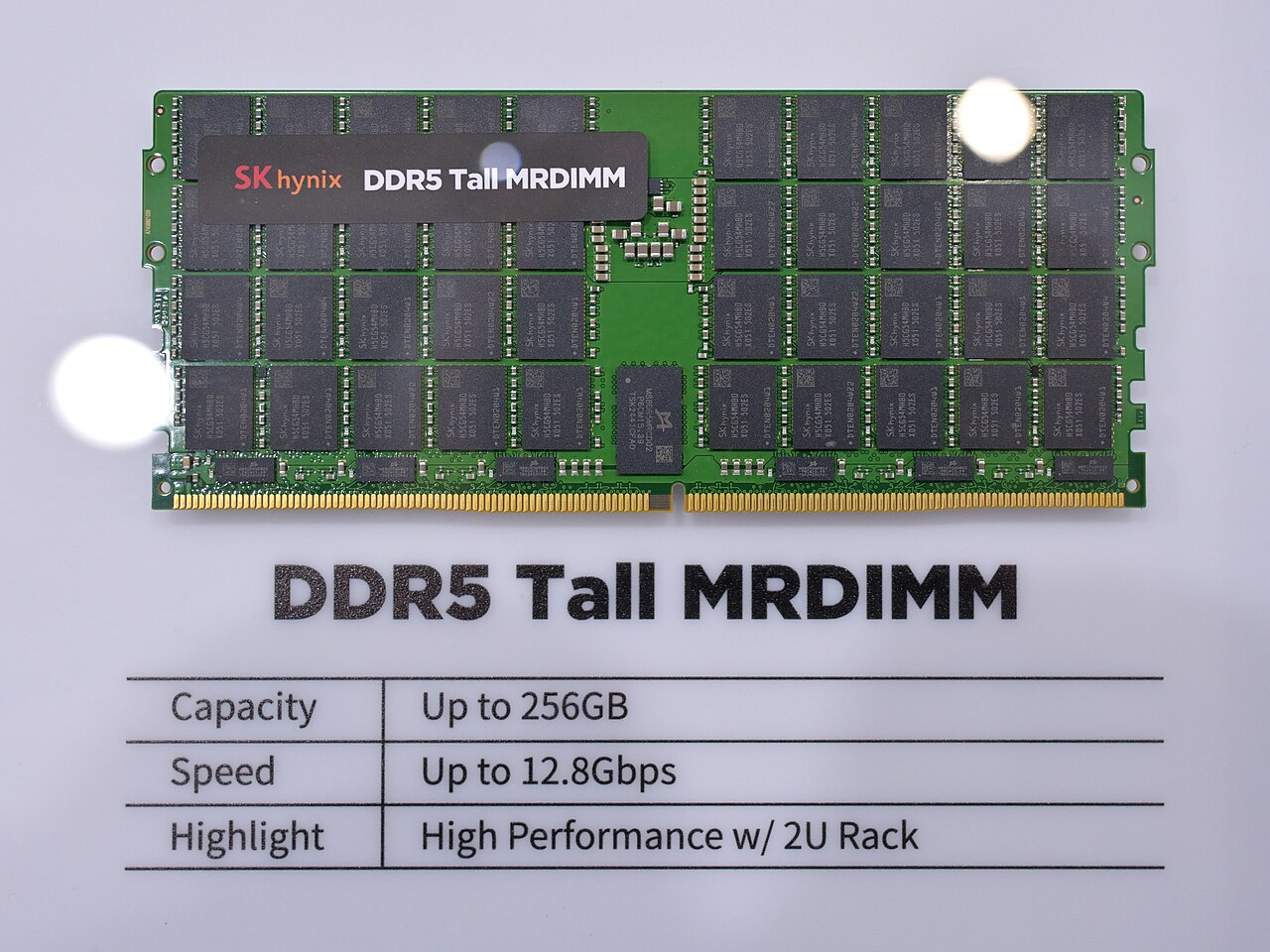
Header image: an SK Hynix DDR5 Tall MRDIMM server memory module on display at Computex Taipei 2025. This is a DDR5 module rather than the HBM4 stacks specifically covered in this deal, no public photograph of Nvidia's unreleased Vera Rubin hardware or SK Hynix's HBM4 exists yet, but it is a genuine SK Hynix AI-server memory product shown by the company. Photo by 4300streetcar via Wikimedia Commons, licensed under CC BY 4.0. In-body photograph: Seoul's skyline at night viewed from Namsan Mountain, illustrating the Korea setting of the deal rather than the planned facility itself, which does not yet exist. Photo by Matt Kieffer via Wikimedia Commons, licensed under CC BY-SA 2.0.