Revolut says it has cut the cost of AI-assisted coding by roughly 90% by making self-hosted open-weight models its default coding assistant instead of leaning mainly on commercial tools such as Claude Code. According to a November 3, 2026 report in The Register, the setup serves about 2,000 engineers from 56 Nvidia B200 GPUs and runs Z.ai's GLM models. The figures come from a conference talk, not an audit, and that distinction shapes how much weight each number can bear.
 Z.ai
 NVIDIA
 Anthropic
 OpenAI
This post separates what was reported from what can be derived, then walks through the build vs buy arithmetic. The headline is a reminder that the economics of self-hosting are mostly a question of utilisation, and that a model-agnostic setup keeps that question open instead of settling it once.
What was reported
The Register's account (by Tobias Mann) is based on a talk by David Abitbol, who leads operations and infrastructure at Revolut, at the AI Engineer conference in New York in October 2026. The main claims:
- Cost. Self-hosted GLM was reported at about $0.30 per million input and output tokens, roughly a tenth of Codex or Claude Code. Before the switch, engineers were reportedly spending $1,000 to $10,000 a month each with little visible return, so access had launched with strict budget limits.
- Model. The deployment started on GLM-5.1 and moved to GLM-5.3. The Register attaches the roughly 754-billion-parameter mixture-of-experts description (about 40 billion active per token) and the roughly 380 GB weight footprint to GLM-5.1. Our earlier coverage of Z.ai's GLM-5.3 describes a base of roughly 744 billion parameters, so treat the exact count as approximate.
- Performance. Time to first token under 3 seconds at about 256K context, roughly 200 tokens per second per request, rising to about 800 for engineers who log in after 5 pm, when load drops.
- Productivity. About 60% better coding time and about 70% better lead time. Abitbol reportedly said code generation was not the main bottleneck: the larger gains came from debugging and from working Jira and Confluence tickets, which unlimited tokens made cheap to hand to the model.
- Engineering. The biggest gains reportedly came from tuning (hyperparameters, NVFP4 quantisation, disaggregated prefill and decode, context-length limits), not from adding GPUs.
A second write-up, from StartupHub on October 29, 2026, reports consistent hardware, cost and productivity figures and adds that the per-token math excluded cloud spend, staffing and observability. That article names the model as GLM 4.5 in places and says it was drafted with AI from the conference video, so we use it only where it agrees with The Register.
The $0.30 figure is a rate for tokens that were actually served. It says little about what the cluster costs when it is idle.
Metir analysis
The build vs buy arithmetic
A per-token price for self-hosted inference is not a price list, it is a quotient: the fixed cost of the cluster divided by the tokens it actually serves. That makes the $0.30 figure a statement about utilisation as much as about the model.
Revolut's real hardware terms are not public, so the numbers below are our illustrative calculation, not Revolut data. We price 56 B200 GPUs at published cloud rental rates over a 720-hour month. Spheron's pricing tracker lists Lambda's 8-GPU B200 node at $5.29 per GPU-hour (June 2026) and a later CoreWeave rate card at about $8.60 per GPU-hour. Rates vary widely by provider and date; the same tracker lists Spheron's own on-demand rate at $10.25 on November 4, 2026.
| Illustrative assumption | Monthly cluster cost | Per engineer (2,000) | Tokens needed to reach $0.30 per million |
|---|---|---|---|
| $5.29 per GPU-hour | about $213,300 | about $107 | about 711 billion |
| $8.60 per GPU-hour | about $346,800 | about $173 | about 1.16 trillion |
Two readings follow, both our own derivations:
- The reported cost per seat is plausible at this scale. Roughly $107 to $173 per engineer per month is well under the $1,000 to $10,000 monthly spending the report cites for the earlier setup. The gap is large enough that the headline direction survives even generous overhead assumptions.
- The $0.30 token price implies very heavy usage. Reaching it on rented GPUs at these rates needs roughly 355 to 578 million tokens per engineer per month, or about 274,000 to 446,000 tokens per second sustained around the clock. Agentic coding loads context repeatedly, so large volumes are plausible, but the figure is worth reading as a utilisation claim. If Revolut owns or has reserved hardware at lower effective rates, or counts only a subset of costs, the required volume falls.
Self-hosted cost per million tokens depends on how full the GPUs are
Illustrative: 56 B200 GPUs rented at $5.29 per GPU-hour for a 720-hour month ($213,293), divided by monthly token volume, against API list prices. Metir calculation, not Revolut data.
Where the break-even sits
For reference prices, a July 2026 analysis by ECorpIT lists blended (80% input, 20% output) API list prices of $2.00 per million tokens for GLM-5.2 and $9.00 for Claude Opus 4.8, as of July 2026. Against those, and using our $5.29 and $8.60 cluster costs, the monthly volume at which a dedicated 56-GPU cluster matches the API bill is:
- Versus a $2.00 API: about 107 billion tokens a month ($5.29) to about 173 billion ($8.60).
- Versus a $9.00 API: about 24 billion tokens a month ($5.29) to about 39 billion ($8.60).
The same ECorpIT analysis reached a cautionary conclusion for smaller teams: for one 8-GPU H200 node running a comparable open-weight model, it estimated a break-even of about 17.9 billion tokens a month (roughly 358 developers at 50 million tokens each) against a $2.00 API, and noted that a small team would pay an effective rate far above API prices. The pattern is consistent: self-hosting rewards scale and steady load, and punishes spiky or small demand.
Revolut's two structural advantages show up in the reporting. It has roughly 2,000 engineers sharing one pool, which smooths load, and it can shape usage (the report mentions faster generation after 5 pm and sandbox rules it controls). An organisation with 50 engineers, or with usage concentrated in short bursts, sits on a very different part of the curve.
Caveats on vendor-reported numbers
- Conference talk, not an audit. The Register states that it did not independently verify the figures. They were presented by a Revolut executive describing a program he runs.
- Scope of the 90%. The reported cost per token appears to exclude staffing, observability and some cloud spend, per StartupHub. A fully loaded comparison would include the platform engineers who tuned the stack, the on-call burden, and capacity that sits idle at night.
- The baseline matters. A cut measured against $1,000 to $10,000 seats that launched with budget limits and little ROI is not the same as a cut measured against a well-managed, cached, right-sized API workload.
- Quality is not priced in. A 60% coding-time gain is a self-reported productivity figure, and Abitbol attributed much of the lead-time gain to non-coding work. Whether the same gain would appear with a frontier model at equal token freedom is untested in what was reported.
- Capability limits are real. GLM here is text-only, so Revolut reportedly routes vision work to other models (the report names Gemini and a GPT model). That is a router, not a single-model fleet.
- Compliance posture. Abitbol acknowledged concern about Chinese open-weight models and said the main risk is calling APIs hosted outside China, not running the weights in regional or on-premises infrastructure. StartupHub reports inference stays in data-equivalency jurisdictions with zero-data-retention providers. These are Revolut's design choices, and a regulator's view is not reported.

Why this points toward model-agnostic setups
The most transferable detail in the reporting is not the savings figure but the architecture: a self-hosted open-weight model for bulk code generation, a router that sends vision and other work to different models, and the ability to swap GLM-5.1 for GLM-5.3 as releases land. That is a model-agnostic design, and it is the part that survives if prices, rankings or regulations move. We covered the general case in our earlier piece on why AI infrastructure should be model-agnostic; Revolut's setup is a concrete example of the routing layer doing real economic work.
It also shows the asymmetry between two kinds of lock-in. A team running its own cluster is locked into capital and operations, but free of any one vendor's pricing. A team on seats is locked into a vendor's pricing, but free of capacity risk. Most teams will land between the two, and tools that let them move work between open-weight and closed models, as a multi-model workspace such as Metir does, reduce the cost of changing their mind later.
What to watch
- Disclosure of loaded costs. Whether Revolut or others publish staffing and idle-capacity figures alongside the per-token rate.
- GPU rental rates. Published B200 rates differ by a factor of two across providers and dates, so the break-even moves with the market.
- Replication. Whether a mid-sized engineering organisation reports a comparable result with a smaller cluster. The reporting itself says portability is unproven.
- Frontier API pricing. If hosted prices for strong models fall, the volume at which self-hosting wins rises. Accenture's recent move to cap Claude spending per employee shows buyers are already pressuring the seat-and-token model from the demand side.
- Open-weight release cadence. Z.ai moved from GLM-5.1 to 5.3 within the deployment's first year, and each swap is a re-tuning cost as well as a capability gain.
Sources:
- The Register, "British fintech Revolut slashes AI coding costs 10x by cutting out Claude and going self-hosted" (November 3, 2026): https://www.theregister.com/ai-and-ml/2026/11/03/british-fintech-revolut-slashes-ai-coding-costs-10x-by-cutting-out-claude-and-going-self-hosted/5307345
- StartupHub.ai, "Revolut says self-hosted AI cut coding costs 90%" (October 29, 2026): https://www.startuphub.ai/ai-news/artificial-intelligence/2026/revolut-says-self-hosted-ai-cut-coding-costs-90
- Spheron, "NVIDIA B200 cloud pricing 2026" (B200 per-GPU-hour rates by provider): https://www.spheron.network/blog/nvidia-b200-cloud-pricing-2026/
- ECorpIT, "GLM-5.2 self-hosted vs API in 2026: what an open-weight coding agent really costs" (July 2026): https://ecorpit.com/glm-5-2-open-weight-self-host-vs-api-coding-2026/
- Metir, "GLM-5.3: How Z.ai Got Frontier Gains From Post-Training Alone": /blog/glm-5-3-open-weight-coding-cyber-2026
- Metir, "Accenture Caps Claude Spending at $29 Per Employee": /blog/accenture-claude-29-dollar-cap-enterprise-ai-token-costs-2026
- Derived figures (monthly cluster cost, per-engineer cost, token volumes, break-evens) are Metir calculations from the cited rental rates and API list prices, using 56 GPUs, 720 hours per month and 2,000 engineers.
Image credits
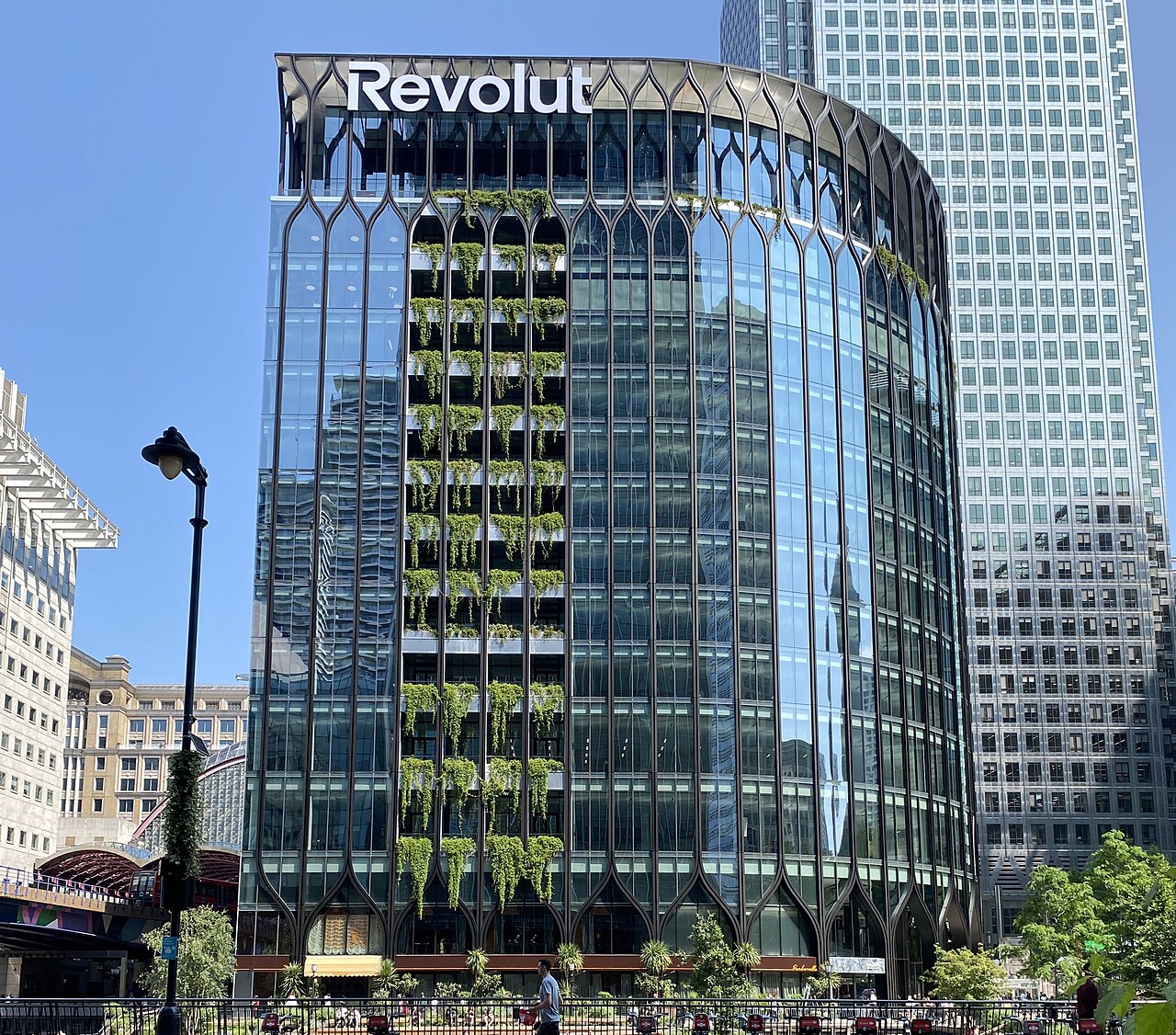
Header image: Revolut's head office at Canary Wharf, London, photographed by Boubloub via Wikimedia Commons, released under CC0 1.0. In-body image: Revolut's headquarters at Canary Wharf, photographed by Zolfeqar Fatihzadeh via Wikimedia Commons, licensed under CC BY-SA 4.0. Both depict the office building, not the AI infrastructure.